
Lecture
In the course of studying organic chemistry, you may have observed that there is an interrelationship between individual classes of organic compounds that makes it possible to synthesize some compounds from others. Let us give examples of problems that can be solved using knowledge of the interrelationship between compounds of different classes.
Example 1. Propose a method for obtaining acetic acid from acetylene.
Let us consider the structural formulas of acetylene and acetic acid: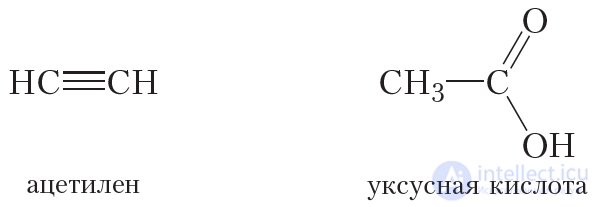 We do not know of a chemical reaction that would allow acetic acid to be obtained directly from acetylene. Therefore, several stages will be required to carry out this transformation.
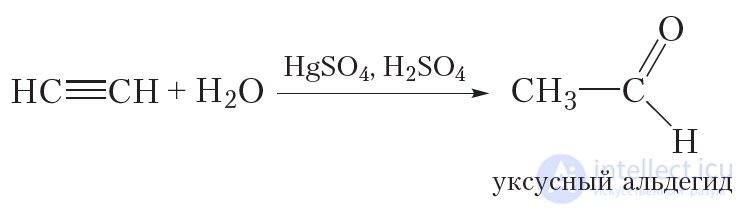
Next, we oxidize the acetaldehyde to acetic acid:
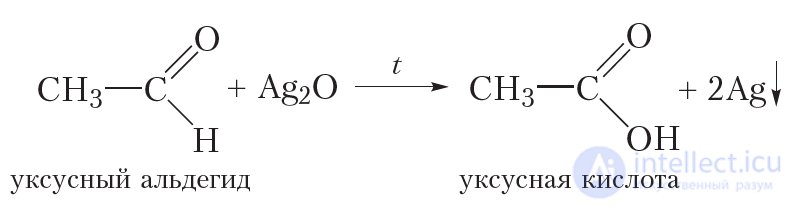
Example 2. Propose a method for obtaining acetic acid from ethylene.
Let us consider the structural formulas of ethylene and acetic acid:
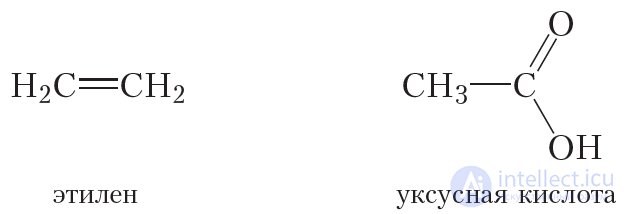
Several stages will again be required to carry out this transformation.
Recall that carboxylic acids can be obtained by the oxidation not only of aldehydes but also of alcohols (without isolating the intermediate aldehyde formed). In particular, acetic acid can be obtained by oxidizing ethanol with a KMnO4 solution in the presence of sulfuric acid. Therefore, we need to obtain ethanol from ethylene: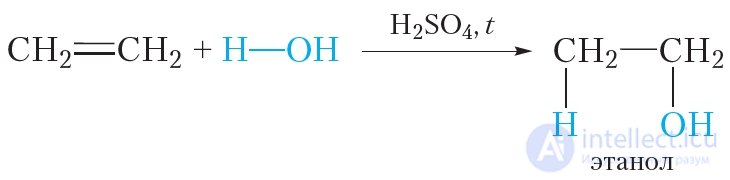
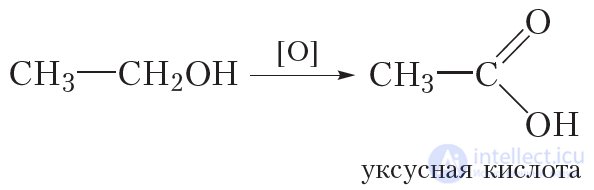
Next, we oxidize the ethanol to acetic acid:
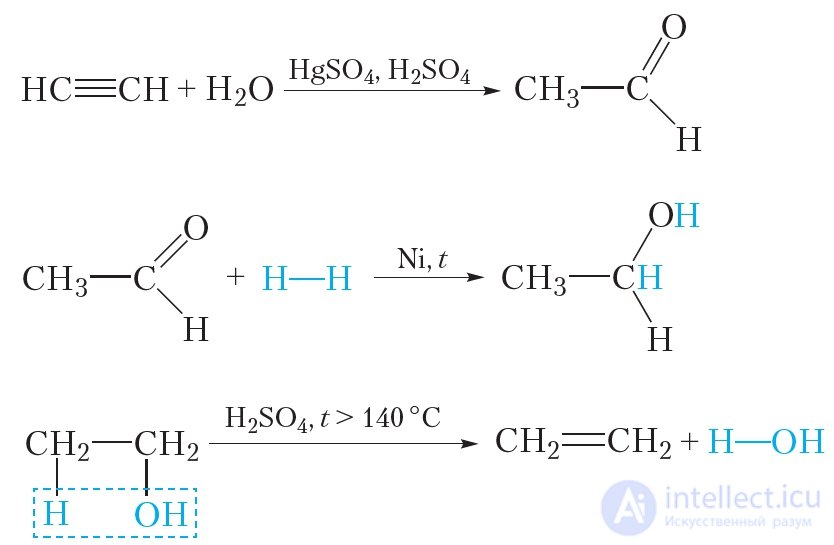
Example 3. Give the equations of the reactions by which the following transformations can be carried out:

Each of the indicated transformations can be carried out in a single stage. Let us give the equations of the corresponding reactions:

|
There is an interrelationship between hydrocarbons, alcohols, aldehydes, and carboxylic acids, owing to which compounds of one class can be obtained from compounds of other classes. Aldehydes are obtained by the oxidation of alcohols; the reduction of aldehydes leads to alcohols. Carboxylic acids are obtained by the oxidation of alcohols and aldehydes. |
1. By which processes — oxidation or reduction — can alcohols be converted into aldehydes, and then into carboxylic acids?
2. Write the equations of the reactions by which ethanal can be obtained from ethane. The first stage should be a halogenation reaction.
3. From propanal, obtain: a) propanoic acid; b) propan-1-ol; c) propane.
4. Complete the transformation schemes:


Comments