
Lecture
Markovnikov's Rule
The addition reactions of hydrogen halides and water to homologs of ethylene have certain peculiarities.
Addition of Hydrogen Halides. Hydrohalogenation
Let us consider the addition reaction of hydrogen chloride to propene. In principle, two products are possible as a result of this reaction — 2-chloropropane and 1-chloropropane:
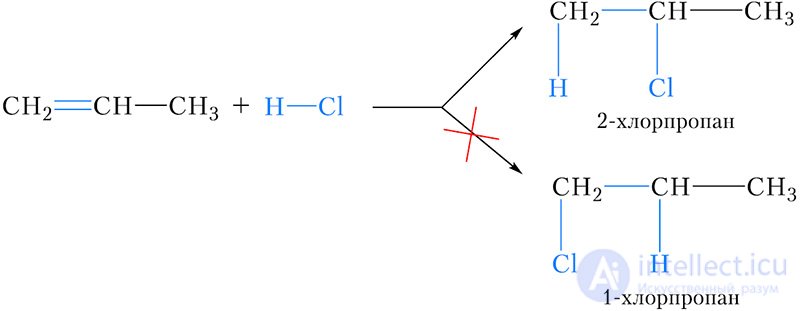
In fact, the predominant product of this reaction is 2-chloropropane.
The same phenomenon (formation of one of two possible products) is observed in the addition of hydrogen chloride to methylpropene:
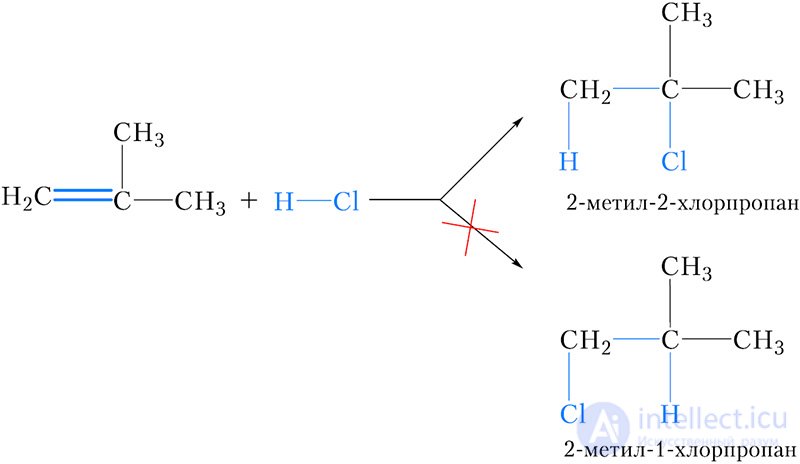
It can be seen that in both cases hydrogen adds to the carbon atom of the double bond that is bonded to the greater number of hydrogen atoms (the more hydrogenated carbon atom). This regularity is called Markovnikov's rule.
As another illustration of Markovnikov's rule, let us write the equation for the addition reaction of hydrogen chloride to methylbutene-2:
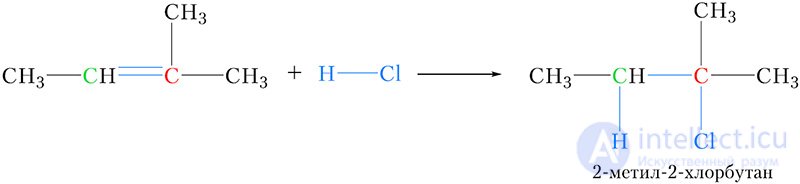
The carbon atom highlighted in green is bonded to one hydrogen atom, while the other carbon atom of the double bond (highlighted in red) has no hydrogen atoms. According to Markovnikov's rule, hydrogen adds to the more hydrogenated carbon atom.
Addition of Water. Hydration
The addition of water to propene and other unsymmetrical alkenes also proceeds in accordance with Markovnikov's rule:

Markovnikov's rule. When hydrogen halides and water add to alkenes, the hydrogen atom adds to the more hydrogenated carbon atom of the double bond.
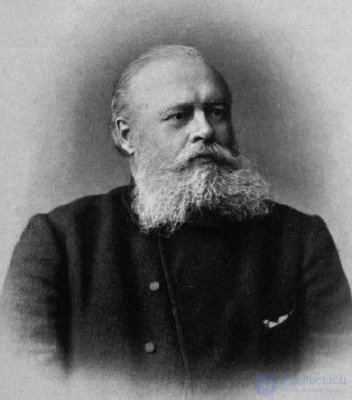
Fig. 15-1.1. V. V. Markovnikov
Interesting to Know
Markovnikov's rule is named after its discoverer — the Russian chemist Vladimir Vasilyevich Markovnikov, a student of A. M. Butlerov. V. V. Markovnikov made a significant contribution to the development of the theory of the structure of organic compounds, particularly regarding isomerism and the mutual influence of atoms in the molecules of organic substances. V. V. Markovnikov discovered cycloalkanes in Caucasian petroleum, and he is also known for his research on the composition of salt springs and salt lakes in Russia.
Explanation of Markovnikov's Rule. Electron-Donating and Electron-Withdrawing Substituents
Markovnikov's rule is explained by the influence of substituents on the electrons of the π-bond. On this basis, all substituents can be divided into two groups:
1. Substituents that attract the electrons of the π-bond. Such substituents are called electron-withdrawing (from English to accept). Examples of electron-withdrawing substituents: the carboxyl group  COOH and the nitro group NO2. The displacement of the π-bond electrons under the influence of an electron-withdrawing substituent is shown in Figure 15-1.2:

Fig. 15-1.2. Displacement of the π-electrons of the C  C bond under the influence of an electron-withdrawing substituent
2. Substituents that repel the electrons of the π-bond (electron-donating substituents). Electron-donating substituents include alkyl radicals CH3, C2H5, and others, the hydroxyl group OH, and the amino group NH2. The displacement of the π-bond electrons under the influence of an electron-donating substituent is shown in Figure 15-1.3:

Fig. 15-1.3. Displacement of the π-electrons of the C C bond under the influence of an electron-donating substituent
Let us consider the addition of hydrogen chloride to propene, taking into account the influence of substituents on the electrons of the π-bond:

The positively charged hydrogen atom of the hydrogen chloride molecule adds to the carbon atom of the double bond that carries a negative charge. This carbon atom is the more hydrogenated atom C(1), which is consistent with Markovnikov's rule.
The addition of hydrogen halides and water to unsymmetrical alkenes proceeds according to Markovnikov's rule — the hydrogen adds to the more hydrogenated carbon atom of the double bond.
Markovnikov's rule is explained by the influence of substituents on the electrons of the π-bond. Electron-withdrawing substituents ( COOH, NO2) attract the electrons of the π-bond, while electron-donating ones (alkyl radicals, OH, NH2) – repel them.
1. Write the equation for the reaction of butene-1 with hydrogen chloride. Why does this reaction produce only one product?
2. Write the equation for the hydration reaction of 2-methylpropene.
3. Write the equation for the addition reaction of hydrogen bromide to the substance whose formula is:
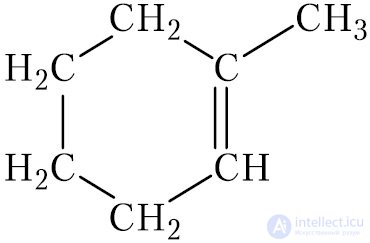
4. Predict the product of the following reaction:
CH2  CH
CH  CH3 + ICl
5. Predict the product of the following reaction:
CH2 CH COOH + HCl

Comments