
Lecture
The hydrocarbons we have studied are of great practical importance, since they are widely used as fuel and also serve as raw material for obtaining many organic substances.
The most important sources of hydrocarbons are natural gas and petroleum.
The main component of natural gas is methane. Besides methane, natural gas also contains ethane, propane, and butanes. Generally, the higher the molecular mass of a hydrocarbon, the lower its content in natural gas. The composition of natural gas varies among different deposits. Table 21.1 shows the approximate content of substances in natural gas.
Table 21.1. Approximate composition of natural gas
|
Substance formula |
CH4 |
C2H6 |
C3H8 |
C4H10 |
N2 and other gases |
|
Content in % by volume |
70—98 |
< 5 |
< 2 |
< 1 |
< 10 |
Natural gas is used mainly as a fuel. It has a number of advantages over solid and liquid fuels: when it burns it releases more heat, it leaves no ash, and its combustion products are more environmentally friendly. Natural gas is used at thermal power plants, as fuel for gas stoves, fuel for automobiles, etc.
 Physical properties and composition of petroleum
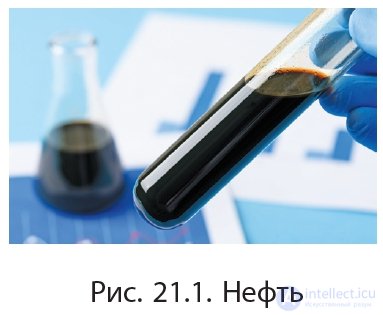
Petroleum is an oily liquid, usually dark in color, with a distinctive odor (Fig. 21.1). It is lighter than water and does not dissolve in water. The main components of petroleum are liquid hydrocarbons and solid hydrocarbons dissolved in them. That is, petroleum is a mixture of hydrocarbons. These are mainly alkanes, cycloalkanes, and aromatic hydrocarbons. The ratio of these hydrocarbons in petroleum from different deposits can vary considerably.
In order to extract products useful for human needs from petroleum, it is subjected to refining.
Primary refining of petroleum
Petroleum does not have a definite boiling point, since it is a mixture of hydrocarbons with different boiling points. During the heating of petroleum, the lightest hydrocarbons (which have low boiling points) are separated out first, followed by the heavier ones.
A mixture of hydrocarbons collected during the distillation of petroleum within a certain temperature range is called a fraction.
Let us consider some fractions of petroleum.
The gasoline fraction distills in the temperature range from 40 to 200 °C and contains hydrocarbons C5 — C11. As the name implies, this fraction is used to obtain gasoline.
Ligroin distills at a temperature from 120 to 240 °C and contains hydrocarbons C8 — C14. Ligroin is used to produce gasoline and diesel fuel, and also as a solvent.
Kerosene — distills in the temperature range from 180 to 300 °C and contains hydrocarbons C12 — C18. It is used as fuel for jet engines (aviation kerosene), for household heating appliances, as a solvent, and for producing diesel fuel.
The process of petroleum distillation is not accompanied by any change in the structure of the hydrocarbons that make it up; it consists only in separating them into individual components, that is, it is a physical process. Such a process is called primary refining of petroleum.
Octane number of gasoline
One of the most important characteristics of gasoline is its detonation resistance. Detonation resistance shows the ability of gasoline to «resist» self-ignition under compression in the engine cylinder. To understand this, let us consider how an automobile engine works (Fig. 21.2).
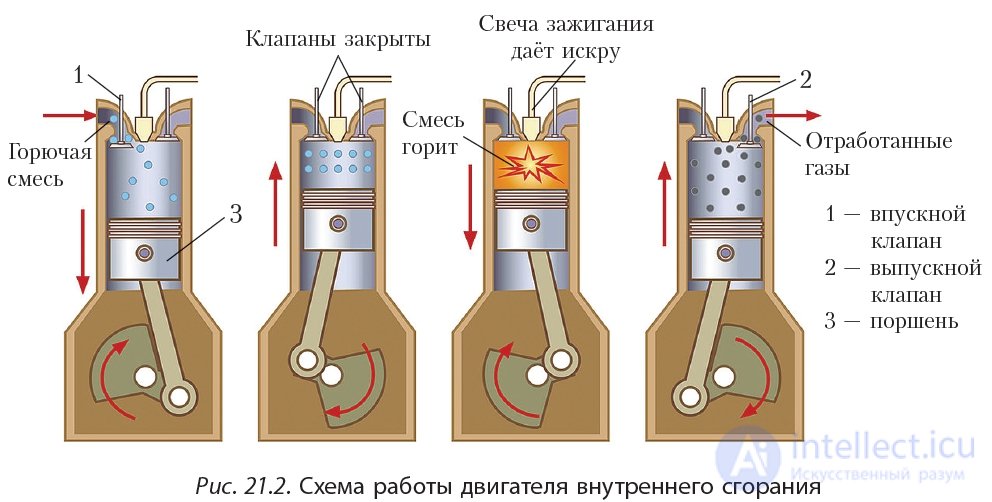
A mixture of gasoline vapor and air enters the engine cylinder. When the piston reaches the top of the cylinder, that is, compresses the mixture to the maximum, a spark from the spark plug ignites it. The resulting gases push the piston down, and it performs work, as a result of which the car moves. This description applies to normal engine operation. But a situation is possible in which the gasoline-air mixture ignites in the cylinder before the spark, due to a rise in its temperature during compression. This process is called detonation. Detonation is very harmful to the engine: it reduces power and leads to premature wear of parts and even to engine failure.
To characterize the detonation resistance of gasolines, the octane number is used. The octane number of isooctane (2,2,4-trimethylpentane), which has high detonation resistance, is taken as 100. The octane number of n-heptane, which detonates extremely easily, is taken as 0. A mixture of n-heptane and isooctane has an octane number equal to the isooctane content in it (in percent by volume). For example, a mixture containing 92 % isooctane and 8 % n-heptane by volume has an octane number of 92. If gasoline has an octane number of 92, this means that it withstands the same compression in the cylinder without detonation as a mixture of 92 % isooctane and 8 % n-heptane. Octane numbers appear in the name of a gasoline grade, for example AI-92, AI-95, etc. Driving past a filling station, one can see that the higher the octane number, the more expensive the gasoline.
It turns out that the most detonation-resistant hydrocarbons are aromatic hydrocarbons and branched-chain hydrocarbons. These hydrocarbons are characterized by high octane numbers, sometimes greater than 100. The octane numbers of unbranched hydrocarbons, on the contrary, are low (Table 21.2).
Table 21.2. Octane numbers of some hydrocarbons
|
Name of hydrocarbon |
Structural formula |
Octane number |
|
n-Heptane |
|
0 |
|
n-Pentane |
|
62 |
|
2,2-Dimethylbutane |
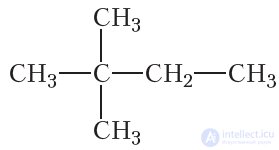 |
92 |
|
Isooctane |
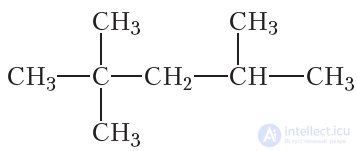 |
100 |
|
Benzene |
|
113 |
Unbranched hydrocarbons predominate in petroleum. Therefore, the gasoline obtained by distilling petroleum has a low octane number (usually below 65) and cannot be used in the engines of modern automobiles. Because of this, the petroleum fractions obtained by distillation are subjected to further processing associated with changing the structure of the hydrocarbons they contain. These processes are called secondary refining of petroleum.
Cracking
The gasoline fraction makes up only a small share of all the petroleum extracted, and the gasoline obtained by distillation cannot satisfy the demand for it. Therefore, one of the goals of secondary petroleum refining is to convert heavy hydrocarbons into hydrocarbons of the gasoline fraction. To do this, molecules with a large number of carbon atoms are broken down into smaller ones. This process is called cracking.
At high temperatures, carbon-carbon chemical bonds break, as a result of which hydrocarbon molecules with a long chain of carbon atoms are converted into hydrocarbons with a shorter chain, for example:

As can be seen from the example given, from a hydrocarbon with the composition C12H26 a mixture of an alkane and an alkene was formed, with the number of carbon atoms in the molecules equal to 6, which corresponds to the gasoline fraction. It should be noted that the splitting of the starting molecule can occur at any carbon-carbon bond, for example:

As a result, a mixture of saturated and unsaturated hydrocarbons, predominantly of unbranched structure, is formed. This process is called thermal cracking. Thermal cracking is carried out at temperatures up to 800 °C. The higher the cracking temperature, the more finely the molecules of the starting substances are broken down. Thus, at temperatures of around 800 °C, a large amount of gaseous alkenes (ethene, propene, and butenes) is formed, which are used to produce polymers.
A drawback of thermal cracking is the high content of unbranched hydrocarbons in its products. Therefore, gasoline obtained in this way has a low octane number (usually no higher than 70). Gasoline with a higher octane number can be obtained by catalytic cracking. Catalytic cracking is carried out at lower temperatures (400–500 °C) in the presence of catalysts. Under these conditions, along with the splitting of molecules, isomerization of the resulting hydrocarbons takes place (§ 10), that is, branched-structure hydrocarbons are formed.
Reforming
An even more effective way of obtaining gasoline with a high octane number is reforming — the process of converting alkanes into aromatic hydrocarbons by heating on a catalyst. For example, when hexane is heated on a platinum catalyst, it is converted into benzene:
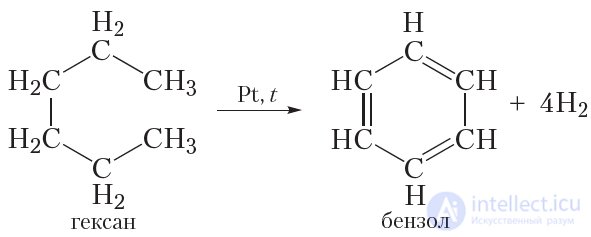
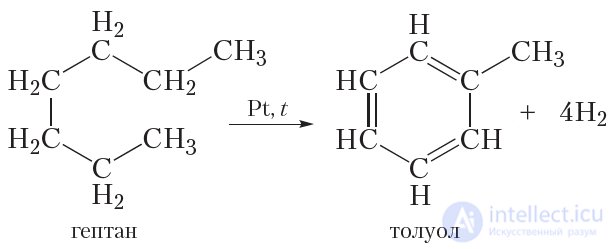
As can be seen, in the course of the reactions described, four molecules of hydrogen are split off from the alkane molecules and cyclic aromatic hydrocarbons are formed; therefore these processes are called dehydrocyclization, or aromatization, of alkanes. Dehydrocyclization of alkanes is used not only to increase the octane number of gasoline, but also to obtain benzene and its homologs.
The use of secondary petroleum refining processes makes it possible to raise the gasoline yield from 15 % (primary refining) to about 60 %. In addition, secondary refining processes produce a large number of valuable substances that serve as raw material for producing polymers and other products.
The processes described involve the refining of enormous volumes of petroleum, amounting to several billion tons per year. In this connection, environmental protection during the extraction and refining of petroleum is of paramount importance.
The release of petroleum and petroleum products into the environment is extremely dangerous. This is related both to the fire and explosion hazard of hydrocarbons and to the toxicity of petroleum components and their transformation products. Petroleum pollution can reach a very large scale. For example, one ton of petroleum can cover an area of sea surface of up to a thousand hectares with a thin film. Therefore, issues related not only to the efficiency of petroleum extraction and refining, but also to the safety of these processes, are relevant today. In addition, considerable attention must be paid to safety issues in the transportation and use of petroleum and petroleum products, as well as to the development of methods for eliminating the consequences of accidents involving the release of these substances into the environment.
As can be seen, there are very many problems, so environmental protection must be ensured across a whole range of industries related both to the extraction of petroleum and to its transportation, refining, and use. At the extraction stage, the task of increasing the efficiency of use of existing deposits, in order to achieve the most complete extraction of petroleum from the subsurface, is currently relevant. To increase oil recovery, methods of injecting water and various solutions into oil-bearing strata are used.
This makes it possible to maintain a high level of extraction without the need to develop new deposits.
Environmentally safe refining of petroleum must be waste-free. This concerns above all the deep processing of all petroleum components into the necessary products. This problem is largely solved by improving production technology. In addition, oil refineries are equipped with treatment systems (settling, filtration, microbiological and chemical treatment of wastewater, etc.).
Environmental protection at the transportation stage of petroleum is related to improving safety regulations and developing methods for cleaning petroleum containers (mainly tankers) of oil residues to prevent it from entering the environment. Elimination of the consequences of emergency situations in the event of oil pollution is carried out using the latest scientific and technical achievements (localization of pollution zones and subsequent collection of oil).
Also of great importance for environmental protection is the development of advanced energy-saving technologies, which make it possible to reduce the consumption of petroleum products and thereby reduce the hazard and damage to the environment.
In recent years, a trend has emerged toward the gradual transition from automobiles running on hydrocarbon fuel to electric vehicles. This will undoubtedly contribute to an improvement in the state of the environment.
 Each of us can make our own contribution to this effort, simply by not forgetting to turn off the light, by cancelling an unnecessary car trip, etc. Recognizing the scale of human activity, including in the use of petroleum, it is important to understand that preserving our wonderful planet is the business of every one of us.
You can learn about the main enterprises of our country's petrochemical industry by following the link in the QR code.
|
The main natural sources of hydrocarbons are natural gas and petroleum. All extracted petroleum is subjected to refining. Refining can be primary or secondary. During primary refining, petroleum is separated by distillation into individual fractions, which are subsequently used as fuel, raw material for the chemical industry, and for secondary refining. Secondary refining of petroleum consists in changing the structure of the hydrocarbon molecules that make it up. As a result, the gasoline yield increases and its octane number rises. Secondary refining of petroleum also yields many valuable products for the chemical industry. One of the most important problems in petroleum refining is environmental protection. |
Petrochemical enterprises play a key role in the world economy, ensuring the production of a wide range of products needed by various industries — from agriculture to automobile manufacturing and medicine. The petrochemical industry is based on the processing of petroleum and natural gas, from which basic chemical substances such as ethylene, propylene, butylene, benzene, toluene, and xylene are obtained. These substances serve as raw material for the production of plastics, synthetic fibers, rubber, detergents, fertilizers, and other chemical compounds. The largest centers of petrochemistry are the United States, China, Saudi Arabia, Russia, India, and the countries of Europe. In the United States, the main market players are companies such as ExxonMobil, Dow Chemical, and Chevron Phillips Chemical. China's petrochemical industry is developing actively thanks to government support and the presence of a vast domestic market — the key enterprises here are Sinopec and PetroChina. Saudi Arabia, possessing enormous reserves of hydrocarbon raw materials, is developing its petrochemical industry as part of strategic initiatives to diversify its economy; the best-known enterprise is the Saudi Basic Industries Corporation (SABIC), which is among the largest chemical companies in the world. In Russia, the petrochemical sector is represented by companies such as Sibur, Gazprom Neftekhim Salavat, and Kazanorgsintez, which are actively developing the processing of hydrocarbon raw materials and increasing export supplies. The European market is characterized by a high degree of environmental regulation, which encourages the introduction of innovative and sustainable technologies; here BASF (Germany), INEOS (United Kingdom), and TotalEnergies (France) play an important role. In recent years there has been a global trend toward the development of «green» petrochemistry — reducing emissions, switching to renewable sources of raw material, recycling plastics, and reducing the carbon footprint. Despite the challenges associated with the environment and fluctuations in oil prices, petrochemical enterprises continue to be among the most important elements of the industrial landscape, adapting to the demands of the times and introducing innovations for sustainable growth.
1. What are natural gas and petroleum? What hydrocarbons make up their composition? What significance do natural gas and petroleum have in our lives?
2. What does the primary refining of petroleum consist of? Why does petroleum not have a definite boiling point? What are petroleum fractions?
3. Gasoline was obtained by distilling petroleum, whose detonation properties are the same as those of a mixture of equal volumes of isooctane and n-heptane. What is the octane number of the gasoline obtained?
4. What is secondary refining of petroleum? For what purpose is it carried out?
5. As a result of the cracking of n-nonane, a mixture of hydrocarbons was obtained, among which were substances A and B. It is known that substance A does not decolorize bromine water, but undergoes a dehydrocyclization reaction to form toluene. Substance B decolorizes bromine water and a solution of KMnO4. In the presence of sulfuric acid, substance B adds water, forming ethanol. Determine the formulas of substances A and B. Write the equations for all the reactions described in the problem and indicate the conditions under which they occur.
6. Solvents 645 and 646, which are widely used for dissolving lacquers and paints, contain 50 % toluene (by mass). Calculate the volume of heptane, with a density of 0.68 g/cm3, that will be required to obtain 1 kg of toluene, if the yield of the dehydrocyclization reaction product is 90 %.
7. What are the main directions of environmental protection in petroleum refining?
8*. The quality of fuel for internal combustion engines is characterized by means of the octane number.
a) 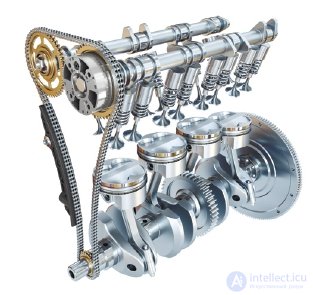 Give the structural formula of isooctane.
b) Give the structural formulas and names of two isomers of n-heptane containing five carbon atoms in the main chain.
c) 20 dm3 of isooctane and 5 dm3 of n-heptane were mixed. Determine the octane number of the resulting mixture.
d) The mass fraction of carbon in an unbranched hydrocarbon A, whose octane number is 25, is 83.72 %. Determine the molecular formula of hydrocarbon A.
e) What mass (kg) of n-heptane must be added to 20 kg of isooctane to obtain a fuel with the same octane number as hydrocarbon A? The density of isooctane equals the density of n-heptane and is 0.69 g/cm3.
9*. Name the main petroleum refining enterprises of the Republic of Belarus. Propose a method for obtaining polyethylene from liquid alkanes contained in petroleum. Write the corresponding reaction equations.



Comments