
Lecture
By studying the previous sections, you have learned a great deal about the structure and properties of alcohols, aldehydes, carboxylic acids, esters, and carbohydrates. The molecules of all these compounds contain oxygen, so they belong to oxygen-containing organic substances. At the same time, there is a large number of organic compounds containing nitrogen. These compounds include proteins, nucleic acids, and many others. Before we begin studying nitrogen-containing organic substances, let us examine the structure and properties of the inorganic substance ammonia, which you already know.
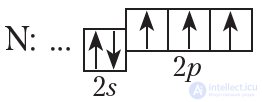
The formula of ammonia is NH3. Let us consider how covalent bonds form in the ammonia molecule. The outer electron shell of the nitrogen atom has three unpaired electrons:
The hydrogen atom has one unpaired electron:

Then the scheme of formation of covalent bonds in the ammonia molecule can be represented as follows: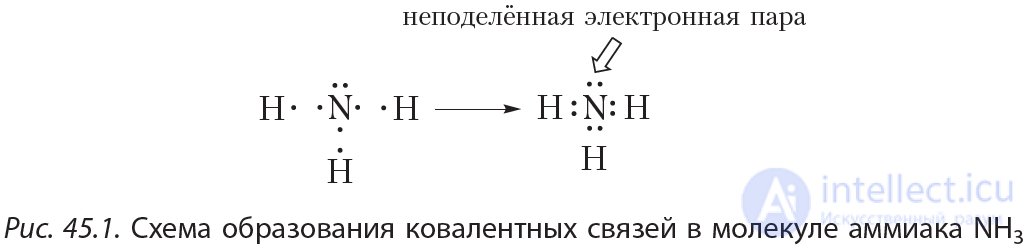
The diagram shows that the three unpaired electrons of the nitrogen atom take part in forming three N—H covalent bonds. At the same time, an electron pair remains on the outer shell of the nitrogen atom. Such an electron pair is called a lone electron pair. Structural formula of ammonia: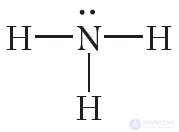 Owing to the presence of the lone electron pair, the nitrogen atom of the ammonia molecule can form one more covalent bond. For example, the ammonia molecule is able to attach a hydrogen cation H+, forming the ammonium ion: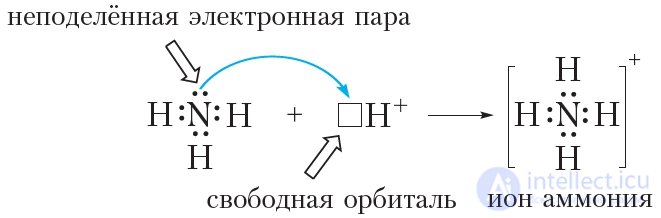
or
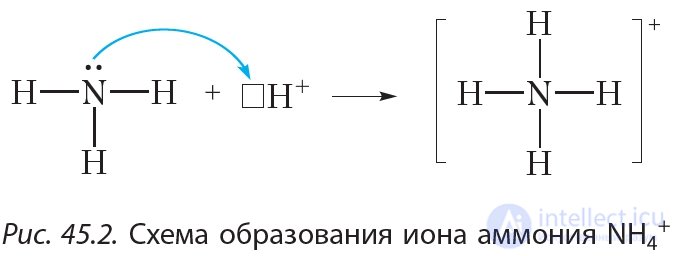
Figure 45.2 shows that all four N—H covalent bonds in the ammonium ion are identical. They are formed by shared electron pairs between the nitrogen and hydrogen atoms. However, the mechanism of formation of these bonds differs. Three N—H bonds are formed from the unpaired electrons of the nitrogen and hydrogen atoms (fig. 45.1). This way of forming a covalent bond is called exchange. The fourth N—H bond in the ammonium ion is formed from the lone electron pair of the nitrogen atom and the empty orbital of the H+ cation (fig. 45.2). This way of forming a covalent bond is called donor-acceptor. Here, the nitrogen atom that provides the electron pair is called the donor, and the hydrogen cation that accepts the electron pair into its empty orbital is called the acceptor.
Substances capable of attaching a hydrogen cation H+ are bases. Consequently, ammonia is a base. The basic properties of ammonia are manifested in reactions with acids. Ammonium salts are formed in these reactions:
or
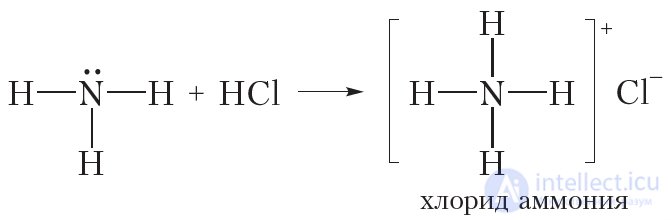
It can be seen that in the reaction with HCl, the NH3 molecule attaches an H+ cation and turns into the ammonium ion NH4+. In the ammonium ion, the nitrogen atom forms four N—H covalent bonds, so the valence of nitrogen is IV. In ammonium chloride, in addition to the N—H covalent bonds, there is an ionic bond between the NH+ cation and the Cl– anion.
Ammonia exhibits basic properties not only when reacting with acids, but also with water. Thus, when ammonia dissolves in water, a reversible reaction takes place:
or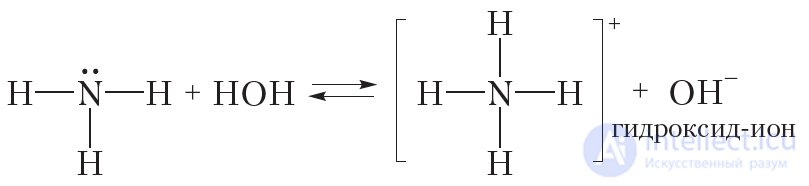
It can be seen that when reacting with water, the ammonia molecule attaches a hydrogen cation. This forms the ammonium ion NH+ and the hydroxide ion OH–. The presence of OH– ions is responsible for the alkaline reaction of aqueous ammonia solutions.
Let us now turn to examining the structure of organic nitrogen-containing substances — amines.
Amines can be regarded as derivatives of ammonia in which one, two, or three hydrogen atoms of the molecule are replaced by hydrocarbon radicals.
For example, let us replace one hydrogen atom of the ammonia molecule with a methyl radical: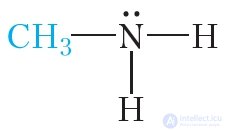 This compound is called methylamine. Methylamine is a colorless gas (tbp = –6 °C) with a pungent smell resembling that of ammonia.
Methylamine is the simplest representative of amines. Its formula can be written as follows: CH3—NH2. It can be seen that the methylamine molecule contains the group —NH2, which is called the amino group.
If two hydrogen atoms of the ammonia molecule are replaced with methyl radicals, dimethylamine is obtained: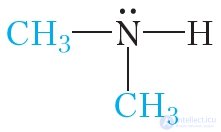
Finally, replacing all three hydrogen atoms of the ammonia molecule with methyl radicals gives trimethylamine: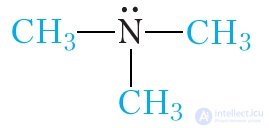
Depending on the number of substituted hydrogen atoms, amines are divided into primary (one hydrogen atom substituted), secondary (two hydrogen atoms substituted), and tertiary (three hydrogen atoms substituted): Methylamine CH3—NH2 is a primary amine. Given that the general formula of alkyl radicals is CnH2n+1 —, it is easy to obtain the general formula of the homologs of methylamine:
CnH2n+1—NH2
In amine molecules, as in the ammonia molecule, the nitrogen atom has a lone electron pair. Owing to this, amines, like ammonia, can attach a hydrogen cation H+. That is, amines are organic bases.
The names of amines consist of the names of the hydrocarbon radicals attached to the nitrogen atom and the ending -amine. Let us give the names of some amines:

In addition to alkyl radicals, amine molecules can contain other substituents. An example of such an amine is aniline:
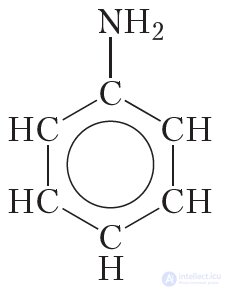
In the molecule of aniline, the group —NH2 is bonded to the radical —C6H5, which is called phenyl. Therefore, aniline is also called phenylamine.
Aniline is a colorless oily liquid, sparingly soluble in water, with a boiling point of 184 °C. Aniline is toxic.
Methylamine CH3—NH2 has no isomers.
The next representatives of alkylamines contain two carbon atoms in the molecule. In this case, two isomers can exist:

Table 45.1 gives the structural formulas, names, and boiling points of some saturated amines.
Table 45.1. Structural Formulas, Names, and Boiling Points of Saturated Amines
|
Formula |
Name |
tbp, °C |
|
CH3—NH2 |
methylamine |
–6 |
|
CH3—CH2—NH2 |
ethylamine |
17 |
|
CH3—CH2—CH2—NH2 |
propylamine |
49 |
|
CH3—CH2—CH2—CH2—NH2 |
butylamine |
78 |
The data in the table show that only methylamine has a boiling point below 0 °C, therefore, under normal conditions, only methylamine is a gas.
The higher boiling points of amines, compared with hydrocarbons, are due to the formation of hydrogen bonds between their molecules: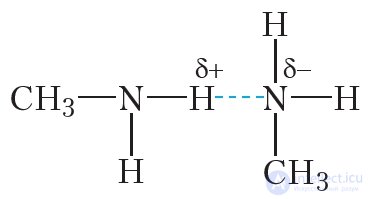
The polarity of the N—H bond is lower than that of the O—H bond. Therefore, the boiling points of amines are lower than those of alcohols with the same number of carbon atoms.
Like ammonia, the lower amines are highly soluble in water. As the hydrocarbon radicals grow larger, the solubility of amines in water decreases. For example, aniline is sparingly soluble in water. About 3,5 g of aniline can be dissolved in 100 g of water at room temperature.
|
Amines can be regarded as derivatives of ammonia in which one, two, or three hydrogen atoms of the molecule are replaced by hydrocarbon radicals. Depending on the number of substituted hydrogen atoms, amines are divided into primary (one hydrogen atom substituted), secondary (two hydrogen atoms substituted), and tertiary (three hydrogen atoms substituted). In amine molecules, as in the ammonia molecule, the nitrogen atom has a lone electron pair. Therefore, amines can attach a hydrogen cation H+ and are organic bases. Owing to the presence of polar N—H bonds, hydrogen bonds can form between amine molecules. Therefore, the boiling points of amines are higher than the boiling points of alkanes with the same number of carbon atoms in their molecules. The lower amines are highly soluble in water. As the hydrocarbon radicals grow larger, the solubility of amines in water decreases. |
1. Give examples of reactions in which ammonia exhibits the properties of a base. Which particle attaches to the ammonia molecule in these reactions?
2. Why does an aqueous solution of ammonia turn phenolphthalein crimson?
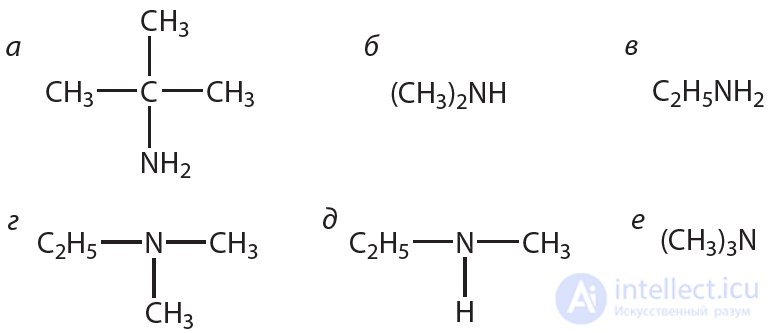
3. Identify the primary, secondary, and tertiary amines among the substances whose formulas are:
4. Write the general formula of the homologs of methylamine.
5. Write the structural formulas of all isomers of propylamine.
6. Show the formation of hydrogen bonds between ethylamine molecules. Can hydrogen bonds form between trimethylamine molecules?
7. The mass fraction of carbon in the molecule of a homolog of methylamine is 61,0 %. Give a possible formula for this substance.

Comments