
Lecture
Solving computational problems that involve not individual substances but their solutions is fundamentally no different from solving ordinary problems that require calculation based on a chemical reaction equation. In this case, it is first necessary to calculate the content of the reacting substances in the solution (this may be a mass or an amount), and then perform the calculation based on the equation of the reaction taking place. Let us consider examples of such problems and their solutions.
Example 1. There are 50 g of an aqueous solution of formic acid with a mass fraction of HCOOH equal to 10%. Calculate the mass of a 5% NaOH solution that will be required to neutralize the acid.
Solution
Equation of the reaction taking place:

Let us calculate the mass of the acid:
m(acid) = ω · m(soln) = 0,1 · 50 = 5 g.
Let us calculate the amount of the acid:
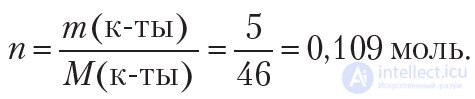
It follows from the reaction equation that 0,109 mol of alkali will be required to neutralize the acid.
Let us calculate the mass of the alkali:
m(NaOH) = n · M = 0,109 mol · 40 g/mol = 4,36 g.
Let us calculate the mass of the 5% NaOH solution:

Answer: 87,2 g of a 5% alkali solution will be required.
Example 2. What volume of a 6% acetic acid solution with a density of 1,007 g/cm3 will be required to «quench» 3 g of baking soda? What volume of carbon dioxide (STP) will be released in this process?
Solution
Equation of the reaction between baking soda and acetic acid:

Let us calculate the amount of soda:

Let us calculate the volume of a 6% acetic acid solution with a density of 1,007 g/cm3 that will be required to react with 0,0357 mol of sodium bicarbonate:
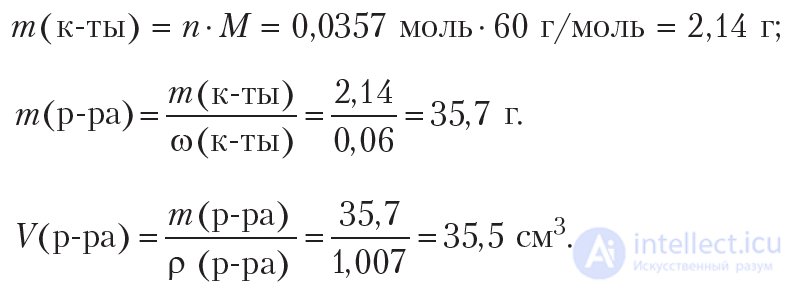
Let us calculate the volume of 0,0357 mol of carbon dioxide (STP) that will be released as a result of this reaction:
V(CO2) = Vm · n = 22,4 dm3/mol · 0,0357 mol = 0,800 dm3.
Answer: 35,5 cm3 of acid will be required, and 0,800 dm3 of carbon dioxide will be released.
Example 3. Complete neutralization of acetic acid dissolved in 30 cm3 of water required 23,4 cm3 of a sodium hydroxide solution with a molar concentration of 0,5 mol/dm3. Calculate the mass fraction of acetic acid in the original solution.
Solution
Equation of the reaction taking place:

Let us calculate the amount of sodium hydroxide consumed to neutralize the acetic acid:
in 1000 cm3 — 0,5 mol NaOH;
in 23,4 cm3 — x mol NaOH;
x = 0,0117.
It follows from the reaction equation that the acetic acid solution contained 0,0117 mol of the substance. The mass of the acetic acid:
m(acid) = n · M = 0,0117 mol · 60 g/mol = 0,702 g.
Let us calculate the mass fraction of acetic acid in the original solution. Recall that the total mass of a solution is the sum of the masses of the solvent and the dissolved substance. The density of water is 1,0 g/cm3.

Answer:: 2,29 %.
|
Calculations based on the equations of reactions occurring in solutions are fundamentally no different from ordinary calculations based on chemical reaction equations. To solve problems of this type, one should use the data on the composition of the solutions to calculate the amounts of the reacting substances, and then perform the calculation based on the reaction equation. |
1. Calculate the mass of sodium acetate that will be required to prepare 100 cm3 of its solution with a molar concentration of 0,2 mol/dm3.
2. Propanoic acid with a mass of 5,92 g is dissolved in water. Calculate the volume of a 10% potassium hydroxide solution with a density of 1,09 g/cm3 that will be required to neutralize the acid.
3. A dough recipe stated the following: «quench one teaspoon of baking soda with several tablespoons of 6% vinegar». However, the cook forgot to note how many tablespoons of vinegar would be required for this. Reconstruct this part of the recipe. Take into account that a teaspoon holds approximately 3 g of baking soda, and the capacity of a tablespoon is approximately 10 cm3. The density of the 6% acetic acid solution is 1,007 g/cm3.

Comments