
Lecture
Heat a copper wire in the flame of a spirit lamp until it glows red. The surface of the copper becomes coated with a black layer as a result of oxidation to copper(II) oxide, which is black. Then quickly dip the glowing wire into a test tube of ethanol. The black coating disappears and the surface of the copper wire becomes shiny again. If the experiment is repeated several times, an apple-like smell characteristic of acetaldehyde can be detected.
Explain the observed phenomena, and write the equations for the reactions taking place.
Demonstrate the oxidation reaction of ethanol by CuO, producing an aldehyde (acetaldehyde) and reducing copper(II) oxide to metallic copper.
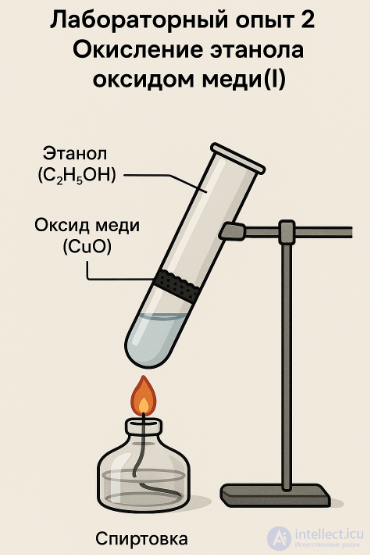
Test tube
Spirit lamp
Test tube holder
Ethanol (C₂H₅OH)
Copper(II) oxide (CuO) — black powder
Water
Pipette
Pour a small amount of copper(II) oxide (black powder) into a test tube.
Add a few drops of ethanol.
Carefully heat the test tube over the spirit lamp, holding it tilted.
Observe the changes:
the color of the copper oxide changes from black to red (metallic copper is formed),
a characteristic smell of acetaldehyde (a sharp, irritating odor) can be detected.
C2H5OH+CuO→t∘CH3CHO+Cu+H2O u+H2O
During the experiment, ethanol was oxidized to acetaldehyde, and CuO was reduced to copper. The reaction confirms that ethanol has reducing properties.

Comments