
Lecture
Electrons in atoms occupy states with definite energies (orbitals). To show this, orbitals are depicted as cells  , and electrons — as arrows
  . The latter makes it possible to represent a characteristic of the electron called spin (from the English spin — rotation). To understand what spin is, imagine that an electron in an atom not only moves around the nucleus but also rotates about its own axis. Depending on the direction of rotation about its own axis (clockwise or counterclockwise), the electron can have one of two spin values. Electrons with opposite spins are denoted by arrows pointing in different directions.
No more than two electrons with opposite spins can occupy a single orbital. Such electrons are called paired. Two paired electrons form an electron pair:
 — a filled orbital (electron pair).
If an orbital contains a single electron, the orbital is said to be partially or half filled, and the electron is called unpaired:
 — a partially or half filled orbital (unpaired electron).
Orbitals with equal energy values form an energy sublevel. Energy sublevels are denoted by the letters s, p, d.
s-sublevel consists of a single orbital, which has a spherical shape (Fig. 1.7).
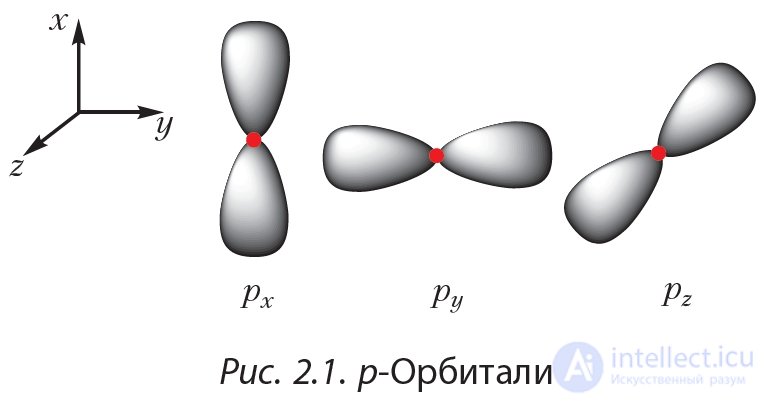
p-sublevel consists of three orbitals  , shaped like three-dimensional figure eights and oriented along three coordinate axes (Fig. 2.1).
d-sublevel consists of five orbitals 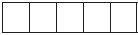 , which have an even more complex shape.
Orbitals with similar energy values form an energy level. Each energy level has a strictly defined number of sublevels and, consequently, orbitals, and this number increases as the energy level number increases (Fig. 2.2).
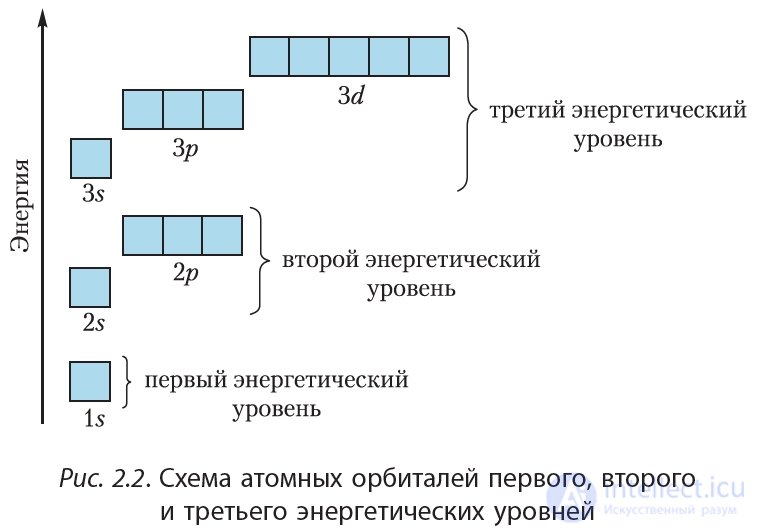
and 2p
third — of three sublevels — 3s 3p and 3d
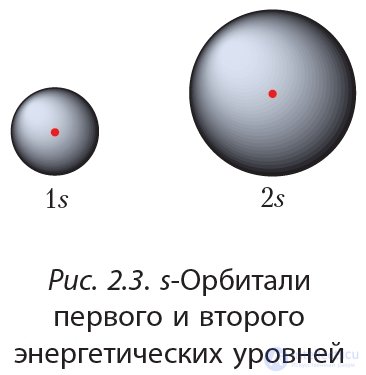 As the energy level number increases, the size of the orbitals increases, and the energy values of the electrons occupying these orbitals increase. Compare the sizes of the 1s and 2s-orbitals (Fig. 2.3).
Electrons in an atom tend to occupy the states of lowest energy.
The arrangement of electrons in atomic orbitals is represented by an electron configuration diagram.
Let us look at the electron configuration diagrams of several atoms. In doing so, we will take into account that levels and sublevels with lower energy are filled first (Fig. 2.2).
The element with atomic number 1 — hydrogen (H). The charge of the hydrogen atom's nucleus is 1+, so the hydrogen atom has a single electron, which occupies the orbital with the lowest energy, 1s.
The electron configuration diagram of the hydrogen atom:

In practice, it is not always convenient to use an electron configuration diagram; it is simpler to represent the structure of an atom's electron shell using the electron configuration formula (also called the electron configuration).
For example, the electron configuration formula of hydrogen:

The element with atomic number 2 — helium (He). The electron configuration formula:
He: 1s2
The first energy level in the helium atom is complete. A complete electron shell is stable, which is why helium does not form chemical compounds, is a noble gas, and exists as individual atoms (monatomic molecules). Other noble gases — Ne, Ar, and so on — also have stable, complete electron shells.
The atoms of all other elements do not have complete shells, which is why they form chemical compounds. In these compounds, atoms acquire the complete shells of the nearest noble gases.
The element with atomic number 3 — lithium (Li). Its electron configuration:
Li: 1s22s1
The electron configuration of the lithium atom shows that, by giving up one outer electron, the atom acquires a complete electron shell, just like the helium atom. Lithium is characterized by reactions in which it gives up one electron, that is, it exhibits reducing properties. In the resulting compounds, the oxidation state of lithium is +1:
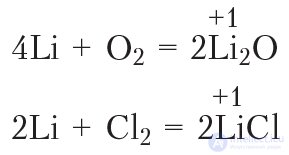
The element with atomic number 4 — beryllium (Be). The electron configuration formula:
Be: 1s22s2
At first glance, it may seem that the structure of the outer energy level of the beryllium atom is the same as that of the helium atom, but the properties of these elements are completely different. Beryllium is a divalent metal, whereas helium is a noble gas.
Let us consider the electron configuration diagram of the beryllium atom. We will not show the inner 1s-orbital; instead, the diagram uses an ellipsis in its place. Recall that the chemical properties of an atom are determined by the structure of its outer energy level. The electron configuration diagram of the outer energy level of the beryllium atom looks like this:
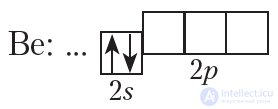
Unlike the helium atom, the outer energy level of the beryllium atom is not complete. To acquire a stable, complete electron shell, the beryllium atom must give up two electrons, so beryllium exhibits an oxidation state of +2 in compounds; its oxide has the formula BeO, and its hydroxide is Be(OH)2.
The element with atomic number 5 — boron (B). Its electron configuration: B: …2s22p1
The next element — carbon (C). The electron configuration diagram and electron configuration of carbon:
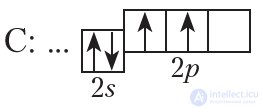
C: …2s22p2
As can be seen from the electron configuration diagram, the electrons in the carbon atom fill different 2p-orbitals. This is because electrons of like charge occupying the same orbital experience electrostatic repulsion, which is reduced when the electrons occupy different orbitals.
Let us look at the electron configuration diagrams and electron configurations of the atoms of the remaining elements of the second period:
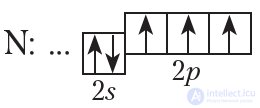 or N: …2s22p3
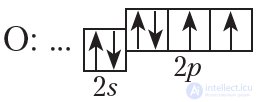 or O: …2s22p4
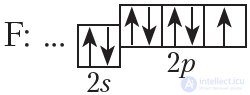 or F: …2s22p5
The last element of the second period — neon (Ne) — has a complete electron shell:
Ne: …2s22p6
Each of the electron configuration diagrams shown represents the most energetically favorable state of the atom (corresponding to the lowest energy). This state is called the ground state.
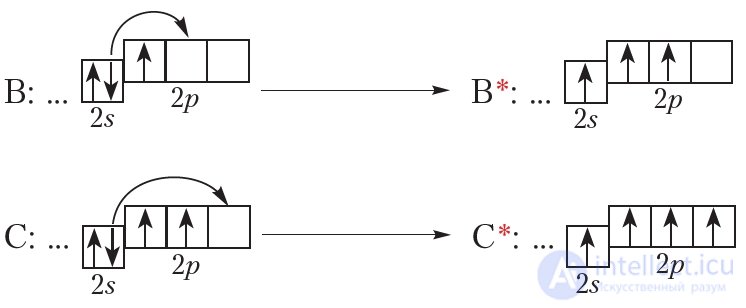
By absorbing energy, an atom can transition to an excited state, in which one or more electrons move from one orbital to another (Fig. 1.6). The energy of an atom in the excited state is higher than in the ground state, so an atom can remain in the excited state for only a very short time before quickly returning to the ground state.
Let us give examples of excited states of atoms (marked with *):
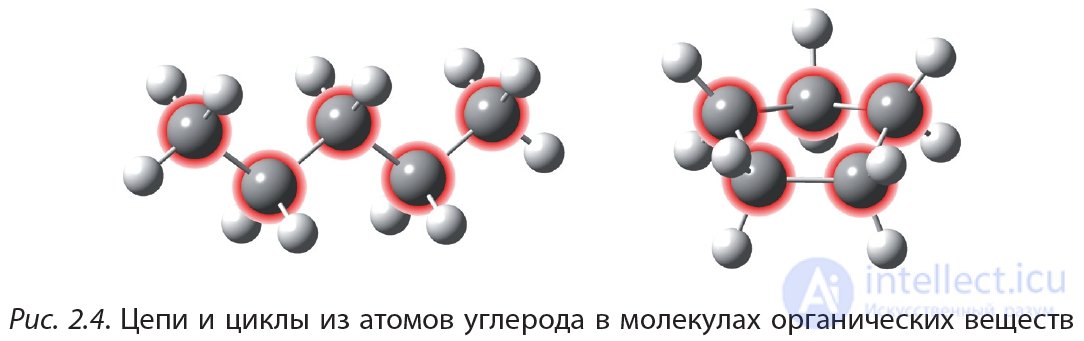
In the 10th grade, you will study organic chemistry — the chemistry of carbon compounds. The uniqueness of this element lies in the fact that the number of electrons in the outer energy level of carbon (four of them) equals the number of orbitals (also four). That is, the outer energy level of the carbon atom is filled exactly halfway. In such a case, it is unfavorable for the atom either to give up or to accept electrons; instead, it is favorable to share them, forming covalent bonds. That is why carbon atoms form fairly strong bonds with one another, joining into long chains or rings. In doing so, each carbon atom forms four covalent bonds.
Figure 2.4 shows chains and rings of carbon atoms in molecules of organic substances. The free valences of the carbon atoms are filled with hydrogen atoms (white spheres):
 It is not surprising that carbon is the basis of a great many organic compounds. Carbon's valence of four makes it possible to form branched structures and multiple (double and triple) bonds, which accounts for the diversity of organic compounds.
You can learn about the structure of the atoms of the chemical elements of the third period by following the link in the QR code.
|
The structure of an atom's electron shell is represented using an electron configuration diagram or an electron configuration formula. When constructing an electron configuration diagram, it is taken into account that orbitals with the lowest energy are filled first, and that no more than two electrons with opposite spins can occupy a single orbital. In the carbon atom, the number of electrons in the outer energy level equals the number of orbitals, which is why carbon atoms are able to form fairly strong covalent bonds with one another, joining into long chains and rings. |
The first element of the third period — sodium. Its electron configuration:
Na: …3s1
As can be seen, the configuration of sodium's outer electron layer repeats that of lithium — in the atoms of both elements, the outer layer has a single s-electron, which the atom readily gives up when forming compounds. Lithium and sodium belong to the family of alkali metals. Since the configuration of the outer electron layer of sodium and lithium is the same, the chemical properties of these metals are largely similar. The electron configuration formulas of alkali metal atoms can be expressed in general form: …ns1 (where n = 2 for lithium, n = 3 for sodium, and so on). Using lithium and sodium as an example, it is clear that as the nuclear charge of the atoms increases, the electron configurations of the outer energy level repeat periodically, and so the properties of the chemical elements repeat periodically as well.
The next element, No. 12, — magnesium. Its electron configuration:
Mg: …3s2
Like beryllium, magnesium is a metal that exhibits an oxidation state of +2 in compounds. But since the valence electrons of magnesium are in the third energy level and are located farther from the nucleus than the valence electrons of beryllium, the metallic properties of magnesium are more pronounced than those of beryllium. This is also reflected in the nature of its compounds. Whereas beryllium oxide and hydroxide exhibit amphoteric properties, MgO is a basic oxide, and Mg(OH)2 is a base.
Element No. 13 — aluminum. Al: …3s23p1. Like boron, aluminum exhibits an oxidation state of +3 in compounds, but, unlike boron, it is a metal. Aluminum oxide Al2O3 and aluminum hydroxide Al(OH)3 are amphoteric.
The electron configuration of the outer layer of element No. 14, silicon, repeats that of carbon:
Si: …3s23p2
Silicon is a nonmetal. Its oxide SiO2 is an acidic oxide, and its hydroxide H2SiO3 is an acid.
Element No. 15, phosphorus, has the same electron configuration of the outer electron layer as nitrogen. But unlike the nitrogen atom, the phosphorus atom, owing to the presence of 3d-orbitals in its outer energy level, can readily transition to an excited state in which there are five unpaired electrons:

P: …3s23p3  P*: …3s13p33d1
The valence of phosphorus can be III or V. Phosphorus exhibits a valence of III in the acidic oxide P2O3. A valence of V — in the acidic oxide P2O5 and in phosphoric acid H3PO4.
Elements that can exhibit different valences are called polyvalent.
Element No. 16 — sulfur. The electron configuration of sulfur:
S: …3s23p4
Like the phosphorus atom, owing to the presence of d-orbitals, the sulfur atom can readily transition to excited states:
S: …3s23p4 S*: …3s23p33d1 S** …3s13p33d2
In the ground state, the sulfur atom has two unpaired electrons, so sulfur can exhibit a valence of II (for example, in hydrogen sulfide H2S). In the first excited state, the sulfur atom has four unpaired electrons, so sulfur can exhibit a valence of IV (SO2, H2SO3). The second excited state of the sulfur atom is characterized by the presence of six unpaired electrons. Examples of compounds in which the valence of sulfur is VI: SO3, and sulfuric acid H2SO4.
The next element is chlorine. Atomic number — 17, electron configuration:
Cl: …3s23p5
In the ground state, the chlorine atom, like its electronic analog fluorine, has one unpaired electron. Examples of compounds in which chlorine is monovalent: the elemental substance Cl2, and hydrogen chloride HCl. But, owing to the presence of d-orbitals at the third energy level, the chlorine atom, like the phosphorus and sulfur atoms, can readily transition to excited states:
Cl: …3s23p5 Cl*: …3s23p43d1 Cl**: …3s23p33d2 Cl***: …3s13p33d3
Therefore, chlorine can exhibit valences of I, III, V, and VII in compounds. Examples of compounds in which the valence of chlorine is III, V, and VII:

The formation of the 3s- and 3p-sublevels is completed at element No. 18 — argon:
Ar: …3s23p6
The eight-electron shell of argon is so stable that, despite the presence of 3d-orbitals, its atoms do not take part in the formation of chemical bonds, and argon is an inert gas.
1. How many electrons can occupy a single orbital?
2. How many orbitals are there in the first and second energy levels, respectively?
3. Determine the oxidation states of the elements in the following compounds: HF, H2SO4, H2, NH3, CH4.
4. Why is beryllium, which has the electron configuration 1s22s2, an active metal, while helium, with a similar electron configuration of the outer energy level (1s2), is a noble gas?
5. What is unique about the structure of the carbon atom that allows it to serve as the basis for the molecules of millions of organic compounds?
6. A chemical element whose electron configuration is …2s22p2 forms an oxide in which the mass fraction of oxygen is 72,7 %. Give the chemical symbol of the element and the formula of the oxide.
7. Which of the given electron configurations correspond to the ground state of the atom, and which to the excited state:
a) 1s22s22p2; b) 1s22s12p2; c) 1s22s22p5; d) 1s22s22p6; e) 1s22s12p3?
8*. Why are elements such as sulfur, phosphorus, and chlorine polyvalent?

Comments