
Lecture
You are already familiar with alcohols and aldehydes — organic compounds whose molecules contain hydroxyl and aldehyde groups. The presence of these groups accounts for the characteristic chemical properties of these classes of compounds, which is why these groups are called functional.
The molecules of carboxylic acids contain a carboxyl functional group: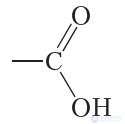 As you can see, the carboxyl group combines the carbonyl and hydroxyl groups:
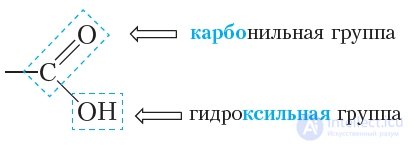
The name «carboxyl group» is also a combination of the names of these two groups.
The formula of the carboxyl group in abbreviated form: —COOH.
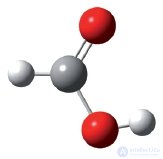
In the molecule of the simplest carboxylic acid, the carboxyl group is bonded to a hydrogen atom: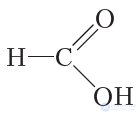 This compound is called formic acid. Ball-and-stick model of the formic acid molecule:
In the molecule of the nearest homolog of formic acid, the carboxyl group is bonded to a methyl radical:
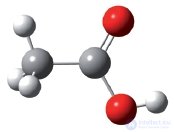
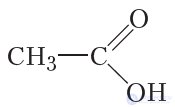 The name of this compound is well known to you — it is acetic acid. Ball-and-stick model of the acetic acid molecule:
 Let us derive the general formula of the homologs of acetic acid. In the molecules of such acids, the —COOH group is bonded to an alkyl radical or to a hydrogen atom. The general formula of alkyl radicals is CnH2n+1 . Then the general formula of the homologs of acetic acid is: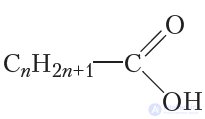
In the acids considered above, the hydrocarbon radical contains no multiple bonds. Such carboxylic acids are called saturated.
The hydrocarbon radical of carboxylic acids may contain one or several multiple bonds. Such acids are called unsaturated carboxylic acids. The simplest unsaturated carboxylic acid is acrylic acid. Its structural formula:

Carboxylic acids whose molecules contain benzene rings are called aromatic carboxylic acids. The simplest representative of such acids is benzoic acid:
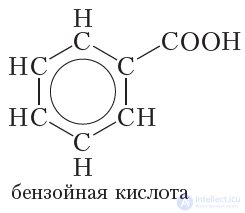
Ball-and-stick model of the benzoic acid molecule: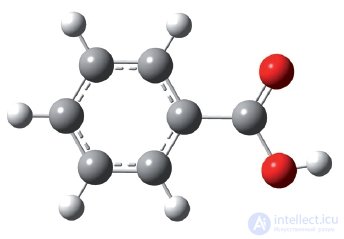 The molecules of carboxylic acids may contain not just one, but several carboxyl groups. The number of carboxyl groups in a carboxylic acid molecule determines its basicity. Acids containing one carboxyl group are monobasic — these include formic, acetic, acrylic, benzoic, and other acids.
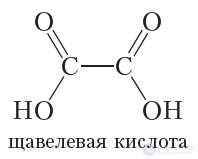
Oxalic acid is found in the leaves of sorrel, which is how it got its name.
Terephthalic acid is an aromatic dibasic carboxylic acid:
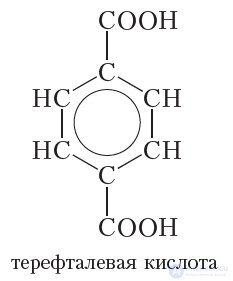
Terephthalic acid is used in the production of the synthetic fiber Lavsan (§ 38).
An example of a tribasic acid is citric acid: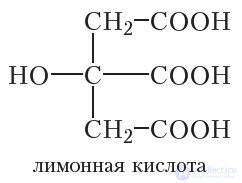
It is found in lemons.
Many carboxylic acids occur in naturally occurring products, which accounts for their names (fig. 31.1).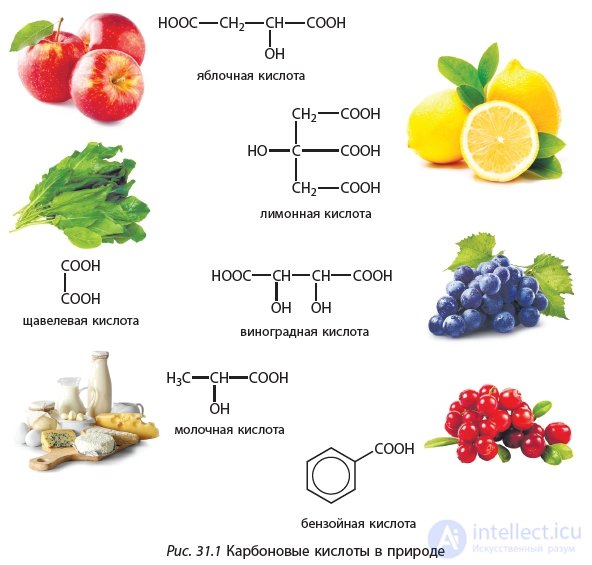
|
Carboxylic acids are organic compounds whose molecules contain one or more carboxyl groups —COOH, bonded to a hydrocarbon radical or a hydrogen atom. The number of carboxyl groups in a carboxylic acid molecule determines its basicity. The general formula of the homologs of acetic acid is CnH2n+1—COOH. Carboxylic acids can be saturated, unsaturated, aromatic, monobasic, or polybasic. |
1. Draw the structural formula of the carboxyl group.
2. Write the structural formulas of one saturated and one unsaturated carboxylic acid whose molecules contain four carbon atoms.
3. Write the structural formula of a dibasic carboxylic acid whose molecule contains three carbon atoms.
4. The figure shows ball-and-stick models of molecules:
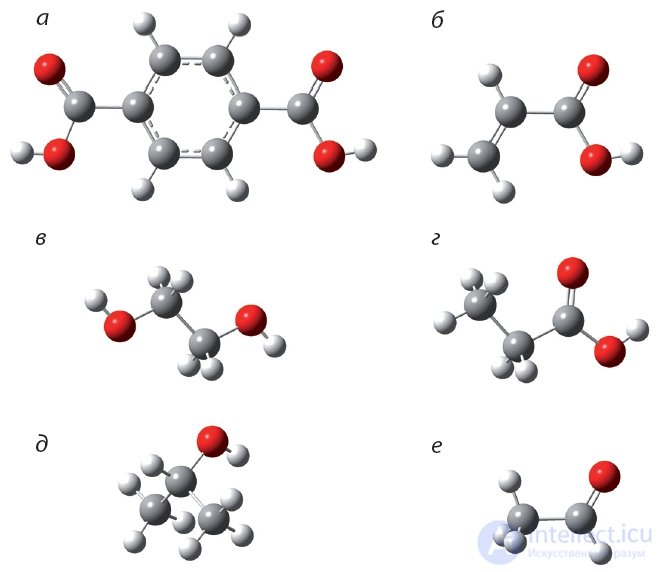
Indicate which models correspond to a saturated monobasic carboxylic acid, a dibasic acid, a monohydric alcohol, a polyhydric alcohol, an aldehyde, and an unsaturated monobasic carboxylic acid.

Comments