
Lecture
It was previously noted that the diversity of organic compounds is largely due to the phenomenon of isomerism — the possibility of compounds existing with the same composition but different structure. Compounds that have the same molecular formula but a different structural formula are called structural isomers. Let us consider the structural isomerism of alkenes.
Obviously, there are no alkenes isomeric to ethylene and propylene. A similar situation was observed for alkanes with two and three carbon atoms — ethane and propane likewise have no isomers. The phenomenon of isomerism in alkanes first appears starting with butane. Let us recall the structure of the molecules of n-butane and isobutane:
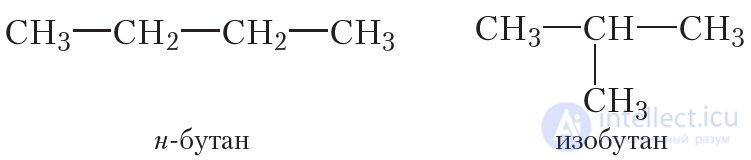
The isomers of butane have different carbon skeleton structures: n-butane has a linear one, while isobutane has a branched one.
Let us consider the possible structure of alkenes with the composition C4H8. As with alkanes, alkenes also exhibit carbon skeleton isomerism:

In addition, alkenes exhibit a new kind of structural isomerism — isomerism of double bond position:


Compounds 1 and 2 are double bond position isomers. Compound 3 is a carbon skeleton isomer relative to compounds 1 and 2.
As can be seen, the possibilities for isomerism in alkenes are broader than in alkanes. This is explained by the fact that, in addition to carbon skeleton isomerism, alkenes can also exhibit isomerism of double bond position.
Unlike alkanes, in the names of alkenes the suffix -ane is replaced by the suffix -ene, which denotes a double bond. The carbon atoms of the main chain are numbered starting from the end closest to the double bond. The position of the double bond is indicated by the number of the carbon atom at which it begins.
According to the rules of nomenclature, ethylene is called ethene.
Propylene is called propene. Let us name the isomeric alkenes with the composition C4H8:

Let us consider a more complex example. Let us name the alkene whose structural formula is:
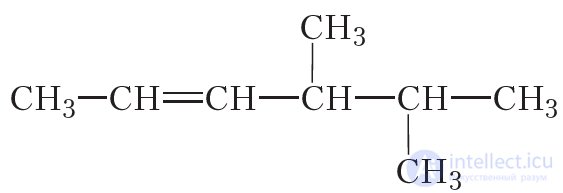
Let us choose the main chain of the compound. In this case the choice presents no difficulty — it is the longest horizontally arranged chain, and it includes the double bond. Let us number the carbon atoms. We begin numbering from the end closest to the double bond:
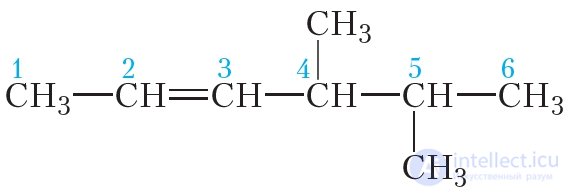
The main chain includes six carbon atoms, and the double bond begins at the second carbon atom, so the end of the name will have the suffix -ene with the number 2. The positions of the two methyl groups at the fourth and fifth carbon atoms are indicated, as in the case of alkanes, by the corresponding numbers. As a result, the name of the compound is: 4,5-dimethylhexene-2.
|
The possibilities for isomerism in the alkene series are broader than in alkanes, since in addition to carbon skeleton isomerism, isomerism of double bond position is also possible. The principles for constructing the names of alkenes are similar to those considered earlier for alkanes. The position of the double bond is indicated by the number of the carbon atom of the main chain at which the |
There are two classes of compounds having the composition CnH2n, — alkenes and cycloalkanes. For example, two substances have the formula C3H6:
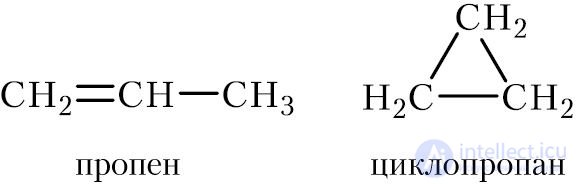
Propene and cyclopropane are isomers, since they have the same molecular formula but different structures. At the same time, propene and cyclopropane belong to different classes of organic substances.
Isomers belonging to different classes of compounds are called interclass isomers, and the corresponding type of isomerism is called interclass isomerism.
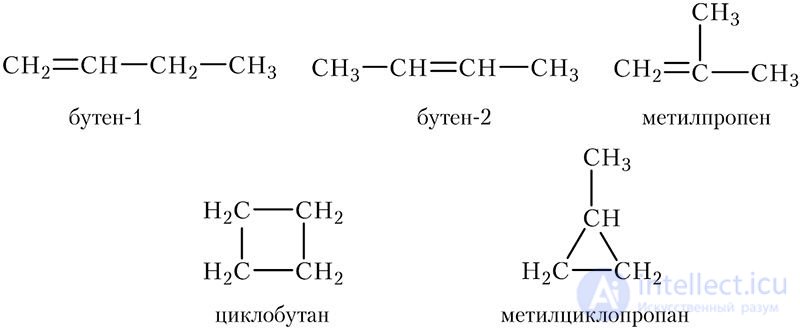
Thus, the number of structural isomers with the composition C4H8 is not limited to the three alkenes — cyclobutane and methylcyclopropane have the same composition. Let us give the formulas and names of all the structural isomers with the composition C4H8:
Task
Write the structural formulas of compounds with the composition C5H10 and give them names.
1. Write the structural formulas of alkenes with the composition C5H10 and give them names.
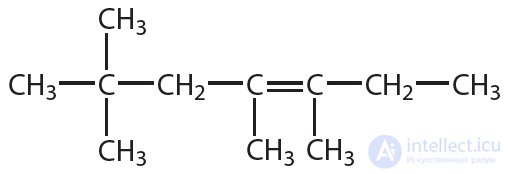
2. Name the alkene whose structural formula is:
3. Write the structural formulas of the following alkenes:
a) 2,3,4-trimethylpentene-1;
b) 4,5-dimethyl-3-ethylhexene-2.
4*. Write the structural formulas of the isomeric compounds with the composition C5H10 and give them names.
 bond begins. The carbon atoms of the main chain are numbered from the end closest to the double bond.
Comments