
Lecture
For example, the simple substance hydrogen consists of H2 molecules, in which two hydrogen atoms are joined by a single covalent bond: 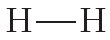 .
.
| Chemical bond — an interaction that binds individual atoms into chemical compounds (molecules or crystals). |
Chemical bond — is the joining of atoms or ions to form molecules, crystals, and other structures. A bond can result from the electrostatic force between oppositely charged ions, as in ionic bonds, or through the sharing of electrons, as in covalent bonds, or from some combination of these effects. Chemical bonds are described as having different strengths: there are «strong bonds» or «primary bonds», such as covalent, ionic, and metallic bonds, and «weak bonds» or «secondary bonds», such as dipole–dipole interactions, London dispersion forces, and hydrogen bonds.
Since opposite electric charges attract, the negatively charged electrons surrounding the nucleus and the positively charged protons inside the nucleus are attracted to one another. Electrons shared between two nuclei will be attracted to both nuclei. «Constructive quantum-mechanical interference of the wave function»] stabilizes the paired nuclei (see Theories of Chemical Bonding). Bonded nuclei maintain an optimal distance (bond length), balancing attractive and repulsive effects, quantitatively explained by quantum theory.
Atoms in molecules, crystals, metals, and other forms of matter are held together by chemical bonds, which determine the structure and properties of matter.
All bonds can be described by quantum theory, but in practice, simplified rules and other theories allow chemists to predict the strength, directionality, and polarity of bonds. The octet rule and VSEPR theory are examples. More complex theories include valence bond theory, which involves orbital hybridization and resonance, and molecular orbital theory, which involves the linear combination of atomic orbitals and ligand field theory. Electrostatics is used to describe bond polarities and their effect on chemical substances.
Only those electrons that are most weakly bound to the nucleus, that is, the electrons of the outer energy level, can take part in forming chemical bonds. Such electrons are called valence electrons.
Valence electrons are conventionally denoted by dots surrounding the symbol of the chemical element. Such formulas are called electron formulas.

electron formulas of the hydrogen and carbon atoms
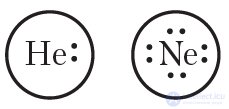
The circle around the electron formula indicates the completeness of the outer shell. That is, the helium atom has a complete two-electron outer shell, while the neon atom has a complete eight-electron outer shell. This leads to an important conclusion — atoms will tend to form stable, complete electron shells by giving up, gaining, or sharing electrons. In doing so, chemical bonds are formed.
Example 1. Formation of an ionic bond between lithium and fluorine.
The lithium atom has one electron in its outer electron shell, so the lithium atom readily gives up this electron, acquiring a complete electron shell like that of the nearest noble gas — helium. The fluorine atom has seven electrons in its outer shell, so fluorine, conversely, readily gains one electron, acquiring a complete eight-electron outer shell like that of the neon atom:
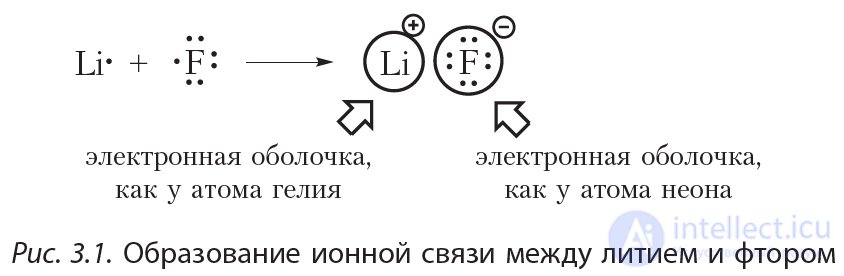
When lithium fluoride forms, an electron from the lithium atom transfers to the fluorine atom. As a result, the ions Li+ and F– are formed. The electron configurations of the ions Li+ and F– are the same as those of the helium and neon atoms, respectively:
Li+: 1s2
F–: …2s23p6
Oppositely charged ions attract one another. Such a bond is called ionic. An ionic bond forms between atoms of a metal and a nonmetal. Ionic bonding is found in salts (NaCl, KF), metal oxides (Na2O, K2O), and metal hydroxides (NaOH, KOH).
Example 2. Formation of a covalent bond in the hydrogen molecule H2.
The outer shell of the hydrogen atom contains one unpaired electron. Since identical atoms interact with one another when a hydrogen molecule forms, the electron will not transfer from one atom to another, and oppositely charged ions will not form. Instead, the unpaired electrons of the two hydrogen atoms form a shared electron pair. In doing so, each hydrogen atom acquires a complete electron shell, like that of the helium atom:
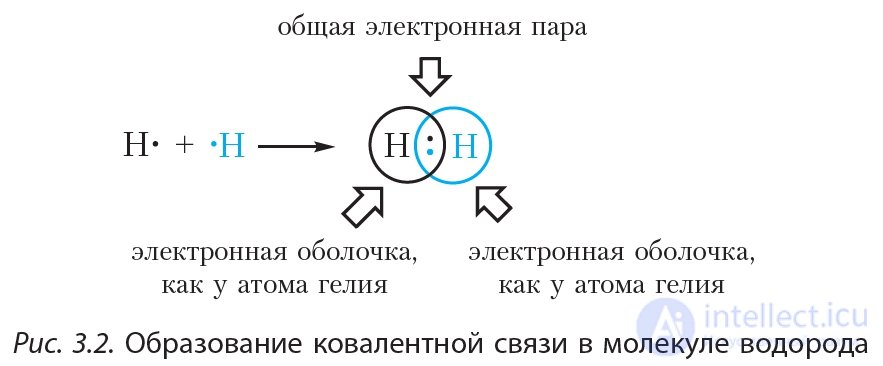
A bond formed by means of a shared electron pair is called covalent. In formulas, a covalent bond (a shared electron pair) is denoted by a dash. For example, the formula of the hydrogen molecule can be written as . Such a formula is called structural. It shows not only the composition but also the structure of the molecule.
A covalent bond forms between atoms of nonmetals. Covalent bonding is found in simple nonmetal substances (H2, Cl2, O2, N2), nonmetal oxides (CO2, SO2), and acids (HCl, H2SO4).
We have examined two types of chemical bond — covalent and ionic. Covalent bond forms between atoms of nonmetals. By means of an ionic bond , metals combine with nonmetals.
When atoms of metals interact with one another, a third type of chemical bond arises — metallic bond. You became familiar with this type of bond in detail in the grade 9 chemistry course. Recall that metallic bonding is found in simple substances formed by metals, for example Na, K, Fe, and in metal alloys.
|
There are three types of chemical bonds: covalent, ionic, and metallic. A covalent bond forms between atoms of nonmetals in simple substances (H2, F2, O2), nonmetal oxides (H2O, CO2), acids (HF, HCl, H2SO4, HNO3). An ionic bond forms between atoms of a metal and a nonmetal in salts (NaCl, KF), metal oxides (K2O, BaO), metal hydroxides (NaOH, KOH). A metallic bond forms between atoms of metals in simple substances (Na, K, Cu) and metal alloys. |
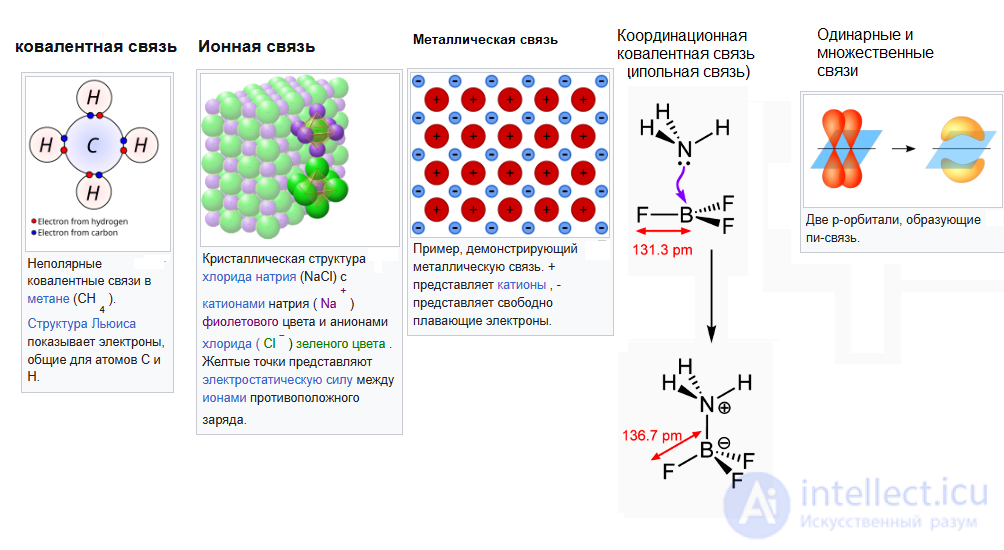
As already mentioned — a chemical bond is an attraction between atoms. This attraction can be viewed as the result of different behaviors of the outer or valence electrons of atoms. These behaviors merge smoothly into one another under various circumstances, so that no sharp boundary can be drawn between them. Nevertheless, it remains useful and conventional to distinguish different types of bonding, which give rise to different properties of condensed matter.
In the simplest representation of a covalent bond, one or more electrons (often a pair of electrons) are drawn into the space between two atomic nuclei. Energy is released when the bond forms. This does not occur as a result of a decrease in potential energy, since the attraction of the two electrons to the two protons is offset by electron-electron and proton-proton repulsion. Instead, the release of energy (and, consequently, the stability of the bond) arises from a decrease in kinetic energy, because the electrons occupy a more spatially distributed orbital (i.e., one with a longer de Broglie wavelength) compared to when each electron is confined closer to its respective nucleus. These bonds exist between two specific identifiable atoms and have a direction in space, which allows them to be depicted as individual connecting lines between atoms in diagrams, or modeled as sticks between spheres in models.
In a polar covalent bond, one or more electrons are unevenly distributed between two nuclei. Covalent bonds often lead to the formation of small clusters of more tightly bonded atoms called molecules, which in solids and liquids are connected to other molecules by forces that are often much weaker than the covalent bonds holding the molecules together internally. Such weak intermolecular bonds give organic molecular substances, such as waxes and oils, their soft bulk character and their low melting points (in liquids, molecules must give up most of their structured or oriented contacts with one another). However, when covalent bonds link long chains of atoms in large molecules (as in polymers such as nylon), or when covalent bonds extend into networks through solids that are not made up of discrete molecules (such as diamond, quartz, or silicate minerals found in many types of rocks), the resulting structures can be both strong and rigid, at least in the direction properly oriented by the networks of covalent bonds. Moreover, the melting points of such covalent polymers and networks increase significantly.
In the simplified representation of an ionic bond, the bonding electron is not shared at all but is transferred. In this type of bond, the outer atomic orbital of one atom has a vacancy that allows one or more electrons to be added. These newly added electrons potentially occupy a lower energy state (in fact, closer to a larger nuclear charge) than they experience in the other atom. Thus, one nucleus offers a more tightly bound position for the electron than the other nucleus, causing one atom to be able to transfer an electron to the other. This transfer causes one atom to acquire a net positive charge, and the other a net negative charge. The bond then arises from the electrostatic attraction between the positively and negatively charged ions. Ionic bonds can be regarded as extreme examples of polarization in covalent bonds. Such bonds often have no definite orientation in space, since they arise from the equal electrostatic attraction of each ion to all the ions surrounding it. Ionic bonds are strong (and therefore ionic substances require high temperatures to melt), but are also brittle, since the forces between ions have a short range and cannot easily bridge cracks and fractures. This type of bonding accounts for the physical characteristics of crystals of classic mineral salts, such as table salt.
A less commonly mentioned type of bond is the metallic bond . In this type of bond, each atom in the metal donates one or more electrons to a «sea» of electrons that exists among many metal atoms. In this sea, each electron is free (by virtue of its wave nature) to be associated with a large number of atoms simultaneously. The bond arises because metal atoms become somewhat positively charged due to the loss of their electrons, while the electrons remain attracted to many atoms without belonging to any single given atom. Metallic bonding can be regarded as an extreme example of electron delocalization over a large system of covalent bonds involving every atom. This type of bond is often very strong (which accounts for the tensile strength of metals). However, metallic bonding is more collective in nature than other types, and therefore it allows metal crystals to deform more easily, since they consist of atoms attracted to one another but not in any particular fixed way. This leads to the ductility of metals. The cloud of electrons in metallic bonds accounts for the good electrical and thermal conductivity characteristic of metals, as well as their bright luster, reflecting most frequencies of white light.
Since atoms and molecules are three-dimensional, it is difficult to use a single method to denote orbitals and bonds. In molecular formulas, chemical bonds (bonding orbitals) between atoms are denoted differently depending on the type of discussion. Sometimes certain details are ignored. For example, in organic chemistry, sometimes only the functional group of a molecule is considered. Thus, the molecular formula of ethanol can be written in conformational form, three-dimensional form, full two-dimensional form (indicating every bond without three-dimensional directions), condensed two-dimensional form (CH 3 –CH 2 –OH), by separating the functional group from the rest of the molecule (C 2 H 5 OH), or by its atomic constituents (C 2 H 6 O), depending on what is being discussed. Sometimes even the non-bonding valence-shell electrons are denoted (with approximate two-dimensional directions), for example for elemental carbon . ' C ' . Some chemists may also mark the corresponding orbitals, for example the hypothetical ethylene anion −4 ( \ / C=C / \ −4 ), indicating the possibility of bond formation.
There are several types of weak bonds that can form between two or more molecules that are not covalently bonded. Intermolecular forces cause molecules to attract or repel one another. These forces often affect the physical characteristics (for example, the melting point) of a substance.
Van der Waals forces are interactions between molecules with closed shells. They include both Coulomb interactions between partial charges in polar molecules and Pauli repulsions between closed electron shells.
Keesom forces are the forces between the permanent dipoles of two polar molecules. London dispersion forces are the forces between induced dipoles of different molecules. There can also be an interaction between a permanent dipole in one molecule and an induced dipole in another molecule
Hydrogen bonds of the form A--H•••B arise when A and B are two highly electronegative atoms (usually N, O, or F), such that A forms a highly polar covalent bond with H, so that H carries a partial positive charge, while B has a lone pair of electrons that is attracted to this partial positive charge and forms a hydrogen bond. Hydrogen bonds are responsible for the high boiling points of water and ammonia compared with their heavier analogues. In some cases, a similar halogen bond can be formed by a halogen atom positioned between two electronegative atoms in different molecules.
At short distances, repulsive forces between atoms also become important.
In the (unreal) limit of a «pure» ionic bond, electrons are perfectly localized on one of the two atoms in the bond. Such bonds can be understood using classical physics. The force between atoms depends on isotropic continuum electrostatic potentials. The magnitude of the force is in simple proportion to the product of the two ionic charges, according to Coulomb's law
Covalent bonds are better understood using valence bond theory (VB) or molecular orbital theory (MO). The properties of the atoms involved can be understood using concepts such as oxidation state, formal charge, and electronegativity. The electron density within a bond is not assigned to individual atoms but is instead delocalized between the atoms. In valence bond theory, a bond is conceptualized as built from electron pairs that are localized and shared between two atoms through the overlap of atomic orbitals. The concepts of orbital hybridization and resonance supplement this basic notion of the electron-pair bond. In molecular orbital theory, a bond is treated as delocalized and distributed over orbitals that extend across the entire molecule and are adapted to its symmetry properties, typically by considering linear combinations of atomic orbitals (LCAO). Valence bond theory is more chemically intuitive, since it is spatially localized, which allows attention to be focused on the parts of a molecule undergoing chemical change. In contrast, molecular orbitals are more «natural» from the standpoint of quantum mechanics, with orbital energies being physically meaningful and directly related to experimental ionization energies from photoelectron spectroscopy. Consequently, valence bond theory and molecular orbital theory are often regarded as competing but complementary frameworks that offer different views of chemical systems. As approaches to electronic structure theory, MO and VB methods can, at least in principle, yield approximations to any desired level of accuracy. However, at lower levels of approximation the two differ, and one approach may be better suited than the other for calculations involving a particular system or property.
Unlike the spherically symmetric Coulomb forces in pure ionic bonds, covalent bonds are, as a rule, directional and anisotropic. They are often classified, based on their symmetry with respect to the molecular plane, as sigma bonds and pi bonds. In general, atoms form bonds that are intermediate between ionic and covalent, depending on the relative electronegativity of the atoms involved. Bonds of this type are known as polar covalent bonds
1. Why do atoms of most chemical elements not exist under normal conditions in a free state (as unbonded individual atoms)? Are there any exceptions to this pattern?
2. What are valence electrons? Indicate the number of valence electrons in atoms of hydrogen, carbon, and nitrogen.
3. Using electron formulas, illustrate the formation of covalent bonds in the molecules F2 and N2. The electron shell of which noble gas do the atoms that formed the chemical bond in these molecules acquire?
4. Determine the type of chemical bond in the substances: I2, H2O, KCl, Na2S, CO2, O2, CH4, Cu.

Comments