
Lecture
Hydrocarbons are the simplest organic compounds in terms of composition. Hydrocarbon molecules consist of only two elements: carbon and hydrogen. The simplest hydrocarbon is methane. The molecular formula of methane — CH4. The molecular formula reflects only the composition of the methane molecule. Let us examine the structure of the methane molecule.
A carbon atom has four valence electrons, a hydrogen atom — one. This can be clearly shown using electron-dot formulas:
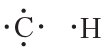
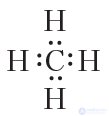
In doing so, the atoms acquire complete outer electron shells: carbon — an eight-electron one, hydrogen — a two-electron one.
The electron-dot formula shown reflects the structure of the methane molecule CH4, in which the central carbon atom is bonded to four hydrogen atoms by means of four shared electron pairs (four covalent bonds). In practice, it is more convenient to represent the structure of organic molecules using structural formulas. The structural formula of methane:
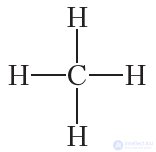
Unlike molecular formulas, structural formulas reflect not only the composition but also the sequence in which the atoms are connected in the molecule.
Methane is a colorless, combustible, odorless gas that is insoluble in water. Methane's boiling point is very low, at –162 °C. Methane is the main component of natural gas. It is also found in coal deposits, and its sudden releases are a cause of fires in coal mines. This is where methane's name «firedamp» comes from. Methane emissions are also observed in peat bogs, which accounts for another of its names — «marsh gas».
Let us construct the structural formula of the next hydrocarbon — ethane. The ethane molecule contains two carbon atoms joined by a single bond. Given that carbon is tetravalent in organic compounds, it is easy to construct the electron-dot and structural formulas of the ethane molecule:
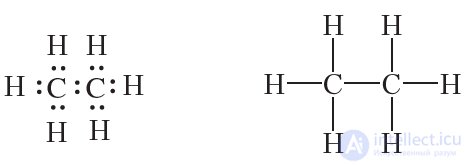
The molecular formula of ethane — C2H6. Like methane, ethane is a colorless, combustible gas, insoluble in water, with a boiling point of –89 °C. Ethane occurs in nature as a component of natural gas.
In organic chemistry, structural formulas rather than molecular formulas are usually used for substances. So that structural formulas do not become too cumbersome, the individual bonds  in them are, as a rule, not shown. In this case, the structural formula of ethane looks much more compact:
 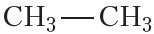 .
.
The next hydrocarbon — propane. The propane molecule contains a chain of three carbon atoms joined by single bonds. Structural formulas of the propane molecule:
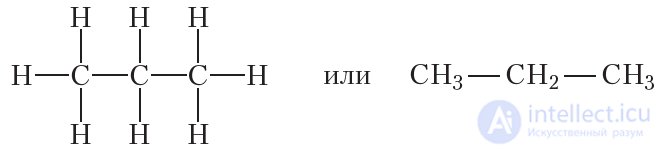
By counting the number of carbon and hydrogen atoms in the structural formula of propane, we can write its molecular formula — C3H8. Propane, like methane and ethane, is a colorless combustible gas and is a component of natural gas.
From four carbon atoms, two types of chains can be built: a normal (unbranched) one and a branched one. Structural formulas of the corresponding hydrocarbons:
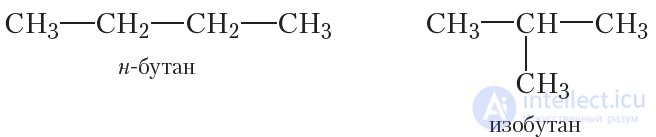
 Recall that to denote hydrocarbons with an unbranched (normal) chain, the letter «n» is placed at the beginning of the name (§ 5).
As you already know from § 5, n-butane and isobutane are isomers. The molecules of these substances have the same qualitative and quantitative composition (molecular formula C4H10), but different structures.
The isomeric n-butane and isobutane, under normal conditions, are colorless, odorless gases — and are present in natural gas. Mixtures of propane and isomeric butanes extracted from natural gas are used to fill the gas cylinders used in everyday life (fig. 6.1).
From five carbon atoms joined by single bonds, the molecules of three hydrocarbons can be built:
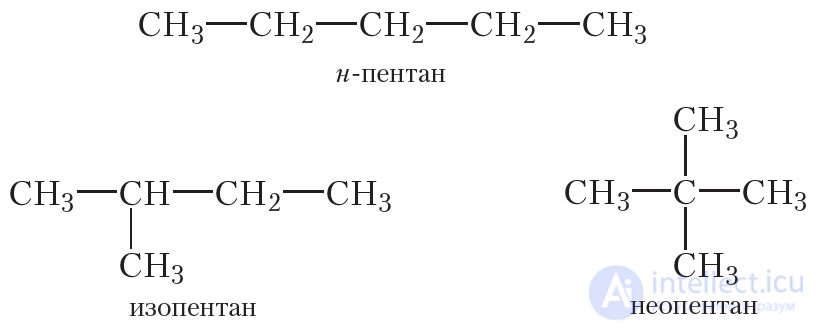
The composition of all three hydrocarbons is the same and corresponds to the molecular formula C5H12. That is, the hydrocarbons shown are isomers.
Obviously, for hydrocarbons with a larger number of carbon atoms in the molecule, the number of isomers will be considerable. For example, there are more than 300,000 isomeric hydrocarbons of composition C20H42, and the number of possible isomeric substances of composition C40H82 exceeds 1012.
The phenomenon of isomerism largely accounts for the diversity of organic compounds and makes organic chemistry truly inexhaustible.
We have examined the structure of hydrocarbons in which carbon atoms are bonded to one another only by single bonds, with the remaining bonds formed between carbon and hydrogen atoms. The composition of such hydrocarbons is described by the molecular formulas CH4, C2H6, C3H8, C4H10, C5H12 and so on. It is easy to see that a general formula can be proposed for these hydrocarbons:
CnH2n+2
All hydrocarbons of non-cyclic structure, whose molecules contain only single bonds, correspond to this general formula. Such hydrocarbons are called alkanes.
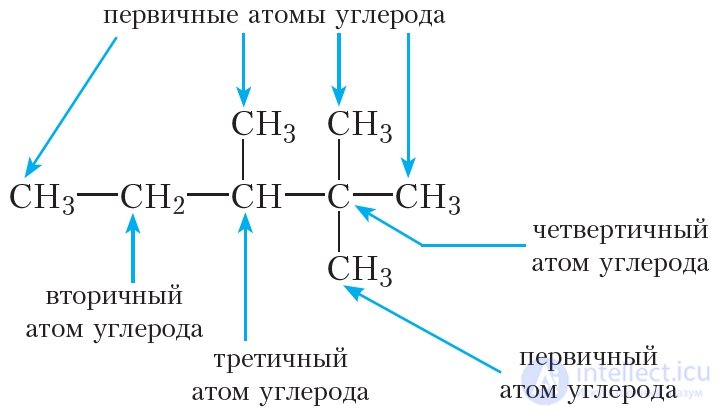
A carbon atom bonded within the carbon chain to only one other carbon atom is called primary. Primary carbon atoms are the terminal elements of the carbon chain. In the ethane molecule, both carbon atoms are primary.
A secondary carbon atom is bonded to two carbon atoms. In the propane molecule, the first and third carbon atoms are primary, and the second atom — secondary.
A tertiary carbon atom is bonded to three carbon atoms; a quaternary atom — to four carbon atoms. Tertiary and quaternary carbon atoms are the branch points of the carbon chain. Such carbon atoms are found in the molecules of isopentane and neopentane (identify them yourself).
|
Hydrocarbons of non-cyclic structure whose molecules contain only single bonds are called alkanes. The general formula of alkanes is CnH2n+2. There are two isomeric alkanes of composition C4H10 and three isomeric alkanes of composition C5H12. |
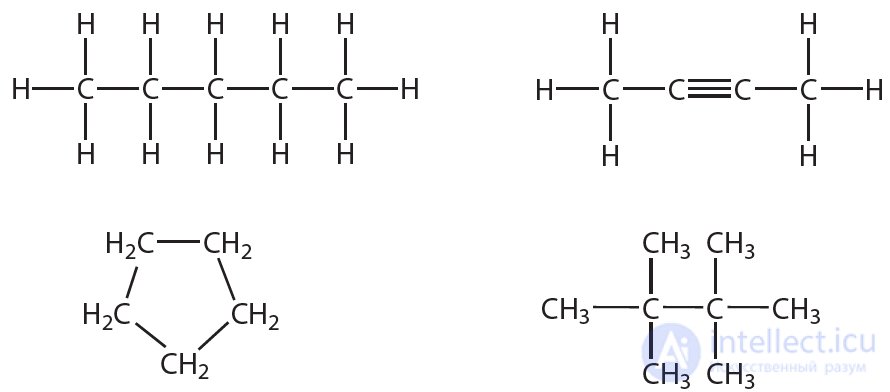
1. Among those listed, identify the formulas of alkanes:
2. Write the structural formulas of n-butane and isobutane.
3. What are isomers? Why do methane, ethane, and propane have no isomers?
4. Write the structural formulas of all hydrocarbons of composition C7H16.
5. Write the molecular formulas of alkanes whose molecules contain: a) eight carbon atoms; b) twenty hydrogen atoms.
6. What number of hydrogen atoms — even or odd — can be contained in alkane molecules, and why?
7*. For the isomeric hydrocarbons of composition C4H10, identify the primary, secondary, and tertiary carbon atoms.

Comments