
Lecture
The molecular formula of cellulose is (C6H10O5)n, that is, cellulose, like starch, is a polysaccharide. At the same time, the structure of cellulose and starch differs. Unlike starch, cellulose macromolecules consist of β-glucose residues. The process of cellulose formation from glucose is shown in the diagram: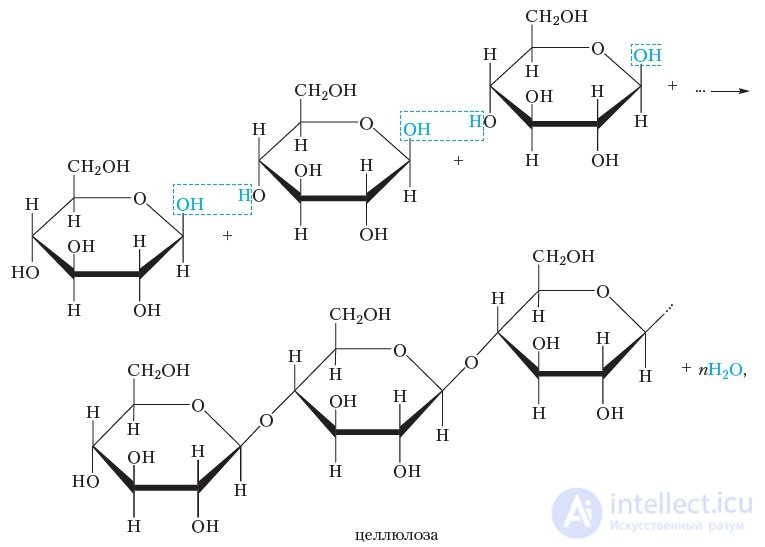
or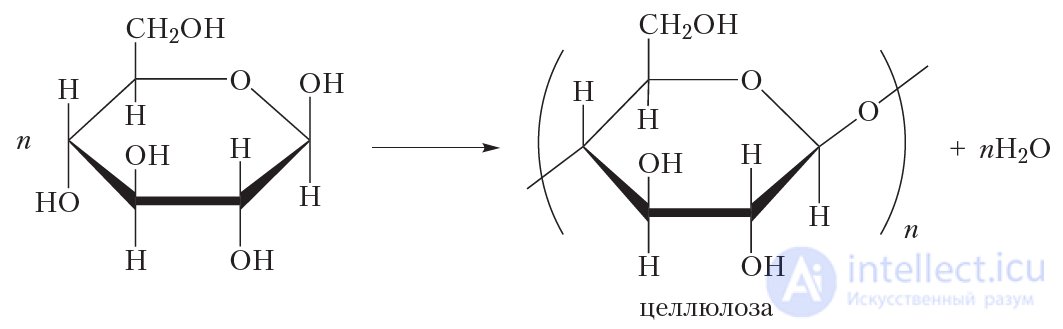
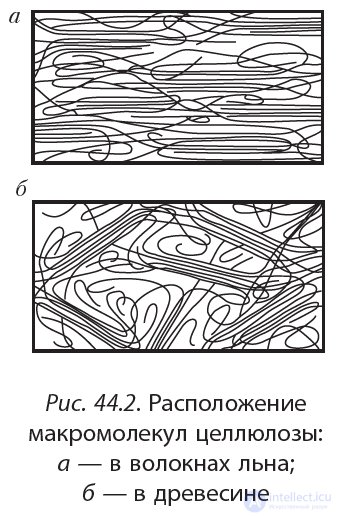
There is another important difference between the structure of cellulose and starch. Starch macromolecules can be linear or branched, whereas cellulose macromolecules have a linear structure. Linear cellulose macromolecules can be arranged parallel to one another and form numerous hydrogen bonds between themselves. Because of this, cellulose has high mechanical strength and does not dissolve in water or organic solvents.
Cellulose macromolecules are found in the cell walls of plants.
Cellulose (from the Latin cellula — cell) is also known as fiber.
Wood contains about 50 % cellulose. Flax and cotton fibers contain even more cellulose (over 90 %) (fig. 44.1).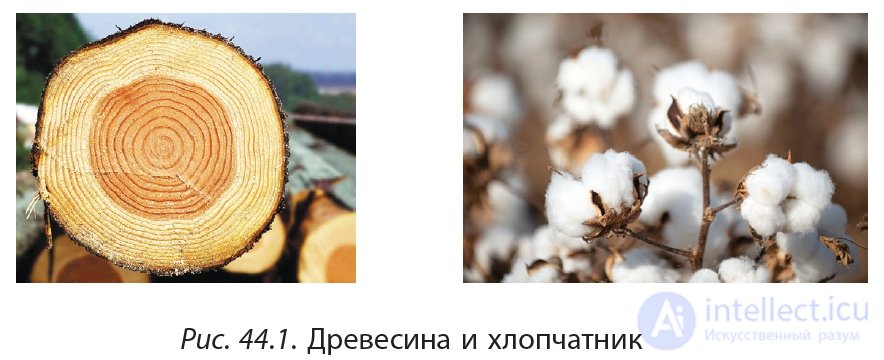 In flax and cotton fibers, cellulose macromolecules are oriented in one direction — along the fiber axis (fig. 44.2, a). In wood, cellulose macromolecules are arranged less regularly (fig. 44.2, b).
1. Hydrolysis
Like starch, cellulose undergoes hydrolysis. The final product of cellulose hydrolysis is glucose:
2. Formation of Cellulose Acetates
Cellulose macromolecules contain hydroxyl groups, so cellulose exhibits properties characteristic of alcohols. For example, cellulose forms esters when reacting with acetic acid (the reaction equation is given for one structural unit of the cellulose macromolecule):
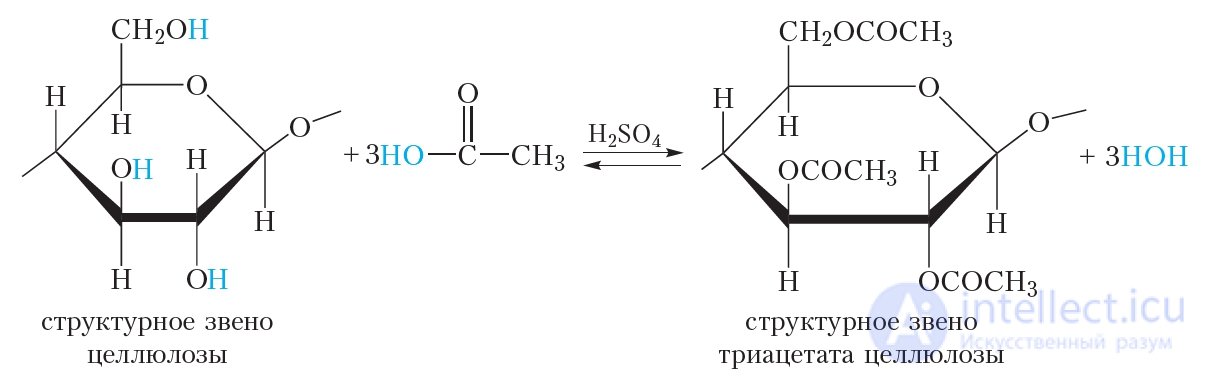
Esters of cellulose with acetic acid are called cellulose acetates. If all the hydroxyl groups of the cellulose molecule react, cellulose triacetate is formed. The diagram shows that cellulose triacetate macromolecules lack hydroxyl groups. Consequently, there are no hydrogen bonds between these molecules, so cellulose triacetate macromolecules are not as tightly bound to one another as cellulose molecules are. As a result, unlike cellulose, its acetates dissolve in certain organic solvents. This is used in the production of man-made fibers.
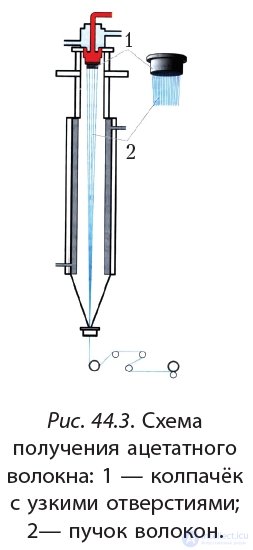 As mentioned earlier, in wood cellulose macromolecules are arranged less regularly than in cotton and flax fibers (fig. 44.2). Therefore, to obtain fibers from cellulose extracted from wood, the cellulose macromolecules must be arranged along one direction — along the fiber axis. To do this, the cellulose molecules must be given mobility, for example, by converting them into solution. Since cellulose itself does not dissolve in either water or organic solvents, cellulose acetates are produced from cellulose in order to bring it into a soluble state. Cellulose acetates are dissolved in organic solvents. This produces a viscous solution. This solution is then forced through narrow openings. In the process, the macromolecules align along one direction (fig. 44.3).
Acetate fiber consists of modified molecules of the natural polymer — cellulose. Such fibers are called man-made fibers. They should be distinguished from synthetic fibers, whose macromolecules are obtained synthetically by a polycondensation reaction. An example of a synthetic fiber is the polyester fiber lavsan (§ 38).
3. Formation of Cellulose Nitrates
Like alcohols, cellulose forms esters with nitric acid. When cellulose is treated with a mixture of concentrated nitric and sulfuric acids, the hydroxyl groups are gradually converted into ester groups: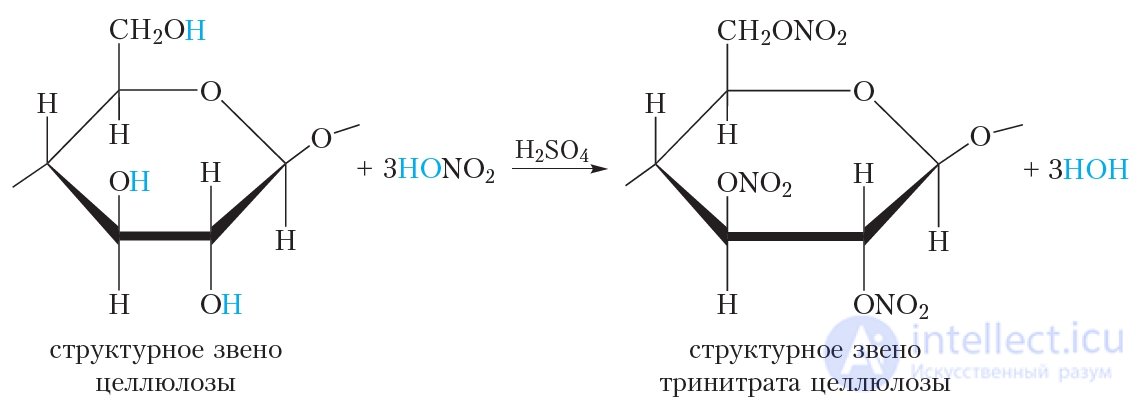 Esters of cellulose with nitric acid are called cellulose nitrates. When all the hydroxyl groups are converted into ester groups, cellulose trinitrate is formed. It is an explosive substance and is used in the manufacture of smokeless powder.
Flax and cotton fibers, consisting mainly of cellulose, are used to make threads and fabrics.
Esters of cellulose with acetic acid are used to produce man-made acetate fiber (acetate silk).
Cellulose extracted from wood is used to make paper. To produce paper, crushed wood is cooked in the presence of acidic or alkaline reagents. The technical cellulose obtained after cooking is purified and bleached. Until the beginning of the XIX century, sheets of paper were made by hand by scooping pulp with a mesh-bottomed mold and drying individual sheets, but in the late XVIII — early XIX century, papermaking machines appeared that formed paper on a continuously moving conveyor mesh and wound it into huge rolls.
Paper made from pure cellulose is too porous, and ink and paint spread on it. Filter paper, found in the chemistry classroom, is an example of such a material. To obtain high-quality paper for writing and copying equipment, special additives (chalk and other fillers, bleaching agents, glue) are introduced into the paper pulp. The surface of paper for copying equipment is subjected to special treatment to prevent the buildup of static electricity on it. It is therefore not surprising that some grades of paper are quite expensive.
The human body has no enzymes capable of breaking the bonds between β-glucose residues. Therefore, unlike starch, cellulose cannot serve as a nutrient for humans. However, ruminant animals have microorganisms in their stomachs capable of breaking down cellulose molecules, so for ruminants cellulose is a source of energy.
|
Cellulose is a natural polysaccharide; it is found in the cell walls of plants. The molecular formula of cellulose is (C6H10O5)n. Cellulose macromolecules consist of residues of β-glucose, linked to one another by oxygen bridges. Unlike starch, cellulose macromolecules have an unbranched structure, so they can arrange themselves parallel to one another and form numerous hydrogen bonds between them. This explains the high strength of cellulose. Complete hydrolysis of cellulose yields glucose. Cellulose forms esters with acetic and nitric acids. Cellulose is used to produce fibers, paper, and smokeless powder. |
1. Where in nature is cellulose found?
2. Treating cellulose with nitric acid in the presence of sulfuric acid produces cellulose trinitrate. Write the equation of the chemical reaction that takes place.
3. What are man-made fibers? Write the equation of the reaction for obtaining cellulose triacetate.
4. The average relative molecular mass of a cellulose sample is 1 420 000. Calculate the average number of structural units in the macromolecule of this cellulose sample.
5. Given the following scheme of transformations of organic substances:

Write the equations of the reactions taking place.
6. Natural polymer A is part of the walls of plant cells. The final product of the hydrolysis of A is substance B. Treating B with an ammoniacal solution of silver oxide produces compound C, which has a dual chemical function. Give the formulas of substances A, B, and C and the equations of the reactions.
7. Indicate the areas of application of cellulose. What substances widely used in everyday life are obtained from cellulose?
8*. A young chemist decided to study the reaction of cellulose with nitric acid. To do this, he took a piece of cotton fabric and placed it in a nitrating mixture (a mixture of concentrated sulfuric and nitric acids). After about 15 minutes, he removed the fabric from the nitrating mixture, rinsed it, and dried it. He then set fire to pieces of the treated fabric, as well as to fabric that had not been treated. The original fabric caught fire with difficulty, giving off a lot of soot and smoke, whereas the fabric treated with the nitrating mixture burned quickly without giving off soot. Explain the phenomenon observed, and write the equations of the reactions taking place.

Comments