
Lecture
The chemical properties of aldehydes are primarily determined by the presence of the aldehyde group in their molecules. Addition reactions can take place at the double bond of the aldehyde group.
1. Hydrogenation. Addition of hydrogen
An aldehyde molecule can add a molecule of hydrogen across its double bond. Such a reaction is accompanied by the breaking of the π-bond in the aldehyde molecule, since it is less strong than the σ-bond:
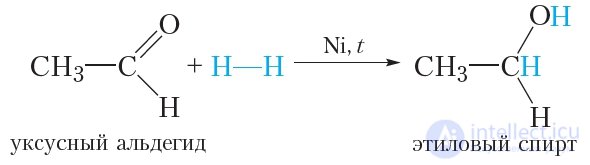
The conditions for this reaction are similar to the hydrogenation of alkenes: a mixture of hydrogen and aldehyde vapor is passed over a heated nickel catalyst.
The product of the addition of hydrogen to an aldehyde is a primary alcohol.
As a result of the addition of hydrogen, the aldehyde molecule is reduced, which is why the reaction with hydrogen is also called the reduction of aldehydes.
2. Oxidation
The aldehyde group is easily oxidized. Ions of metals located to the right of hydrogen in the activity series — silver ions (Ag+) and copper ions (Cu2+) — can act as oxidizing agents.
Oxidation of aldehydes with an ammoniacal solution of silver oxide
If ammonia solution is added to a dilute solution of silver nitrate, a white precipitate of silver oxide forms:


Video 30.1
The "silver
mirror" reaction
This precipitate immediately dissolves in excess ammonia. The resulting clear solution is called an ammoniacal solution of silver oxide. If a solution of acetic aldehyde is added to this solution and the mixture is carefully heated, a shiny mirror-like coating of silver soon forms on the walls of the test tube, which is why this reaction is called the "silver mirror" reaction.
In the reaction taking place, acetic aldehyde is oxidized to acetic acid, while silver oxide is reduced, forming metallic silver:
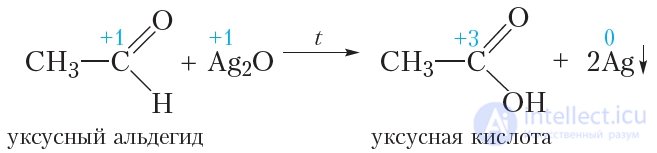
The "silver mirror" reaction is a qualitative reaction for aldehydes.
Oxidation of aldehydes with copper(II) hydroxide
Copper(II) hydroxide can also be used as an oxidizing agent to convert aldehydes into the corresponding acids. To carry out this reaction, a solution of copper(II) sulfate is placed in a test tube, then an alkali solution is added. This produces a blue precipitate of copper(II) hydroxide:

Then an aqueous solution of the aldehyde is added to the test tube with the precipitate, and the mixture is heated. During heating, the initially blue precipitate turns yellow, and on further heating — red. The equation of the reaction taking place:
As can be seen from the equation of the reaction given, the reduction of copper(II) hydroxide produces a yellow precipitate of copper(I) hydroxide, which decomposes on heating to form red copper(I) oxide.
As in the case of the "silver mirror" reaction, the product of aldehyde oxidation is a carboxylic acid.
The reaction of aldehyde oxidation with copper(II) hydroxide, like the "silver mirror" reaction, is a qualitative reaction for aldehydes.
The ability of aldehydes to be oxidized to carboxylic acids and reduced to alcohols vividly demonstrates the relationship between classes of organic compounds, thanks to which substances of one class can be obtained from representatives of other classes.
1. Incomplete oxidation of alcohols
As you already know, aldehydes can be obtained by the incomplete oxidation of primary alcohols with copper(II) oxide (§ 24). For example, oxidation of ethyl alcohol produces acetic aldehyde: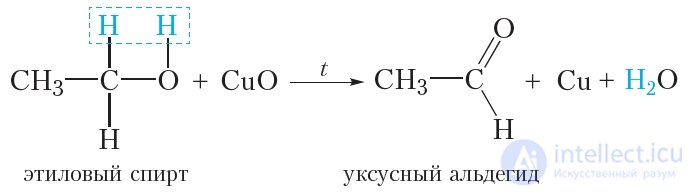
To carry out this reaction, copper wire is heated in the flame of a spirit lamp, causing the surface of the wire to become coated with black copper(II) oxide. The wire is then dipped into ethyl alcohol, whereupon the copper(II) oxide oxidizes the alcohol to acetic aldehyde and copper is formed, so the wire becomes shiny again (video 24.1).
2. Hydration of acetylene
Acetic aldehyde can be obtained by the addition of water to acetylene in the presence of mercury salts and sulfuric acid: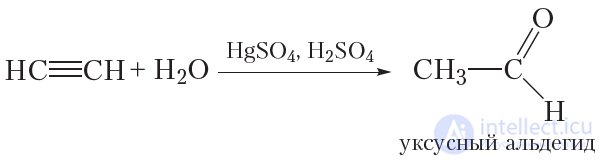 This reaction is named after the Russian chemist Mikhail Grigoryevich Kucherov.
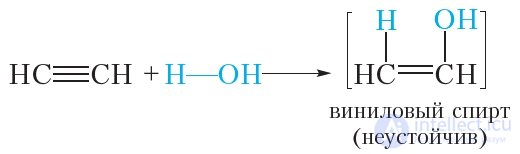
Recall that the radical CH2  CH
CH  has the trivial name vinyl. Alcohols in which the hydroxyl group is located at the double bond C C are unstable, so vinyl alcohol immediately converts into acetic aldehyde: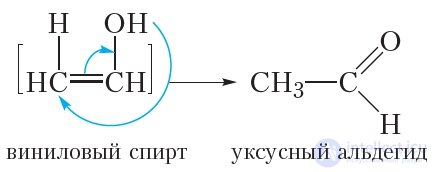
 You can learn about the industrial method for producing acetic aldehyde by following the link in the QR code.
Formic aldehyde and acetic aldehyde have the widest application.
Some uses of formic aldehyde are based on its property of coagulating proteins. It is used in medicine as a preservative for biological tissues. Formaldehyde is widely used in the leather industry, since by acting on the proteins of the hide it makes the leather harder and more resistant to decay.
The reaction of formaldehyde with ammonia produces a medicinal substance — urotropine (hexamethylenetetramine).
In addition, formaldehyde is used in the production of phenol-formaldehyde plastics. The basis of such plastics is a high-molecular-weight compound — phenol-formaldehyde resin. It is formed by heating phenol with formaldehyde in the presence of a catalyst. The mechanism of formation of phenol-formaldehyde resin is quite complex and is represented schematically:
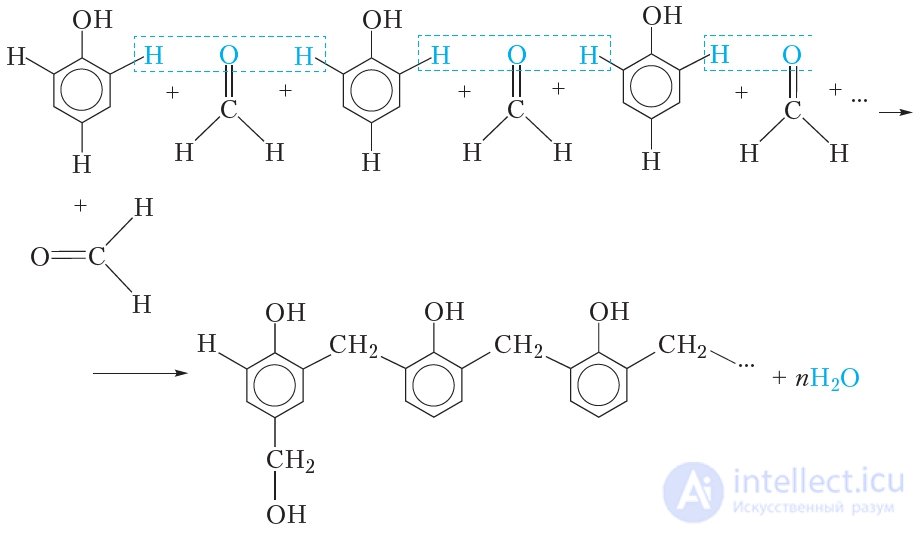
As can be seen from the scheme shown, the reaction produces a linear polymer in which phenol molecules are joined by —CH2— groups through positions 2 and 6 of the benzene ring. In addition, some phenol residues contain —CH2OH groups at position 4 of the benzene ring.
Owing to the —CH2OH groups, on heating to 130—150 °C such a polymer "cross-links," forming a very hard and strong phenol-formaldehyde resin with a "network" structure: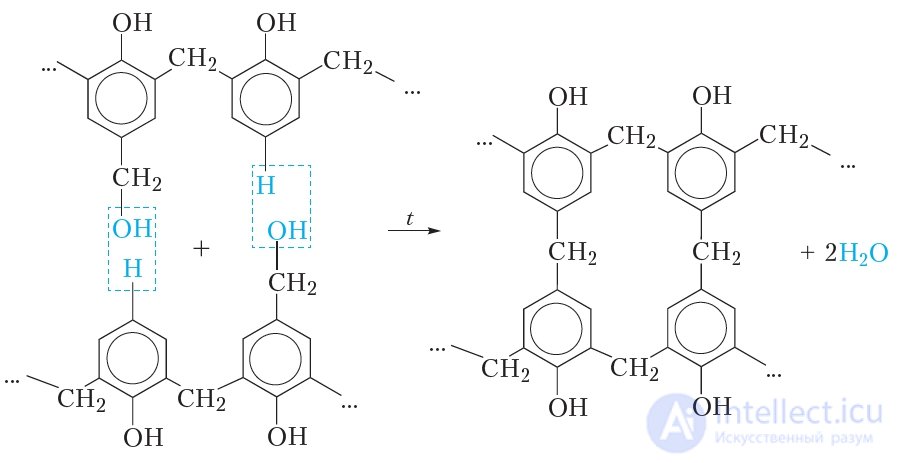
Materials based on phenol-formaldehyde resins are usually made by mixing the molten linear polymer with a filler (wood flour, shavings, asbestos, etc.). The resulting material is then pressed while being heated. During this process, the molten polymer fills the mold well and then hardens, forming a "network" structure. This results in a solid, monolithic item. Some materials in which phenol-formaldehyde resin serves as a binder are well known to you. For example, some types of particleboard (chipboard) are a mixture of wood shavings bonded together with phenol-formaldehyde polymer.
In the process of forming phenol-formaldehyde resin from the low-molecular-weight substances phenol and formaldehyde, a high-molecular-weight substance is formed as a result of the elimination of water. Such a process is called polycondensation. Polycondensation and polymerization should be distinguished from each other. In the process of polycondensation, a by-product low-molecular-weight substance is formed alongside the high-molecular-weight compound. In the polycondensation reaction of phenol with formaldehyde discussed here, this by-product is water.
In the process of polymerization, a high-molecular-weight substance (a polymer) is formed as a result of a repeatedly occurring addition reaction. Therefore, unlike polycondensation, the process of polymerization is not accompanied by the formation of by-product low-molecular-weight substances.
Acetic aldehyde is used in large quantities to produce acetic acid, as well as other organic substances.
|
Aldehydes undergo addition reactions at the double bond C Aldehydes are oxidized by copper(II) hydroxide and by an ammoniacal solution of silver oxide to form carboxylic acids. These reactions are qualitative reactions for the aldehyde group. Aldehydes can be obtained by oxidizing primary alcohols with copper(II) oxide. Acetic aldehyde can be obtained by adding water to acetylene in the presence of mercury salts and sulfuric acid. Aldehydes are used in the production of plastics and medicines, in the synthesis of organic substances, and in perfumery. |
Acetic aldehyde is currently produced by the so-called Wacker process. To do this, a gaseous mixture of ethylene and oxygen is passed through an aqueous solution containing palladium(II) and copper(II) chlorides. The processes taking place can be expressed by the overall equation:

1. What alcohols are formed as a result of the reduction of ethanal and 2-methylpropanal with hydrogen? Write the reaction equations and name the resulting products.
2. Write the equation for the reaction of propanal with copper(II) hydroxide on heating. Describe the observed phenomena.
3. Heating an aqueous solution of substance A with an ammoniacal solution of silver oxide produces acid B, and the walls of the test tube become coated with a silver deposit.
When a mixture of substance A and hydrogen is passed over a heated nickel catalyst, alcohol C is formed. Heating alcohol C with concentrated sulfuric acid produces hydrocarbon D, slightly lighter than air. Determine the formulas of substances A—D and give the equations of the reactions described in the assignment.
4. Oxidation of 2.15 g of a homolog of acetic aldehyde with an ammoniacal solution of Ag2O yielded 5.4 g of silver. Determine the molecular formula of the aldehyde.
5. One of the modern industrial methods for producing acetic aldehyde is the oxidation of ethylene with palladium chloride in the presence of copper(II) chloride and atmospheric oxygen (the Wacker process):

To synthesize ethanal under industrial conditions, a mixture of ethylene and oxygen is passed through a reactor containing a solution of palladium and copper(II) chlorides at a temperature of 130 °C and a pressure of 400 kPa. It is known that the conversion rate of the substances in the reactor under these conditions is 25%. Determine the mass of ethanal formed from a volume (at STP) of 10 m3 of ethylene and a sufficient amount of oxygen.
6*. The action of water on solid substance A produces a gas (at STP) B, lighter than air. Passing B through a hot aqueous solution containing sulfuric acid and mercury(II) sulfate produces organic substance C. Substance C can also be obtained by a two-step synthesis. First, substance B is hydrogenated using special catalysts. This produces a gas (at STP) D, lighter than air. Then a mixture of gas D and oxygen is absorbed by an aqueous solution containing a mixture of CuCl2 and PdCl2. This produces substance C.
a) Give the structural formulas of substances A, B, C, and D.
b) Write the equations of all the reactions described in the problem.
c) Hydrogenation of substance C produces substance E, which has only one isomer (substance F). Give the formulas and names of substances E and F, as well as the equation for the hydrogenation reaction of substance C.
d) Which substance (E or F) has the higher boiling point, and why?
7*. Write the reaction schemes by which ethyl bromide can be obtained in two steps, starting from acetic aldehyde.
 O
O
Comments