
Lecture
While studying inorganic chemistry, you became acquainted with substances of the most varied composition, many of which form the basis of minerals, building materials, mineral fertilizers, precious stones, and so on. In doing so, you never encountered a single chemical element that was necessarily present in all inorganic substances. A distinctive feature of organic substances is that carbon atoms, alongside other elements, are always present in their composition. The study of carbon compounds — their structure, chemical properties, and methods of production — constitutes the subject of organic chemistry.
| Organic chemistry is the chemistry of carbon compounds. |
Alongside carbon, organic substances most often also contain hydrogen (CH4 — methane), oxygen (CH3COOH — acetic acid), and nitrogen (C6H5NH2 — aniline), and less often halogens (CCl4 — carbon tetrachloride), sulfur (CH3SH — methyl mercaptan), and other elements. Note that some carbon compounds are classified as inorganic substances. You became acquainted with them earlier. These are carbon dioxide (CO2), carbonic acid (H2CO3), its salts — carbonates — and some other substances.
The number of known organic compounds significantly exceeds the number of inorganic compounds. This diversity is due to the ability of carbon atoms to bond with each other, forming chains and rings that include hundreds or even thousands of carbon atoms.
It should be noted that organic substances have been known to humanity since ancient times. Using relatively simple methods of processing plants, people have long known how to obtain cane sugar, natural dyes, vegetable oils, vinegar, and so on. However, the science of carbon compounds arose only at the beginning of the 19th century, after chemists learned to determine the composition of substances and express it in the form of molecular formulas. It was then that it became known that substances of plant and animal origin contain carbon.
In 1806, the Swedish chemist J. Berzelius proposed calling substances obtained from living organisms organic, and the science that studies them — organic chemistry. The presence of carbon in every organic substance allowed Berzelius to define organic chemistry as the chemistry of carbon compounds. This definition remains generally accepted today. At the same time, Berzelius mistakenly believed that the fundamental difference between organic and inorganic substances was that the former could not be obtained in a laboratory but were created only by living organisms under the influence of a special «vital force». The theory of the «vital force» became known as «vitalism» (from the Latin vitalis — vital). This theory was soon dealt a crushing blow when, in 1824, oxalic acid was synthesized from inorganic substances by the German chemist F. Wöhler, and in 1828 — urea. In 1845, acetic acid was obtained (A. Kolbe, Germany), and in 1854 the French chemist M. Berthelot synthetically obtained fats. Today, many organic substances have been synthesized, not only those found in nature but also ones that do not occur in it, for example medicines, plastics, synthetic rubbers, liquid crystals, and many others. Thus, the doctrine of the «vital force» suffered complete defeat. Nevertheless, the division of chemistry into organic (the chemistry of carbon compounds) and inorganic has persisted to this day.
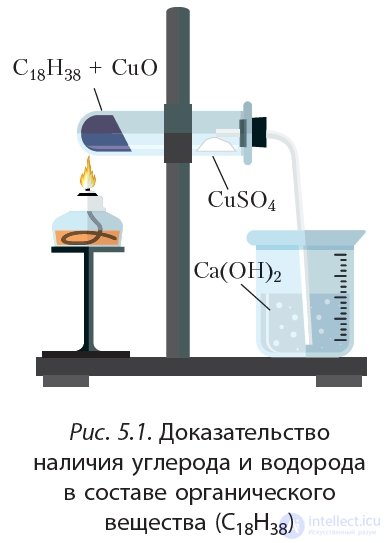 Carbon is present in the composition of all organic substances. Most organic compounds also contain hydrogen atoms. Proof that carbon and hydrogen are present in the composition of organic compounds is provided by the following experiment.
Copper(II) oxide and paraffin are placed in a test tube. Paraffin is a mixture of solid hydrocarbons (organic substances consisting of carbon and hydrogen). The test tube is clamped horizontally in a laboratory stand (Fig. 5.1). Anhydrous copper(II) sulfate is carefully placed on the wall of the test tube closer to its mouth.
Anhydrous copper(II) sulfate CuSO4 is white, unlike the blue copper sulfate pentahydrate CuSO4 · 5H2O. The test tube is closed with a stopper fitted with a gas outlet tube, the end of which is placed in a beaker of clear limewater (an aqueous solution of calcium hydroxide Ca(OH)2). The test tube is heated in the flame of an alcohol lamp.
In this experiment, copper(II) oxide acts as the oxidizing agent. It oxidizes the hydrocarbons to CO2 and water, while the copper(II) oxide is reduced to copper. For example, for the hydrocarbon C18H38, which is part of paraffin, the reaction that takes place can be represented by the equation:

The following phenomena are observed during the experiment. Droplets of water appear on the walls of the test tube, and the white copper(II) sulfate turns blue as it converts into copper sulfate pentahydrate:

The carbon dioxide gas released causes the limewater to turn cloudy, since a white precipitate of CaCO3 forms:

The residue of the reaction mixture takes on a reddish tint due to the formation of metallic copper. Thus, this experiment proves the presence of carbon and hydrogen in the molecules of the organic substance.
The theory of the structure of organic substances took shape in the second half of the 19th century. By that time, many organic compounds had been obtained and studied, their qualitative and quantitative composition had been established, and their properties described.
Thus, at the end of the 18th and the beginning of the 19th century, the most important hydrocarbons (organic substances consisting only of carbon and hydrogen) were isolated and their molecular formulas established. However, it turned out that knowledge of molecular formulas, which reflect only the composition of a substance, was clearly insufficient for understanding the structure and properties of organic compounds. Let us give some examples of contradictions that puzzled scientists in the first half of the 19th century.
Example 1. The molecular formulas of the simplest hydrocarbons methane, ethane, and propane — CH4, C2H6 and C3H8 respectively.
By the middle of the 19th century, E. Frankland had already proposed the concept of atomic valence, and A. Kekulé suggested that carbon atoms are tetravalent. If one assumes that hydrogen is monovalent, then, looking at the molecular formulas given above, one might mistakenly conclude that only in methane CH4 does carbon have a valence of four, that the valence of carbon in ethane C2H6 should equal three, and that in propane C3H8 carbon must have a fractional valence.
 Example 2. Identical formula C4H10 is shared by two different substances.
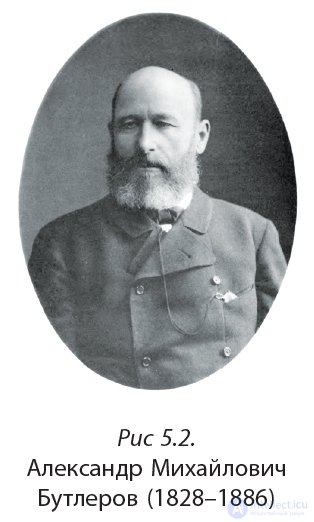
The boiling point of one of these substances is –0,5 °C, while the boiling point of the other is more than 11 °C lower, at –12 °C. The accumulation of such facts, inexplicable at the time, became the impetus for creating a new theory — the theory of the structure of organic compounds. Its main principles were formulated in the middle of the 19th century by A. M. Butlerov.
By that time it was known that molecules consist of atoms, but scientists did not yet attach importance to how the atoms were arranged within a molecule, and considered it impossible to determine this. A. M. Butlerov suggested that the atoms in a molecule are joined in a specific sequence, which can be established by chemical methods and represented in a structural formula.
Let us state the most important principles of A. M. Butlerov's theory of the structure of organic compounds:
This theory paved the way for the widespread use of structural formulas to represent the structure of organic substances.
Let us use the principles of A. M. Butlerov's theory to explain the contradictions described in Examples 1 and 2.
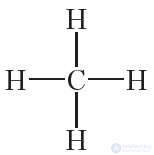
Let us first explain the structure of the molecules of the simplest hydrocarbons. Given that the valence of carbon is four and the valence of hydrogen is one, the structural formula of methane CH4 is as follows:
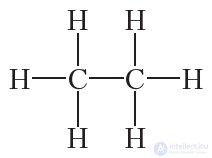
In the ethane molecule C2H6, all the carbon and hydrogen atoms are part of a single particle. For this, the two carbon atoms must form a chemical bond with each other. Each carbon atom uses its remaining three valence units to bond with three hydrogen atoms. The structural formula of ethane is then:
Similar reasoning for propane C3H8 leads to the structural formula:
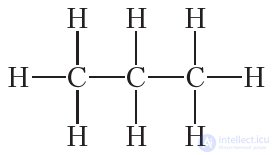
As can be seen, carbon is tetravalent in all of these hydrocarbons. Let us now consider what effect the sequence of atom bonding in a molecule has on the properties of substances, using as an example a compound with the molecular formula C4H10. Two chains of four carbon atoms can be constructed: a linear one and a branched one:
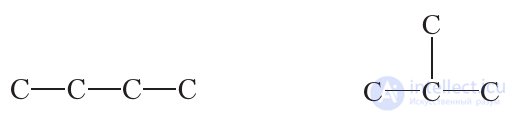
Thus, two substances have the molecular formula C4H10:
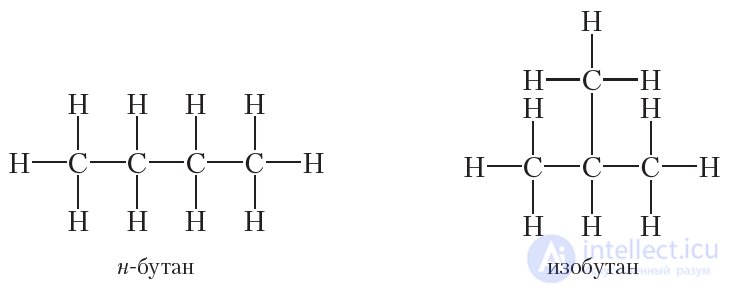
Since n-butane (n — short for normal) and isobutane are different substances, they must have different properties. Indeed, the boiling point of n-butane is –0,5 °C, while the boiling point of isobutane is –12 °C. Thus, Butlerov's theory made it possible to explain why compounds with an entirely identical composition can have different properties. Substances whose molecules have the same qualitative and quantitative composition but a different structure are called isomers.
The further development of science has only supplemented and refined A. M. Butlerov's theory, showing its validity not only for organic but also for inorganic compounds. Structural formulas, first proposed by A. M. Butlerov, are still successfully used today to represent the structure of molecules of both organic and inorganic compounds.
The significance of the theory lies in the systematization of a vast body of factual material, which made possible the targeted synthesis of new substances with predetermined properties.
|
Organic chemistry is the chemistry of carbon compounds. Organic compounds form the basis of living organisms. A. M. Butlerov's theory of the structure of organic compounds is based on the idea that the properties of substances are determined not only by their composition but also by the sequence in which atoms are joined in the molecule. Molecules of different substances can have the same composition but a different sequence of atom bonding within the molecule. |
1. Atoms of which element are present in the composition of all organic substances?
2. What is the essence of the theory of the «vital force»? Name the scientists who made a significant contribution to the development of organic chemistry.
3. How can the presence of carbon and hydrogen atoms in the molecules of organic compounds be proven?
4. State the most important principles of the theory of the structure of organic substances. Is this theory valid for inorganic compounds?
5. List the basic principles of the structure of the molecules of organic compounds. What is the valence of carbon atoms in organic substances?
6. Which type of chemical bond predominates in the molecules of organic compounds?
7. When the gaseous products of the complete oxidation of an organic substance weighing 0,508 g were passed through an excess of limewater, 3,600 g of precipitate was obtained. Calculate the mass fraction (%) of carbon in the organic substance.

Comments