
Lecture
Many chemical properties of alcohols are determined by the presence of a hydroxyl group in their molecules, so the hydroxyl group is called functional.
Let us consider the chemical properties of saturated monohydric alcohols.
1. Reaction with alkali metals
If a piece of sodium is placed in a beaker of ethanol, a vigorous reaction begins, accompanied by the release of hydrogen:

In this reaction, the hydrogen atom of the hydroxyl group is replaced by a metal atom.
Other alcohols react with sodium in the same way. Let us give the equation for the reaction of propan-1-ol with sodium:

When reacting with active metals, alcohols exhibit acidic properties. The acidic properties of alcohols are very weak (weaker than those of water!), so alcohols do not change the color of indicators, do not react with alkalis and can only react with the most active metals, such as the alkali metals sodium and potassium.
The products formed when the hydrogen atom of an alcohol's hydroxyl group is replaced by a metal atom are called alkoxides. Let us give the names of some alkoxides:

Alkoxides are solid, salt-like substances. They decompose in water to form an alcohol and an alkali:

2. Reaction with hydrogen halides
Alcohols react with hydrogen halides (HCl, HBr, HI). At this the hydroxyl group is replaced by a halogen. Let us give the equation for the reaction of ethanol with hydrogen bromide:
Other alcohols react with hydrogen halides in the same way. For example, when propan-2-ol reacts with hydrogen chloride, the hydroxyl group is replaced and 2-chloropropane is formed:
3. Dehydration. Elimination of water
When heated with strong dehydrating agents, such as concentrated sulfuric acid, alcohols eliminate a molecule of water. The reaction of eliminating a water molecule is called the reaction of dehydration (§ 16).
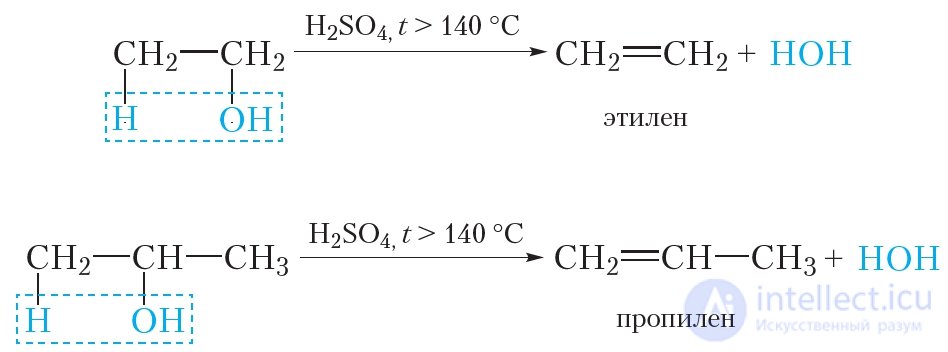
In these reactions, one molecule of water is eliminated from one molecule of alcohol. Such a reaction is called intramolecular dehydration. As a result of the intramolecular dehydration of alcohols, alkenes are formed.
With less intense heating, one molecule of water can be eliminated from two molecules of alcohol:
This reaction is called intermolecular dehydration.
As a result of the intermolecular dehydration of alcohols, ethers are formed. The structure of ethers can be expressed by the following formula: R—O—R'. The hydrocarbon radicals in an ether molecule can be the same or different. Ethers are isomeric with alcohols (§ 22).
The product of the intermolecular dehydration of ethanol — diethyl ether — is a colorless liquid with a distinctive odor and a low boiling point (tb.p. = 35 °C). It is used in medical practice for anesthesia and for disinfecting skin during injections.
Let us give the equation for the intermolecular dehydration of methanol:

This produces dimethyl ether — a substance that is gaseous under normal conditions with a boiling point of –25 °C.
Note that the boiling points of ethers are much lower than those of the isomeric alcohols. Figure 24.1 shows ball-and-stick models of the molecules of ethanol and dimethyl ether and gives their boiling points.
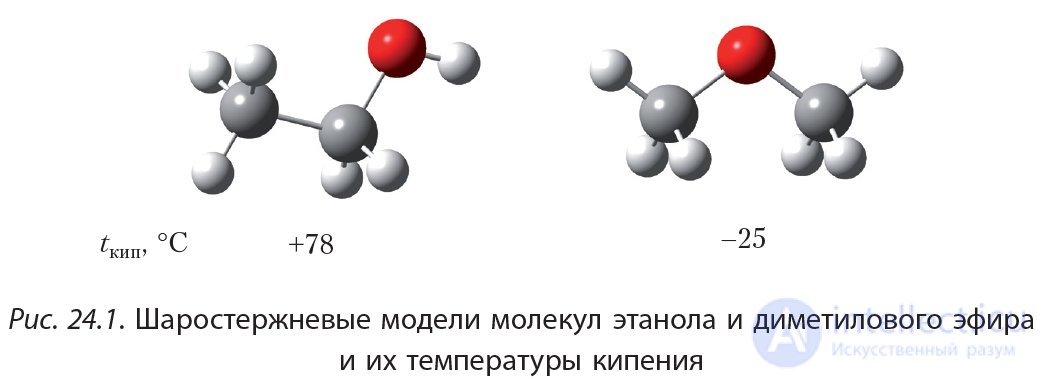
Ethanol and dimethyl ether are isomers, and their molecules are approximately the same size, so one might expect their boiling points to be close. Nevertheless, the boiling point of ethanol is more than 100° C higher than that of dimethyl ether. Recall that the high boiling points of alcohols are explained by the formation of hydrogen bonds between their molecules. A hydrogen bond forms between the hydrogen atom of the hydroxyl group of one alcohol molecule and the oxygen atom of another molecule. No hydrogen bonds form between molecules of ethers, since ether molecules contain no hydroxyl groups.
4. Oxidation
Alcohols burn when ignited, as we can see by lighting a spirit lamp:

This produces carbon dioxide and water. Such a reaction is called complete oxidation.

Video 24.1.
Oxidation of ethanol
by copper(II) oxide
Incomplete oxidation of alcohols is also possible. It can be carried out as follows. Heat a copper wire in the flame of a spirit lamp until it glows red. The shiny surface of the wire will then become coated with a black layer of copper(II) oxide as a result of the oxidation of the copper:
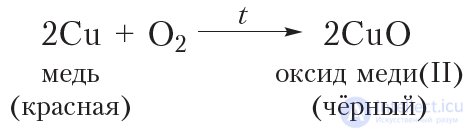
After that, quickly place the glowing wire into a beaker containing a small amount of ethanol. The wire becomes shiny again (video 24.1). This shows that the black copper(II) oxide has been converted back into copper. In other words, the copper(II) oxide has been reduced. The reducing agent is the ethanol. In the course of the reaction, it is oxidized to acetaldehyde: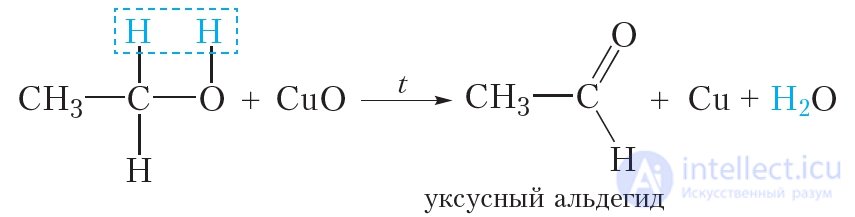

* Oxidation
of secondary alcohols
Acetaldehyde has an apple-like smell, which can be detected when carrying out the experiment described above.
You can learn about the oxidation of secondary alcohols by following the link in the QR code.
You already know some reactions that produce alcohols (§ 15).
1. Hydration of alkenes
Alcohols are formed by the addition of water to alkenes. This reaction is called the hydration reaction:
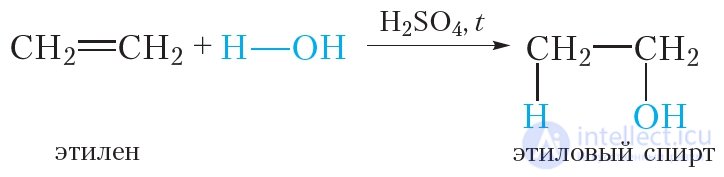
2. Reaction of haloalkanes with an aqueous alkali solution
Alcohols can be obtained from haloalkanes by treating them with an aqueous alkali solution:

In this reaction, the halogen atom is replaced by a hydroxyl group. In turn, halogen derivatives of alkanes can be obtained from hydrocarbons. For example, chloroethane is formed by the reaction of ethane with chlorine: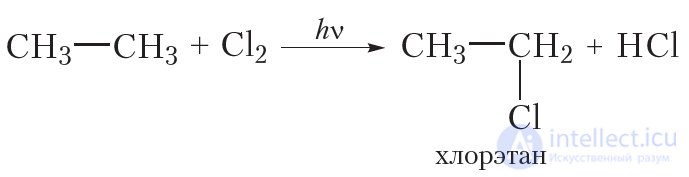
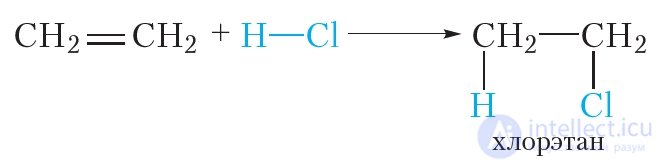
Chloroethane can also be obtained from ethylene by adding hydrogen chloride to it:

* Industrial
production of methanol
Thus, alcohols can be synthesized using hydrocarbons as starting materials.
Methanol and ethanol are used as solvents. In addition, they are used in the chemical industry as reagents for obtaining many organic substances. Ethanol is used in the food industry.
|
Alcohols react with alkali metals, whereby the hydrogen atom of the hydroxyl group is replaced by a metal atom. Alcohols react with hydrogen halides, whereby the hydroxyl group is replaced by a halogen. Alcohols undergo intramolecular and intermolecular dehydration reactions, forming alkenes and ethers. Alcohols undergo oxidation reactions. Complete oxidation of alcohols produces carbon dioxide and water. Incomplete oxidation of primary alcohols can produce aldehydes. Alcohols are obtained by the reaction of haloalkanes with an aqueous alkali solution and by the addition of water to alkenes. |
Oxidation of primary alcohols produces aldehydes. Let us give the scheme for the oxidation reaction of ethanol:
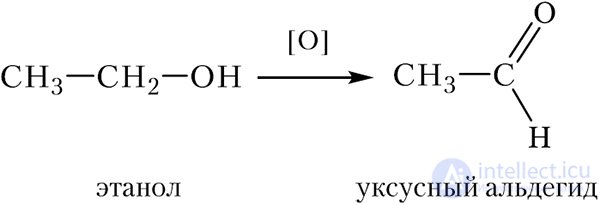
In organic chemistry, the symbol for oxygen in square brackets [O] is often used in the schemes of oxidation processes. The oxidizing agents can be various substances; in the case of alcohol oxidation, this is usually a chromic mixture (a mixture of potassium dichromate K2Cr2O7 and concentrated sulfuric acid).
Oxidation of secondary alcohols produces ketones; for example, the product of the oxidation of propan-2-ol is acetone:
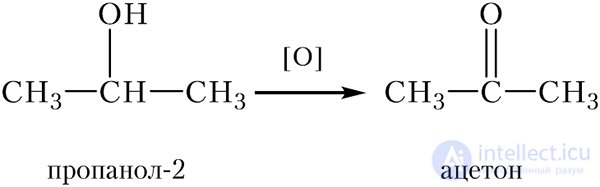
Oxidation of tertiary alcohols proceeds under harsh conditions. In this case, the carbon skeleton of the molecule is destroyed.
Unlike ethanol, methanol cannot be obtained by hydration of an alkene. Methanol used to be produced by heating wood without access to air, the so-called dry distillation of wood, hence its trivial name — wood alcohol. The modern method of industrial methanol production is the reaction of carbon(II) oxide with hydrogen. The reaction is carried out at high pressure (10 MPa) and a temperature of 250 °C in the presence of catalysts based on zinc and copper oxides:

Recall that a mixture of carbon(II) oxide and hydrogen is called synthesis gas.
1. Write the equation for the reaction of propan-2-ol with sodium. What volume (at STP) of hydrogen will be released when 1,2 g of sodium is dissolved in excess propan-2-ol?
2. Write the equations for the reactions of: a) ethanol with hydrogen iodide; b) propan-2-ol with hydrogen bromide; c) 2-methylpropan-2-ol with hydrogen chloride. Name the resulting halogen derivatives using IUPAC nomenclature.
3. Write the equations for the reactions that can be used to obtain methanol from methane.
4. Suggest two ways of obtaining ethanol from ethane.
5. Given the reagents: sodium, hydrogen bromide, potassium hydroxide, bromine water. Which of these substances react with ethanol? Write the equations for the reactions.
5. A volume of 50 cm3 of ethanol was mixed with concentrated sulfuric acid and heated to 150 °C. This released a volume of 5,3 dm3 of ethylene (at STP). Calculate what fraction (%) of the ethanol underwent intramolecular dehydration. The density of ethanol is 0,79 g/cm3.
6. What volume of ethanol can be obtained by hydration of 100 m3 (at STP) of ethylene if the yield of the reaction product is 95 %? The density of ethanol is 0,79 g/cm3.
7*. Write reaction schemes that can be used to obtain the following from ethanol: a) bromoethane; b) acetylene; c) benzene; d) ethylene glycol.

Comments