
Lecture
In studying carboxylic acids, we became acquainted with the esterification reaction — the formation of an ester through the reaction of a carboxylic acid with an alcohol:
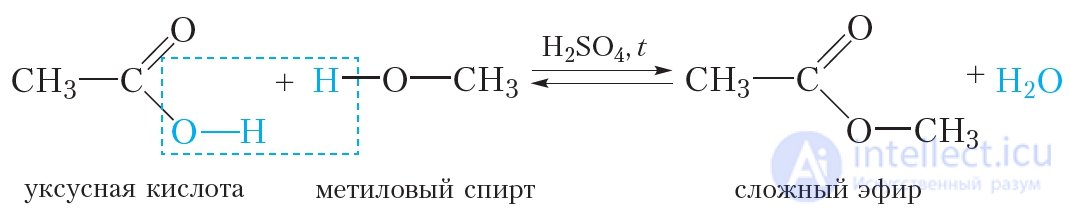
The name of an ester is formed from the names of the alcohol and the acid from which it is derived. For example, the ester shown above was formed from methyl alcohol and acetic acid, so its name is methyl ester of acetic acid. There is another way of constructing the names of esters. In this case, one starts from the name of the corresponding acid residue (Table 33.1) and the radical attached to it. In the ester shown above, the residue of acetic acid (acetate) is attached to a methyl radical. Such an ester is called methyl acetate.
Let us consider another example. Let us name the following ester: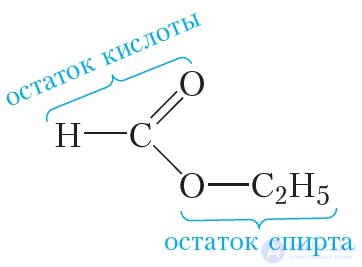
As can be seen, this ester is formed from the residues of ethyl alcohol and formic acid. The name of this ester is ethyl ester of formic acid, or ethyl formate.
Esters of the simplest carboxylic acids and alcohols are liquids that often have a pleasant fruity or floral smell.
For example, the pentyl ester of acetic acid has the smell of pears, the pentyl ester of butanoic acid has the smell of apricots, the butyl ester of butanoic acid has the smell of pineapples, and so on. Indeed, the pleasant smells of flowers and fruits are often due to the esters present in them.
Esters are prepared by the esterification reaction already familiar to you. For example, the ethyl ester of acetic acid can be obtained from ethanol and acetic acid:

Sulfuric acid acts as a catalyst. Concentrated (practically water-free) solutions of ethyl alcohol, acetic acid, and sulfuric acid are used to carry out this reaction. As a result of heating the mixture of starting substances, the ester is removed from the reaction mixture in the form of a vapor and then condenses in a receiving test tube: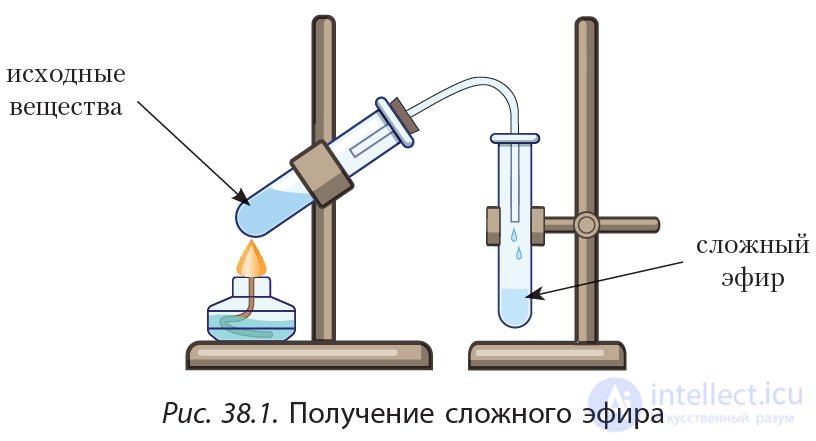
The removal of the ethyl ester of acetic acid from the reaction mixture is explained by the fact that, among all the substances participating in the reaction, the ethyl ester of acetic acid has the lowest boiling point, tb = 77 °C. The comparatively low boiling point of the ester is due to the fact that its molecule lacks polar —OH groups, so hydrogen bonds cannot form between ester molecules. The molecules of water, ethanol, acetic acid, and sulfuric acid contain —OH groups, so these substances have hydrogen bonds, and their boiling points are higher than that of the ethyl ester of acetic acid.
Acid hydrolysis
An important chemical property of esters is their reaction with water in the presence of sulfuric acid, leading to the formation of a carboxylic acid and an alcohol. This reaction is called acid hydrolysis of an ester:
As can be seen, the hydrolysis reaction of an ester is the reverse of the esterification reaction. Whereas concentrated (practically water-free) solutions of the starting substances are used to carry out the esterification reaction, hydrolysis, by contrast, is carried out in an excess of water.
Alkaline hydrolysis
In order to prevent the reverse reaction — the reaction of the resulting alcohol and acid to form an ester — hydrolysis can be carried out in the presence of an alkali (alkaline hydrolysis). In this case, the alkali converts the carboxylic acid into a salt, thereby eliminating the possibility of the reverse reaction occurring:
Owing to their pleasant smell, esters are used in the production of fruit-flavored beverages, confectionery, and cosmetics. Some esters, such as the ethyl ester of acetic acid, are used as solvents.
The synthetic fiber Lavsan is an ester of polymeric structure. It is obtained through the reaction of terephthalic acid and ethylene glycol:
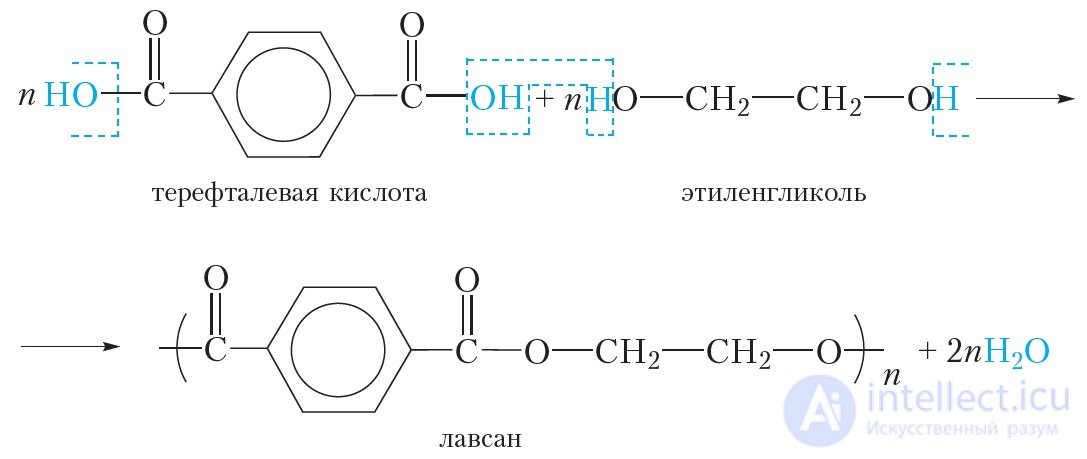 As can be seen, these substances react with each other through a repeatedly recurring esterification reaction, resulting in the formation of Lavsan macromolecules and a low-molecular-weight by-product — water. Recall that processes in which a high-molecular-weight compound and a low-molecular-weight by-product are formed from low-molecular-weight substances are called polycondensation (§ 30). Since Lavsan is the product of a repeatedly recurring esterification reaction, it can be called a polyester, and therefore Lavsan belongs to the synthetic polyester fibers. In our country, Lavsan is produced at OJSC «Mogilevkhimvolokno».
|
Esters are formed by the reaction of carboxylic acids with alcohols — the esterification reaction. The names of esters are formed from the names of the alcohol and the acid from which they are derived. Esters of the simplest carboxylic acids and alcohols are liquids with pleasant smells. Esters react with water to form the corresponding carboxylic acid and alcohol. The synthetic polyester fiber Lavsan is obtained through a polycondensation reaction between terephthalic acid and ethylene glycol.
|
1. Identify the ball-and-stick model of the methyl ester of formic acid:
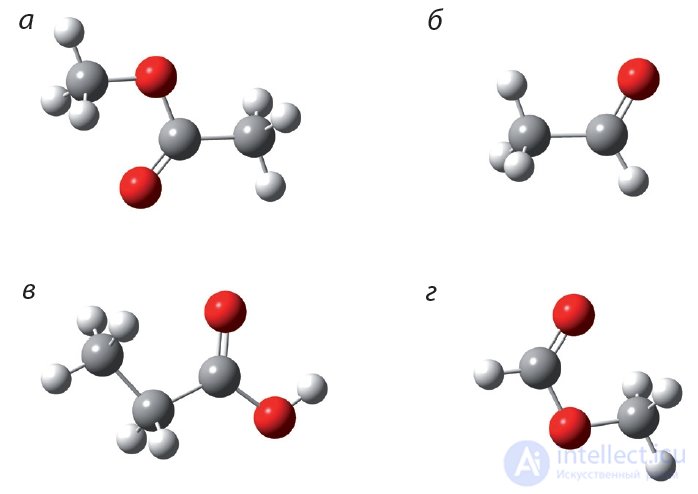
2. Write the equation of the esterification reaction between formic acid and ethyl alcohol. Name the resulting ester.
3. Write the structural formulas of the methyl ester of formic acid, the ethyl ester of formic acid, and the methyl ester of acetic acid. Which of these substances are isomers?
4. Calculate the mass of the ethyl ester of acetic acid that can be obtained from the reaction of 30 g of acetic acid with 40 g of ethyl alcohol, if the yield of the reaction product is 75%.
5*. The structural formula of a polymer macromolecule obtained as a result of a polycondensation reaction can be represented as follows:
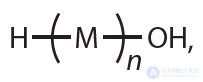
where M is the structural unit of the polymer, n is the number of monomer residues in the macromolecule, and H— and —OH are the terminal groups of the macromolecule.
As a result of the reaction of ethylene glycol with terephthalic acid, a polymer was formed in which the number of residues of both monomers is the same. Determine the average number of ethylene glycol residues in the macromolecule, given that the mass of ethylene glycol that reacted is 1,86 g, and the mass of water formed is 1,0567 g.
6*. How can ethyl acetate be obtained from ethylene? Write the equations of the reactions.
7*. How can the ethyl ester of acetic acid be obtained from calcium carbide and inorganic substances? Write the equations of the reactions.
8*. Burning 740 mg of an organic substance in excess oxygen produced 540 mg of water and 672 cm3 of carbon dioxide (STP). It is known that this organic substance is a colorless liquid with a pleasant smell, and in the presence of an alkali it undergoes hydrolysis, producing two organic substances.
a) Determine the structural formula of this organic substance. Write the equation of its hydrolysis reaction in the presence of an alkali. This organic substance has an isomer that is a colorless liquid with a pungent smell, which turns litmus solution pink.
b) Write the structural formula and name of this isomer, and the equation of its reaction with baking soda.
(Answer:
a) The simplest formula is C3H6O2.
This simplest formula corresponds to ethyl formate HCOOC2H5.
b) Its isomer possessing acidic properties is acetic acid.)

Comments