
Lecture
Alkenes are chemically more reactive substances than alkanes, so their content in natural sources of hydrocarbons (petroleum and natural gas) is low.
The main application of alkenes — obtaining polymers by means of the polymerization reaction. Industrial production of alkenes and polymers based on them occupies an important place in the economy of many countries. In our country, polyethylene and polypropylene are produced in Novopolotsk (OAO «Naftan»).
Let us consider the methods of obtaining ethylene and other alkenes.
1. Dehydration of alcohols
Alkenes can be obtained as a result of the elimination of water from alcohols. The reaction of elimination of a water molecule is called the reaction of dehydration (the prefix de- means elimination).
Ethylene is formed as a result of the dehydration reaction of ethyl alcohol. To do this, a mixture of ethyl alcohol and concentrated sulfuric acid is heated in a test tube with a gas outlet tube (see video 15.1). In the process, a water molecule is eliminated from the alcohol molecule and ethylene is formed. Reaction equation:

The ethylene released is easily detected using qualitative reactions for alkenes. If ethylene is passed through bromine water or a dilute aqueous solution of potassium permanganate, they become decolorized.
In the previous section, we studied the reverse reaction — the addition of water to an ethylene molecule with the formation of ethyl alcohol. The catalyst for both the forward and the reverse reaction is sulfuric acid, but the conditions under which they proceed are different. For the dehydration reaction to proceed, a higher temperature and concentrated (practically water-free) sulfuric acid are required. For the hydration reaction of alkenes, an excess of water is used. Recall that the conditions under which a reaction proceeds are conventionally indicated above the arrow in the reaction equation. From the example given, it is clear that, depending on the conditions, the reaction can proceed in either the forward or the reverse direction. Therefore, the conditions under which chemical reactions proceed must always be indicated.
2. Dehydrohalogenation of halogenated alkane derivatives
Dehydrohalogenation is the name given to the reaction of elimination of hydrogen halides from molecules of organic substances. This method can be used to obtain alkenes from halogenated alkane derivatives. Under the action of an alcoholic alkali solution, a hydrogen halide molecule is eliminated from the halogenated derivative molecule and an alkene is formed:

 You can learn about other methods of obtaining alkenes by following the link in the QR code.
3. Dehydrogenation of alkanes
Dehydrogenation is the name given to the reaction of elimination of a hydrogen molecule (H2) from an organic substance. Two hydrogen atoms are eliminated from two adjacent carbon atoms, forming an alkene. The equation for the dehydrogenation reaction of ethane:
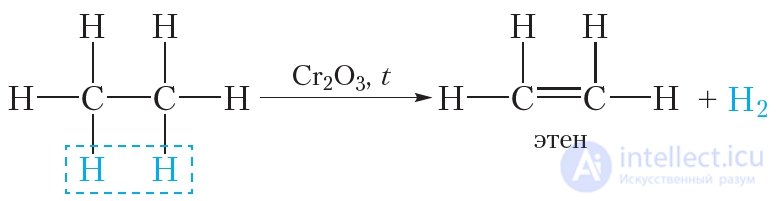
Recall that the conditions under which a reaction proceeds are conventionally indicated above the arrow in the equation. Most organic reactions cannot proceed under ordinary conditions, so the conditions under which they proceed must always be indicated! Thus, the dehydrogenation reaction of alkanes proceeds at a temperature of about 500 °C and on a Cr2O3 catalyst. In the previous section, we studied the reverse reaction — the addition of hydrogen to ethylene. Recall that the reverse reaction — hydrogenation of alkenes, proceeds on a platinum or nickel catalyst at 100–200 °C.
Let us consider the dehydrogenation of other alkanes. In the case of propane, the reaction proceeds according to the equation:

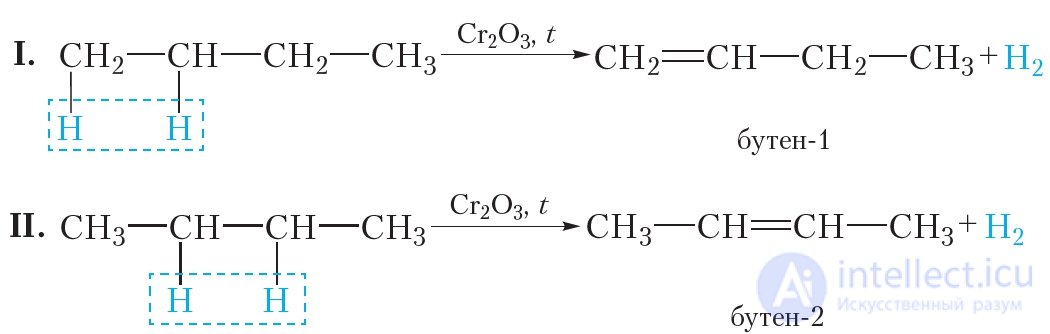
In this case, only one alkene can be formed — propene. Dehydrogenation of butane produces a mixture of alkenes:
Alkenes are also obtained through petroleum refining. You will learn about this topic later.
The main application of alkenes — obtaining polymers. Polyethylene and polypropylene are obtained from ethylene and propylene, from which the most diverse products used in everyday life and industry are manufactured.
Ethyl alcohol is obtained by the hydration reaction of ethylene.
Addition of chlorine to ethylene produces 1,2-dichloroethane, which is used as a solvent: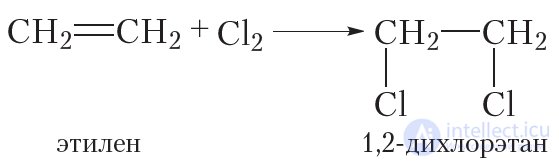
Ethylene accelerates the ripening of various fruits (pears, melons, tomatoes, etc.). For better preservation, fruits can be transported unripe and brought to ripeness on site by introducing ethylene into the air of storage facilities.
In addition, alkenes are used for the synthesis of various organic substances.
Interesting to know
Apples release ethylene during storage, so to speed up the ripening of certain fruits, such as bananas, a few pieces of apple are placed in the container where they are stored. Try this experiment at home with green bananas.
|
Unlike alkanes, the content of alkenes in natural sources is low, so they must be obtained by means of chemical reactions. Alkenes are obtained by dehydration of alcohols, dehydrohalogenation of halogenated alkane derivatives, and dehydrogenation of alkanes. Alkenes are used as monomers in the production of polymers and for the synthesis of various organic substances. |
In the laboratory, alkenes can be obtained by heating dihalogenated alkane derivatives with zinc:

Note that the halogen atoms must be located on adjacent carbon atoms. Since a halogen molecule is eliminated from the organic substance molecule as a result of the reaction, such a reaction is called a dehalogenation reaction.
Another method of obtaining alkenes is the hydrogenation of hydrocarbons whose molecules contain a triple bond C  C. If the hydrogenation process is carried out using ordinary catalysts, such as palladium, the resulting alkene readily adds hydrogen to form an alkane. To prevent this from happening, the activity of the catalyst is reduced by treating it with a lead salt. Compounds that reduce the activity of catalysts are called catalytic poisons, and the catalyst itself is said to be «poisoned». Scheme of the hydrogenation reaction of acetylene on a «poisoned» catalyst:

1. Write the equations for the reactions used to obtain: a) ethylene from ethyl alcohol; b) propylene from 2-bromopropane; c) propylene from propane. Indicate the conditions under which these reactions proceed. All of the reactions listed can be carried out in the reverse direction. Write the equations for the reverse reactions and indicate the conditions under which they proceed.
2. Propose two methods of obtaining chloroethane from ethylene. Write the equations for the reactions taking place.
3. How many alkenes can be obtained by dehydrogenation of 2-methylbutane? Write the equations for the reactions and indicate the conditions under which they proceed.
4. Complete combustion of hydrocarbon A produced 27 g of water and 33,6 dm3 (STP) of carbon dioxide gas.
a) Determine the simplest formula of hydrocarbon A.
b) By passing this hydrocarbon in a mixture with excess hydrogen over a nickel catalyst with heating, hydrocarbon B was obtained, having a density of 1,964 g/dm3 (STP).
Derive the molecular formulas of hydrocarbons A and B.
5. Hydrogenation of alkene X produces an alkane which, upon chlorination, can yield only two isomeric monochloro-substituted substances. The reaction of alkene X with bromine water produces a substance of composition C6H12Br2, having a symmetric structure. Give the structural formula of alkene X and write the equations for all the reactions taking place.
6. An alkane and an alkene contain the same number of carbon atoms in their molecules. The mass fraction (%) of hydrogen in the alkane is 2,38 units greater than in the alkene. Determine the molecular formula of the alkene.
7. Calculate the mass of polyethylene that can be obtained from 200 m3 (STP) of ethane, if the yield of the dehydrogenation reaction product is 96 %, and of the polymerization reaction is 98 %.
8. Write the equations for the reactions by which the following transformations can be carried out:


Comments