
Lecture
As you already know, the benzene molecule contains a stable conjugated system of π-bonds. Therefore, substitution reactions are characteristic of benzene, since the conjugated system is preserved in these reactions. In contrast, addition reactions are not very characteristic of benzene. For example, benzene does not decolorize bromine water, but in the presence of a catalyst it undergoes a substitution reaction with bromine.
1. Halogenation
To carry out this reaction, benzene is mixed with bromine in a flask and the catalyst FeBr3 is added. This proceeds as a substitution reaction of one hydrogen atom by bromine:
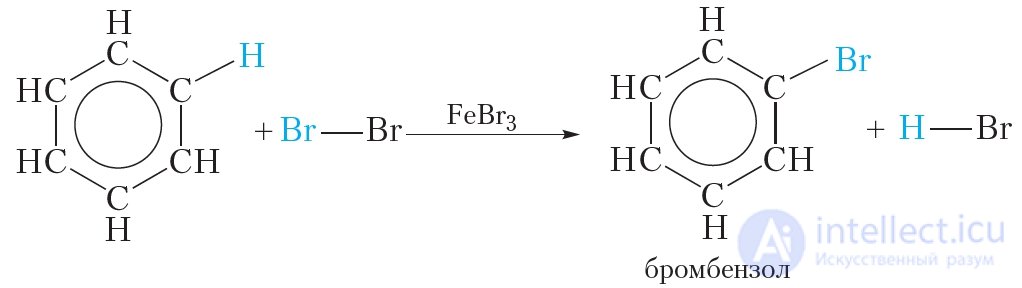
The progress of the reaction can be judged by the evolution of hydrogen bromide, which changes the color of a moist indicator paper placed in the upper part of the flask. The product of the bromination of benzene is called bromobenzene.
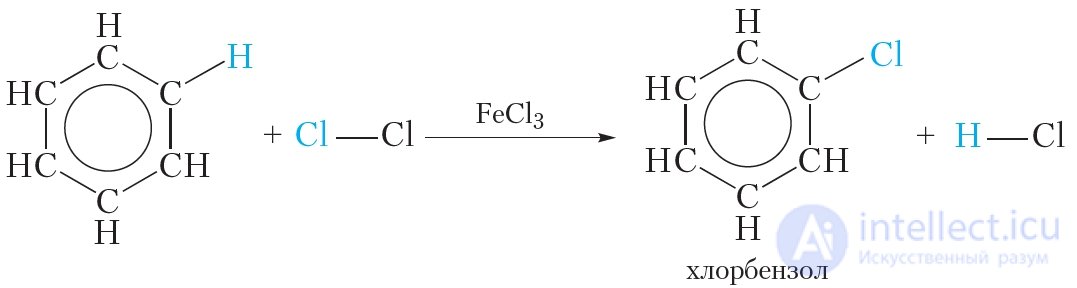
As can be seen, in this reaction the unified system of π-electrons is preserved. The chlorination of benzene is carried out in a similar way:
This is the name given to reactions in which a — NO2 group, called a nitro group, is introduced into the molecule of an organic compound.
If benzene is added to a mixture of concentrated nitric and sulfuric acids, the nitration reaction of benzene occurs, producing a heavy yellowish liquid with the smell of bitter almonds — nitrobenzene:
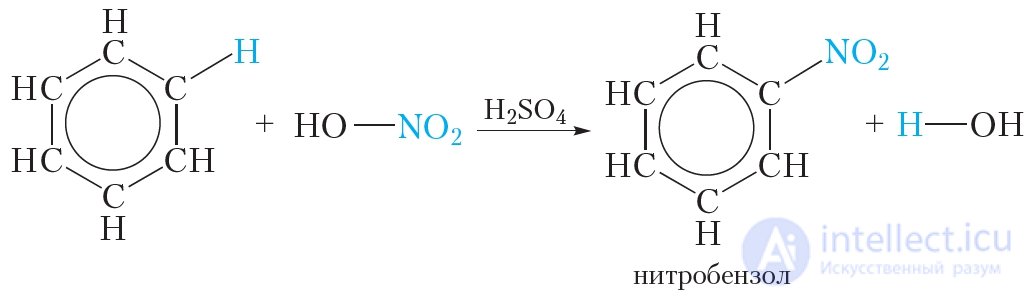
 This reaction, just like halogenation, is a substitution reaction — one hydrogen atom in the benzene molecule is replaced by a — NO2 group.
A mixture of concentrated nitric and sulfuric acids is called a nitrating mixture. In the nitrating mixture, nitric acid acts as the nitrating reagent, while sulfuric acid serves as the catalyst.
You can learn about the nitration of the benzene homologue toluene, the product of which is an explosive substance, by following the link in the QR code.
3. Hydrogenation
Under harsh conditions, benzene can undergo addition reactions. An example of an addition reaction involving benzene is its hydrogenation, which proceeds at a temperature of about 200 °C under pressure in the presence of hydrogenation catalysts (nickel or platinum). In this process, one molecule of benzene adds three molecules of hydrogen at once and is converted into cyclohexane:
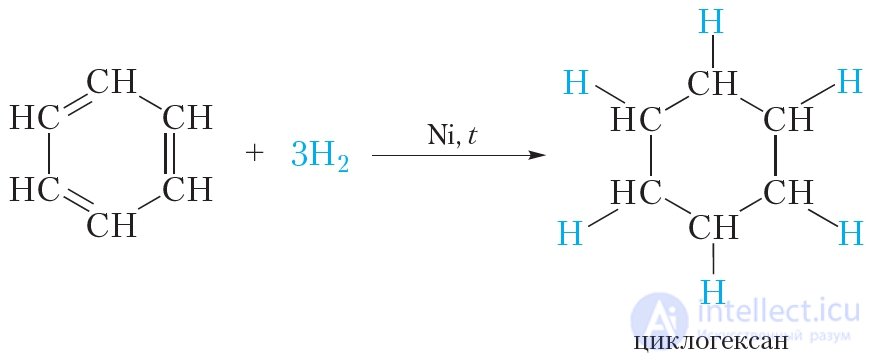
 The hydrogenation of benzene proceeds under harsher conditions than the hydrogenation of alkenes, because during hydrogenation the stable conjugated system of π-bonds in the benzene molecule is destroyed.
You can learn about the addition reaction of chlorine to benzene by following the link in the QR code.
4. Combustion
Like all hydrocarbons, benzene burns. The equation for the combustion reaction of benzene:
From Natural Sources
Thanks to the high stability of the conjugated system of p-bonds, aromatic fragments are found as part of coal. Therefore, one of the methods for producing benzene is the processing of coal. Under strong heating without access to air, coal undergoes complex chemical transformations. This produces many volatile products, from which, along with other substances, benzene is extracted.
Benzene is also produced as a result of the processing of petroleum. These processes will be discussed in the next section.
From Acetylene
Benzene can be obtained from acetylene:
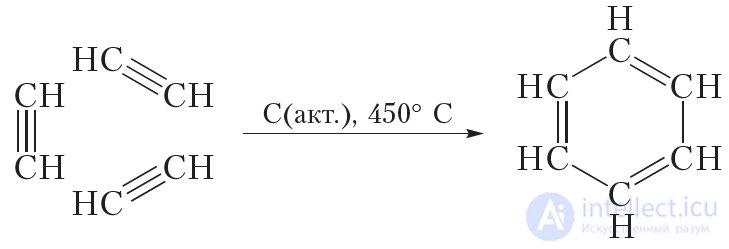
In this reaction, three molecules of acetylene form one cyclic molecule of benzene, which is why this reaction is called a cyclotrimerization reaction. This reaction proceeds by passing acetylene over heated activated carbon.
A significant portion of benzene is used for the synthesis of other substances. For example, nitration of benzene produces nitrobenzene, which is the starting material for the synthesis of aniline (§ 45). Chlorination of benzene produces chlorobenzene, which is used to obtain phenol (§ 27), pesticides, etc. Ethylbenzene is obtained from benzene. Dehydrogenation of ethylbenzene is used to synthesize vinylbenzene (styrene), which serves as a raw material for the production of polymers.
Benzene and some of its homologues are used as solvents for organic substances; however, due to the high toxicity of benzene, its use in this capacity is limited.
|
Substitution reactions, in which the conjugated system of π-bonds is preserved, are characteristic of benzene. Benzene does not decolorize bromine water, but in the presence of a catalyst it undergoes a substitution reaction with bromine to form bromobenzene. Under harsh conditions, benzene undergoes an addition reaction with hydrogen. This produces cyclohexane. Benzene is produced from the processing of petroleum and coal. In addition, benzene can be obtained by the cyclotrimerization reaction of acetylene. |
Nitration of Toluene
An example of a nitro compound with several nitro groups in the molecule is the product of the nitration of the nearest homologue of benzene — toluene. In this process, three hydrogen atoms of the benzene ring are replaced by nitro groups:
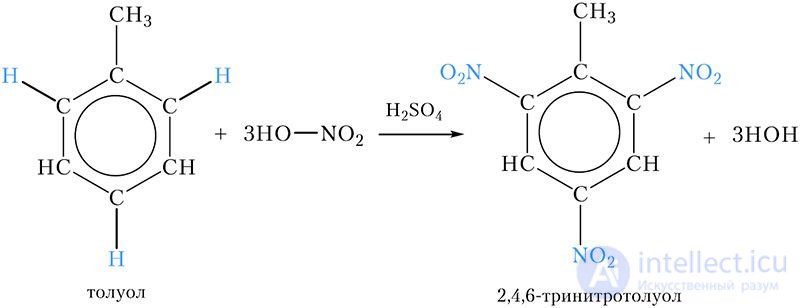
The name of the product is 2,4,6-trinitrotoluene; it is often simply called trinitrotoluene, TNT, or trotyl. Trinitrotoluene is an explosive substance used in industry and in military affairs.
Chlorination of Benzene
The benzene molecule can add three molecules of chlorine. The reaction proceeds under heating and irradiation with ultraviolet light:
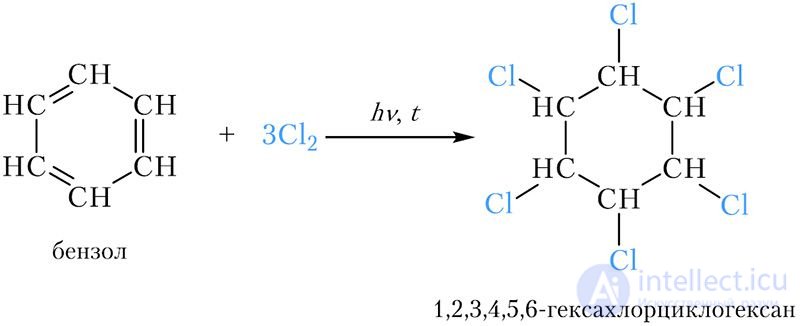
This produces 1,2,3,4,5,6-hexachlorocyclohexane, or hexachlorane. This substance was used for a long time as an insecticide. It is no longer used today due to its high toxicity.
Reactions of Benzene Homologues Involving the Side Chain
Homologues of benzene can undergo substitution reactions in which hydrogen atoms of the side chain are replaced by other atoms. Using this property, benzene and toluene can easily be distinguished. To do this, 2–3 cm3 of benzene and toluene, respectively, are poured into two test tubes, followed by 2–3 cm3 of bromine water. The test tubes are stoppered and shaken. The bromine then passes from the aqueous phase into the organic layer on top, due to its better solubility in hydrocarbons. As a result, the organic layer becomes colored orange. The test tubes are then intensively illuminated for some time. After a few minutes, it can be observed that in one test tube the orange color of the organic layer has been preserved, whereas in the other test tube the organic layer has become decolorized. Decolorization occurred in the test tube with toluene due to a substitution reaction in which a hydrogen atom of the methyl group is replaced by a bromine atom:
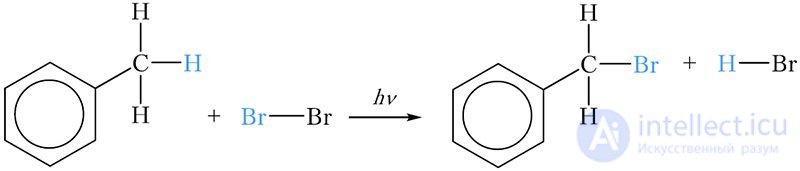
The resulting bromo derivative of toluene is colorless.
This reaction resembles the substitution reaction of hydrogen atoms by halogen atoms in alkane molecules. The reaction proceeds under illumination, which indicates a radical mechanism for the substitution reaction, initiated by light (§ 10).
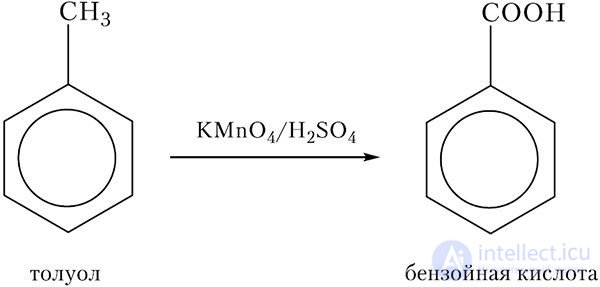
The carbon atom of the methyl group in the toluene molecule is readily oxidized, producing benzoic acid. A solution of potassium permanganate acidified with sulfuric acid, or a chromic mixture (a solution of potassium dichromate K2Cr2O7, acidified with H2SO4), is usually used as the oxidizing agent. The scheme for the oxidation reaction of toluene:
1. How can the three liquids benzene, hexane, and hexene-1 be identified based on their chemical properties? Give the equations for the corresponding reactions. Indicate the conditions under which they proceed. Describe the observed phenomena.
2. Write the equations for the reactions of methane and benzene with chlorine. Indicate the conditions under which they proceed. Why are both reactions called substitution reactions?
3. It is known that in the presence of platinum, ethylene adds hydrogen even at room temperature. Benzene does not add hydrogen under these conditions. The addition reaction of hydrogen to benzene proceeds under harsh conditions — at a temperature of 200 °C under pressure and in the presence of nickel as a catalyst. Explain what accounts for this difference in the reactivity of ethylene and benzene.
4. Give the equation for the cyclotrimerization reaction of acetylene in the presence of activated carbon. What products can be formed by the cyclotrimerization of propyne under similar conditions? Give their structural formulas and names.
5. Write the equations for the reactions by which the following transformations can be carried out

6*. Write the equation for the nitration reaction of toluene. Name the product of the reaction. Where is it used?
7*. Write the equations for the reactions by which the following transformations can be carried out:
heptene-1  heptane toluene 2,4,6-trinitrotoluene.
8*. Write the structural formulas of all the homologues of benzene with the composition C9H12. Name them.
9*. What is the structure of the hydrocarbon with the composition C8H8 that decolorizes bromine water, readily polymerizes, and yields benzoic acid upon oxidation? Write the equations for the reactions described.
(Answer: styrene.)
10*. Determine the structure of the aromatic hydrocarbon with the composition C9H12 that, upon monohalogenation in the presence of a catalyst, yields only one halogen derivative.
(Answer: 1,3,5-trimethylbenzene.)

Comments