
Lecture
Under normal conditions, alcohols are colorless liquids with a characteristic odor. Higher alcohols, whose molecules contain a large number of carbon atoms, — are solid substances resembling paraffin.
Interesting to know
Many alcohols are found in natural objects. For example, the well-known weed hogweed contains methanol; cholesterol, which under improper nutrition is deposited on the walls of blood vessels and impedes blood flow, belongs to the class of alcohols. At the same time, many alcohols have a pleasant smell, for example menthol, found in the leaves, stems, and roots of mint: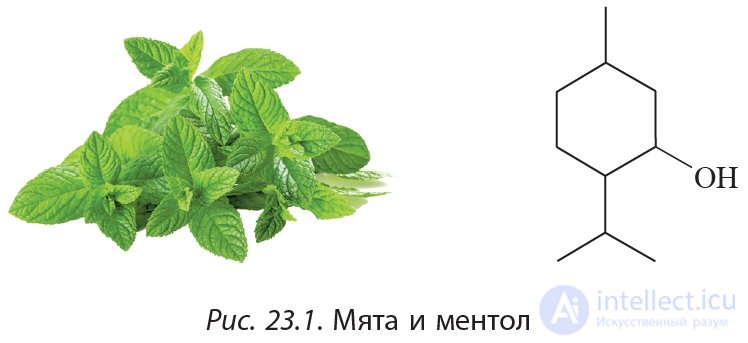 Table 23.1 shows the structural formulas, names, and boiling points of saturated monohydric alcohols.
Table 23.1. Structural formulas, names, and boiling points of saturated monohydric alcohols CnH2n+1—OH
|
Formula |
Name |
tb, °C |
|
CH3—OH |
methanol |
65 |
|
CH3—CH2—OH |
ethanol |
78 |
|
CH3—CH2—CH2—OH |
propanol-1 |
97 |
|
CH3—CH2—CH2—CH2—OH |
butanol-1 |
118 |
|
CH3—CH2—CH2—CH2—CH2—OH |
pentanol-1 |
138 |
From Table 23.1, it can be seen that, unlike hydrocarbons, the homologous series of saturated monohydric alcohols contains no gaseous substances. Even the simplest alcohol — methanol — is a liquid under normal conditions, with a boiling point of 65 °C.
When studying the physical properties of alkanes (§ 8), we saw that their boiling points increase with increasing molecular size. Figure 23.2 shows ball-and-stick models of methane, ethane, and propane molecules and indicates their boiling points:
 The sizes of ethane and methanol molecules are similar, so one might expect these substances to have similar boiling points. Nevertheless, the boiling points of ethane and methanol differ by more than 150 °C and are –89 and +65 °C respectively:
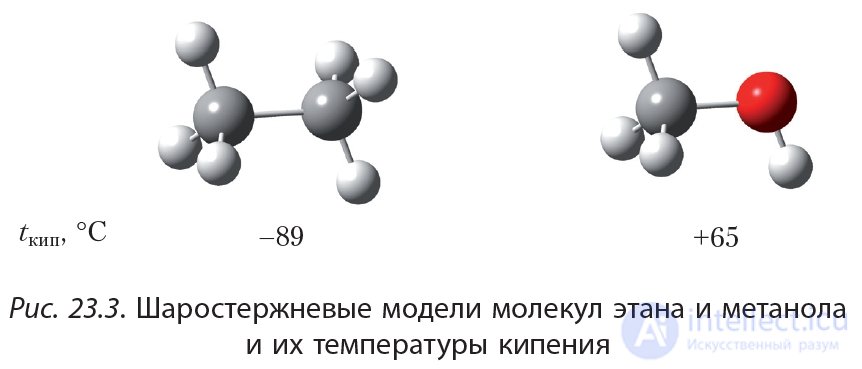 What, then, is the reason for the abnormally high boiling points of alcohols? The explanation for this phenomenon is as follows. The molecules of a liquid are close to one another. This is possible because the molecules attract each other, that is, there are forces that hold the molecules of a liquid together. From the 8th-grade chemistry course, you know that these forces are called forces of intermolecular interaction. To turn a liquid into a gas, the forces of intermolecular interaction must be overcome:
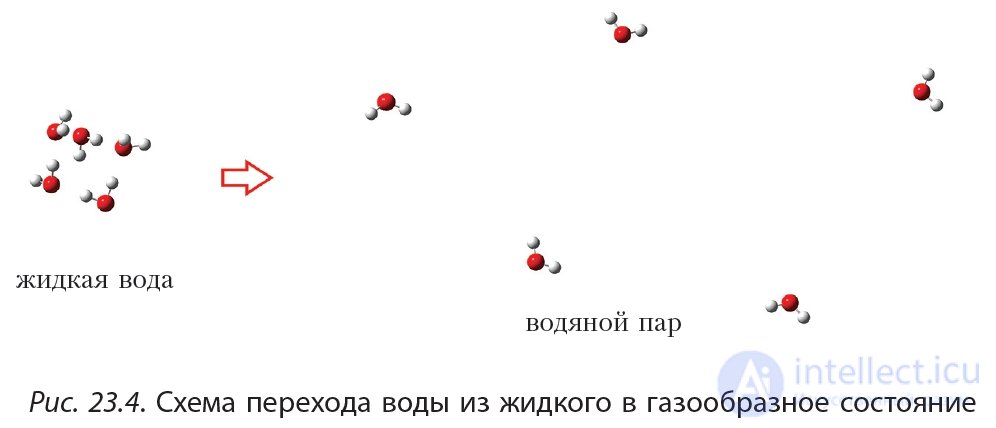 Obviously, the stronger the interaction between the molecules of a substance, the higher its boiling point.
The forces of intermolecular interaction are electrostatic in nature. The interaction will be very weak between molecules that are small in size and whose atoms lack partial electric charges, that is, between small nonpolar molecules.
Example. The boiling points of nitrogen N2 and oxygen O2 are very low and equal –196 and –183 °C respectively. This is explained by the fact that the molecules of these substances are small in size, the bonds in the molecules are nonpolar, there are no partial charges on the atoms, so the molecules attract each other very weakly.
In the series «methane — ethane — propane», as the size of the molecules increases, the area of their contact increases and, consequently, the intermolecular interaction increases (Fig. 23.2). Therefore, in the homologous series of alkanes, the boiling points rise as the number of carbon atoms in the molecule increases.
Intermolecular interaction becomes stronger when polar bonds appear in a molecule. In molecules with covalent polar bonds, the electron density is distributed unevenly. For example, in the hydrogen chloride molecule HCl, the shared electron pair is shifted toward the more electronegative chlorine atom. As a result, a partial negative charge arises on the chlorine atom, and a partial positive charge — on the hydrogen atom (§ 4).
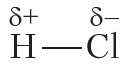
Due to the presence of partial charges, the hydrogen atom of one HCl molecule will be attracted to the chlorine atom of another molecule: The boiling point of hydrogen chloride is –61 °C.
An even stronger interaction exists between alcohol molecules. Let us consider this using methyl alcohol as an example. The hydrogen atom of the hydroxyl group —O—H of the methanol molecule forms a strongly polar bond with the oxygen atom. This is explained by the fact that oxygen — one of the most electronegative elements — is second in electronegativity only to fluorine. Thus, the hydrogen atom, upon bonding with oxygen, is almost completely stripped of its electron cloud. Being small in size and, unlike other atoms, having no inner electron shells, such a hydrogen atom is able to penetrate the electron shells of atoms of other molecules. As a result, a special type of intermolecular interaction arises between methanol molecules — a hydrogen bond: A hydrogen bond is conventionally denoted by a dotted line. Hydrogen bonds hold methanol molecules together quite strongly, so the boiling point of methanol (+65 °C) is significantly higher than the boiling point of ethane (–89 °C), between whose molecules there are no hydrogen bonds, despite the fact that the sizes of the molecules of these substances are similar.
The energy of a hydrogen bond is approximately 10 times less than the energy of a covalent bond, so a hydrogen bond is not conventionally regarded as a separate type of chemical bond. It is a special kind of strong intermolecular interaction.
Alcohol molecules form hydrogen bonds not only with each other, but also with water molecules (Fig. 23.7).

Considering the solubility of alcohols, let us again recall the principle «like dissolves like». Unlike hydrocarbons, alcohol molecules contain a polar —OH group. The polar —OH group gives alcohols solubility in water, whose molecules are polar. The hydrocarbon radical, on the contrary, «hinders» alcohols from dissolving in water: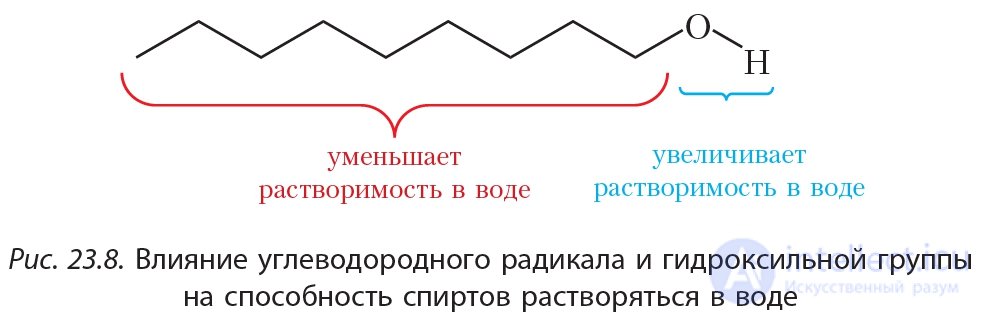
Indeed, methanol, ethanol, and the isomeric propanols mix with water in any proportions; as the number of carbon atoms in the alcohol molecule increases, the solubility in water decreases.
As can be seen, the presence of hydroxyl groups in alcohol molecules gives these substances properties different from those of hydrocarbons. Alcohols have high boiling points, and the lower alcohols are highly soluble in water. The chemical properties of alcohols also have a number of distinctive features, which will be discussed in the next section.|
When a substance passes from the liquid state to the gaseous state, the forces of intermolecular interaction are overcome. Therefore, the stronger the interaction between the molecules of a substance, the higher its boiling point. A hydrogen bond is a special kind of intermolecular interaction. Due to the presence of polar —OH groups, hydrogen bonds form between alcohol molecules, so the boiling points of alcohols are much higher than the boiling points of alkanes with the same number of carbon atoms in the molecules. The polar group —OH gives alcohols solubility in water. Methanol, ethanol, and the isomeric propanols are unlimitedly soluble in water; as the number of carbon atoms in the alcohol molecule increases, the solubility in water decreases. |
1. How does the presence of hydroxyl groups in alcohol molecules affect their physical properties?
2. Why are the boiling points of alcohols much higher than those of hydrocarbons with the same number of carbon atoms in the molecule?
3. Why is the boiling point of dimethyl ether (–25 oC) much lower than the boiling point of ethyl alcohol (78 oC)?
4. Why does the boiling point increase in the series of substances: methanol, ethanol, propanol-1?
5. Explain why, as the number of carbon atoms in alcohol molecules increases, their solubility in water decreases.
6*. One water molecule can form four hydrogen bonds. How many hydrogen bonds can one methanol molecule form?
7*. The molar mass of substances that are low-boiling liquids can be measured using the apparatus shown in the figure:
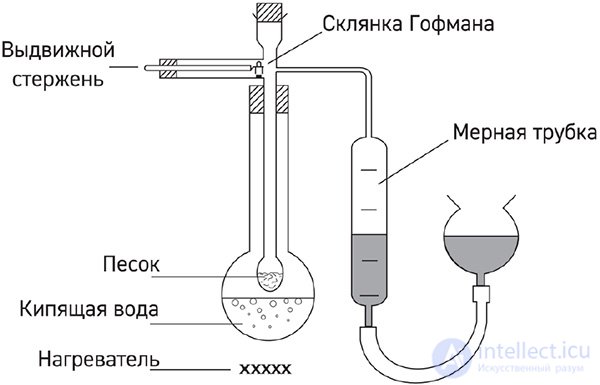
To determine the molar mass of an unknown liquid X, 1,000 g of it was placed into a Hofmann flask (a small glass beaker). After the flask was dropped onto heated sand by means of a sliding rod and substance X had completely evaporated, 760 mL of liquid was displaced from the measuring tube.
a) Based on the results of the experiment described, calculate the molar mass of substance X, given that the density of pentane, measured under the experimental conditions, is 2,554 g/dm3.
b) The value of the molar mass of substance X, determined by other methods, is 32 g/mol. It has been established that the error in determining the molar mass in the experiment described is due to the fact that, in the vapor, substance X is partially dimerized. Using the correct value of the molar mass and the results obtained in part a), calculate how many molecules of X2 there are for every 100 molecules of X in the vapor.
c) Propose a possible structure for substance X and explain the reason for its dimerization.
(Answer:
a) M = m/n = 1,47/0,0396 = 37,1 g/mol.
b) There are 18,6 or 19 molecules of dimer for every 100 molecules of monomer.
c) Substance X is methanol, which is partially dimerized in the vapor due to the formation of hydrogen bonds between molecules.)

Comments