
Lecture
In the previous section we examined the types of structural isomerism of alkenes — isomerism of double bond position and isomerism of the carbon skeleton. In addition to structural isomerism, alkenes can also exhibit spatial isomerism. This is because alkene molecules, even when they have the same sequence of atom connections and the same position of the double bond, can differ in the arrangement of atoms in space.
As we already know, in alkane molecules rotation around single carbon-carbon bonds occurs easily (lab experiment 1). Because of this, the carbon chain can take on various spatial forms. For example, for the molecule of n-butane:
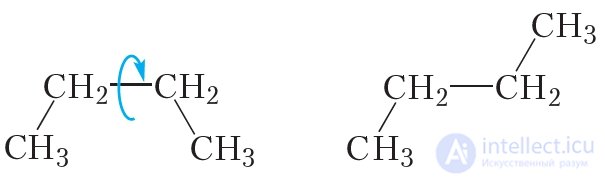
In one organic chemistry textbook, the collection of alkane molecules was compared to a cluster of continuously wriggling worms.
The situation is different in the case of alkenes. Let us consider the structure of the butene-2 molecule:

The carbon atoms joined by the double bond are in a state of sp2-hybridization (§ 12), so two planar structures are possible for the butene-2 molecule:
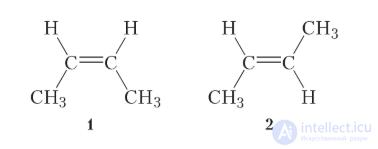
In structure 1, the methyl groups are located on the same side relative to the double bond, while in structure 2 — on opposite sides. Because rotation around the double bond is impossible, structures 1 and 2 cannot convert into one another under normal conditions and therefore represent different substances, that is, isomers.
If the substituents (in this case, the methyl groups) are located on the same side of the double bond:
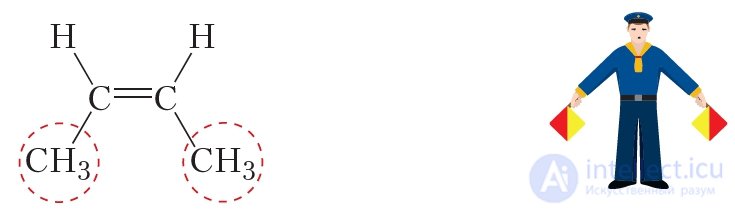
the corresponding isomer is called the cis-isomer.
In the case where the substituents are located on opposite sides of the double bond:
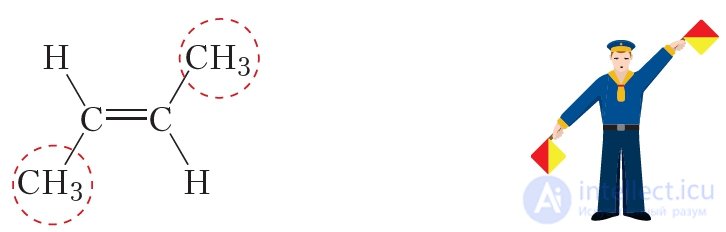
the corresponding isomer is called the trans-isomer.
Consequently, butene-2 exists in the form of two isomers, in whose molecules the sequence of atom connections and the position of the double bond are completely identical, but the spatial arrangement of the atoms differs.
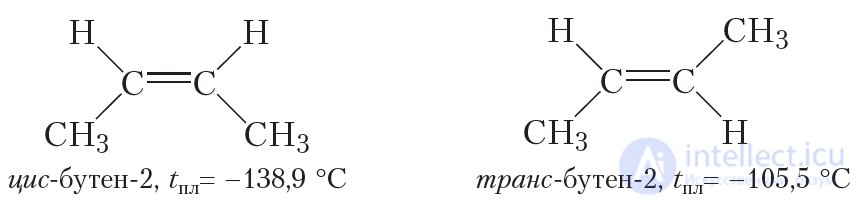
Since cis-butene-2 and trans-butene-2 are different substances (isomers), they have different properties. The melting point of cis-butene-2 is –138,9 °C, while that of trans-butene-2 is more than 33 °C higher (–105,5 °C).
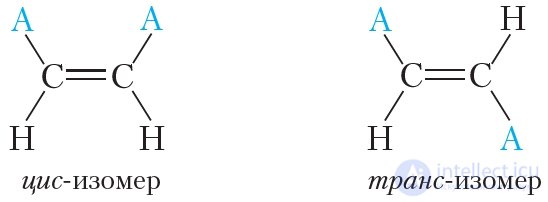
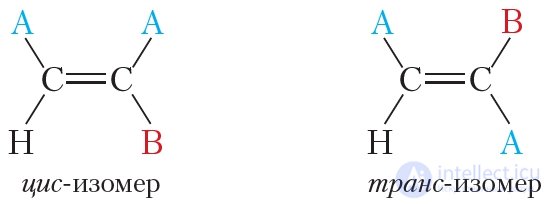
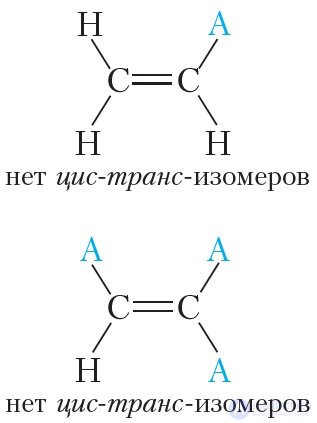
Spatial isomerism is possible only when each of the carbon atoms joined by the double bond has a substituent or two different substituents. If at least one carbon atom joined by the double bond has no substituents or has identical substituents, then spatial isomerism is not possible:
---------------------------------------------------------------------------
---------------------------------------------------------------------------
The structural isomers of butene-2 are butene-1 and 2-methylpropene. Let us examine the structure of their molecules for the possibility of spatial isomers existing:
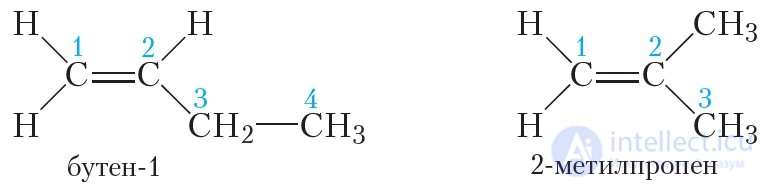
Obviously, swapping the positions of the two hydrogen atoms of the 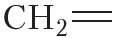 group does not change the molecule of either butene-1 or 2-methylpropene. It follows that among the isomeric butenes, only butene-2 can exist in the form of spatial isomers.
Thus, there are four isomeric butenes:
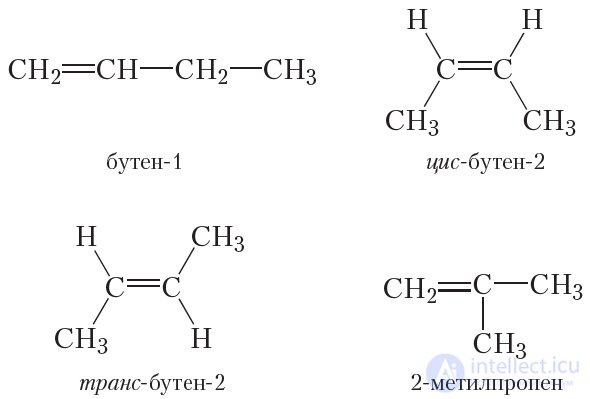
Cis-butene-2 and trans-butene-2 are spatial isomers.
|
Both structural and spatial isomerism are possible for alkenes. Spatial isomers have the same sequence of atom connections and the same position of the double bond, but differ in the spatial arrangement of the atoms in the molecule. The occurrence of spatial isomerism in alkenes is due to the impossibility of rotation around the double bond. Alkenes that have substituents on the carbon atoms joined by the double bond can exist in the form of spatial cis- and trans-isomers. |
1. What is spatial isomerism of alkenes? How does it differ from carbon skeleton isomerism and isomerism of double bond position?
2. Why is rotation possible around a single carbon–carbon bond but not possible around a double bond?
3. For which of the compounds listed below is cis-trans-isomerism possible:
a) pentene-2; b) 2-methylbutene-2; c) 2-methylpropene; d) hexene-3. Write the formulas of the cis- and trans-isomers.
4. Determine the structure of the alkene molecule and give it a name according to IUPAC nomenclature, if the following is known about this alkene:
a) the molar mass of the alkene is 56 g/mol; b) the alkene molecules have an unbranched structure; c) the alkene cannot exist in the form of cis-, trans-isomers.

Comments