
Lecture
1. Acidic properties
The acidic properties of carboxylic acids are expressed considerably more strongly than those of alcohols and phenol. In aqueous solution, molecules of carboxylic acids dissociate into a hydrogen cation H+ and an acid-residue anion RCOO-: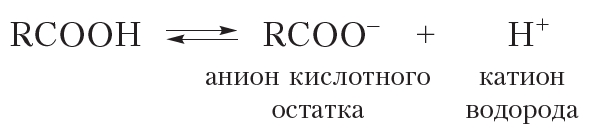 Table 33.1 shows the formulas and names of the acid residues of some carboxylic acids.
|
Formula |
Name |
|
H—COO— |
methanoate (formate) |
|
CH3—COO— |
ethanoate (acetate) |
|
CH3—CH2—COO— |
propanoate |
|
CH3—CH2—CH2—COO— |
butanoate |
|
CH3—CH2—CH2—CH2—COO— |
pentanoate |
To detect H+ ions in the laboratory, indicators are used. Solutions of carboxylic acids change the color of litmus from violet to pink, and methyl orange from orange to red. Solutions of alcohols and phenol do not affect indicators.
Carboxylic acids are weak acids, meaning they dissociate into ions only to a small extent. For example, in a solution of acetic acid with a mass fraction of CH3COOH equal to 6%, only about one in 250 molecules dissociates into a hydrogen cation and an acid-residue anion. Since molecules, rather than ions, predominate in a solution of a carboxylic acid, the formulas of carboxylic acids should be written in molecular form in ionic reaction equations.
The formation of hydrogen ions as a result of dissociation accounts for carboxylic acids exhibiting properties common to inorganic acids. Let us examine these and compare them with the properties of inorganic acids.
Reaction with metals
Carboxylic acids react with active metals, for example, Mg, Al, Zn. This produces a salt of the carboxylic acid and releases hydrogen:

Compare the reaction equation given above with the equation describing the reaction of zinc with hydrochloric acid:
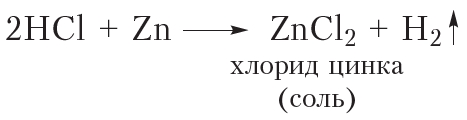 It should be noted that when zinc reacts with strong hydrochloric acid, hydrogen is released more intensely than when it reacts with weak carboxylic acids.
Reaction with metal hydroxides
Like inorganic acids, carboxylic acids react with metal hydroxides, forming a salt of the carboxylic acid and water:
 Hydrochloric acid reacts with sodium hydroxide in a similar way:
Reaction with ammonia
Carboxylic acids react with ammonia to form ammonium salts:
 Compare the reaction equation given above with the equation describing the reaction of ammonia with hydrochloric acid: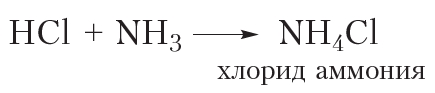
Reaction with metal oxides
Carboxylic acids react with metal oxides, forming a salt and water:

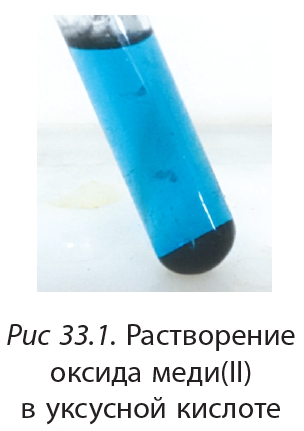 When black CuO powder is heated in a test tube with a colorless solution of acetic acid, the precipitate gradually dissolves and the solution turns blue (Fig. 33.1). The blue color of the solution is imparted by copper ions Cu2+. The process of Cu2+ ions passing into solution is clearly reflected by the ionic equation of this reaction:
Reaction with salts of carbonic acid
Carboxylic acids are stronger than carbonic acid, and therefore displace it from its salts. Recall that carbonic acid is unstable and immediately decomposes into water and carbon dioxide:

Therefore, when carboxylic acids act on salts of carbonic acid, gas evolution is observed:


Video 33.1.
Reaction of sodium carbonate
with acetic acid
Reaction with salts of carbonic acid is a qualitative test for carboxylic acids.
This reaction is often carried out in everyday life. Many cooking recipes describe the preparation of a leavening agent for dough this way: «take baking soda quenched with vinegar». The formula of baking soda is NaHCO3. Let us give the equation of the reaction that takes place:

2. Reaction with alcohols. Esterification
In addition to exhibiting typical acidic properties, the carboxyl group of a carboxylic acid can participate in other chemical reactions. One such reaction is the formation of esters upon reaction with alcohols:
 In practice, this reaction is carried out as follows. 2–3 cm3 of concentrated acetic acid and ethyl alcohol are placed in a test tube, then 1–2 drops of concentrated sulfuric acid (which acts as a catalyst) are added. After brief heating of the mixture, a distinctive pleasant smell is noticeable. This smell indicates the formation of a new substance — an ester.
The reaction taking place is called the «esterification reaction». Esters will be discussed in more detail in the next section.
3. Substitution of a hydrogen atom in the hydrocarbon radical by a halogen
An important property of carboxylic acids is their ability to undergo substitution reactions in which hydrogen atoms of the hydrocarbon radical are replaced by a halogen (chlorine or bromine):
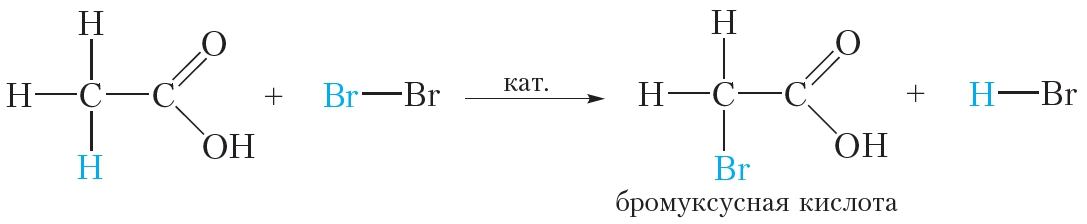
This reaction is carried out in the presence of red phosphorus.

* Derivatives
of carboxylic acids
It should be noted that in such reactions, substitution of the hydrogen atom occurs at the carbon atom adjacent to the carboxyl group. This produces halogen-substituted carboxylic acids, which are widely used in organic synthesis. The presence of a halogen atom next to the carboxyl group leads to an increase in acidic properties. Thus, bromoacetic acid is about 70 times stronger than acetic acid.
You can learn about some derivatives of carboxylic acids by following the link in the QR code.
|
Carboxylic acids are weak acids. In aqueous solution, they reversibly dissociate into a hydrogen cation H+ and an acid-residue anion RCOO–. The formation of hydrogen ions as a result of dissociation accounts for carboxylic acids exhibiting properties common to inorganic acids: they change the color of indicators, react with active metals, metal oxides and hydroxides, and ammonia, and displace carbonic acid from its salts. In the presence of sulfuric acid, carboxylic acids react with alcohols to form esters. This reaction is called the esterification reaction. The hydrogen atom in the hydrocarbon radical of a carboxylic acid can be substituted by a halogen atom. |
Derivatives of carboxylic acids
One of the derivatives of carboxylic acids widely used in the chemical industry is acetic anhydride. Acetic anhydride can be obtained by treating acetic acid with such a strong dehydrating agent as phosphorus(V) oxide. In this case, an intermolecular dehydration reaction of the acid takes place:
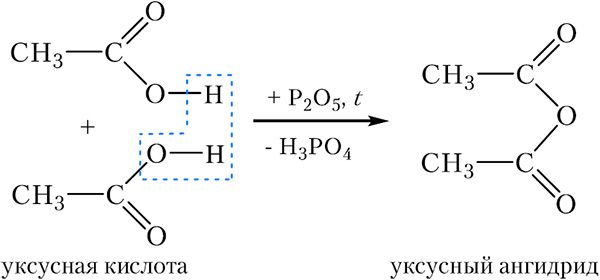
Acetic anhydride (a colorless liquid with a pungent smell, tb.p. = 140 °C) is used in industry to produce synthetic fibers.
Amides are derivatives of carboxylic acids. One of the simplest amides — the amide of acetic acid, or acetamide — can be obtained by heating ammonium acetate:
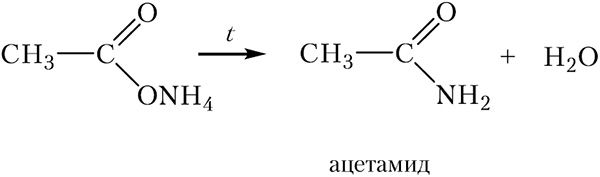
Some amides are used as medicines. For example, paracetamol:
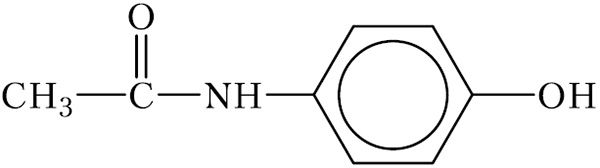
The amide group  CO NH is very stable, so compounds containing amide groups are widespread in nature. Thus, amide groups are the main structural elements of protein molecules.
Features of formic acid
Unlike other members of the saturated carboxylic acids, formic acid is readily oxidized. In particular, formic acid undergoes the «silver mirror» reaction, which is characteristic of aldehydes. To explain this feature of formic acid, let us examine its formula closely:
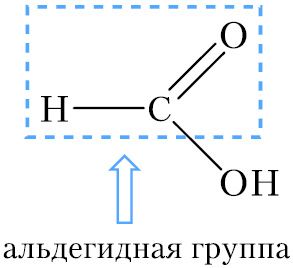
We can see that the molecule of formic acid essentially contains an aldehyde group, so it is quite logical that it undergoes a reaction characteristic of aldehydes:
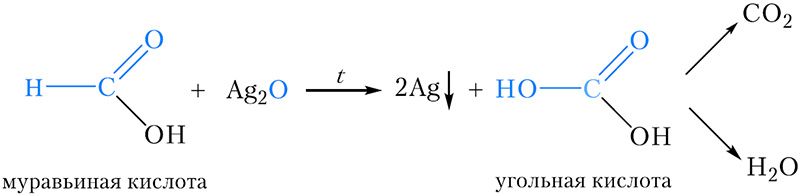
As a result of the oxidation of formic acid, carbonic acid is formed, which decomposes into carbon dioxide and water.
1. What colors does a solution of acetic acid turn: a) litmus; b) phenolphthalein; c) methyl orange?
2. Write the equations of the reactions of acetic acid, in molecular and ionic form, with the following substances: a) potassium hydroxide; b) magnesium; c) calcium oxide; d) barium carbonate.
3. Four unlabeled test tubes contain aqueous solutions of the following substances: ethanol, glycerol, acetaldehyde, and acetic acid. You have available aqueous solutions of the following substances: baking soda (NaHCO3), copper(II) sulfate, and sodium hydroxide. How can you use the available reagents to distinguish the substances in the test tubes? Describe the course of the experiment and your observations in detail. Write the corresponding reaction equations.
4. Substance A with the composition C4H10O, having an unbranched carbon skeleton, reacts with metallic sodium to form organic substance B. Dehydration of substance A produces alkene C, which is able to exist as cis- and trans-isomers.
a) Give the formula of alkene C and the corresponding formulas and names of its cis- and trans-isomers.
b) Give the structural formulas of substances A and B.
c) Write the equations of all the reactions described in the problem and indicate the conditions under which they occur.
d) Substance D is an isomer of substance A. Substance D does not contain tertiary carbon atoms and reacts with metallic sodium. Give the structural formula of substance D.
e) Write the equations of the reactions by which the following transformations can be carried out:

5*. Determine the formulas of substances X and Y in the transformation scheme:

6*. Arrange the following substances in order of increasing acidic properties: phenol, acetic acid, ethanol, carbonic acid.
7*. There are two substances with the composition C3H6O2. One of them displaces carbon(IV) oxide from sodium carbonate, the other does not react with sodium carbonate but, when heated with a solution of NaOH, forms an alcohol and a salt. Write the possible structural formulas of these compounds.
8*. Five numbered test tubes contain solutions of the following substances: acetone, formaldehyde, phenol, ethylene glycol, and formic acid. Determine by chemical means which substance is in each test tube. Write the reaction equations.
9*. Neutralizing a mixture of formic and acetic acids required 10 mL of a 40%-by-mass KOH solution with a density of 1.4 g/mL. When the same amount of the mixture was reacted with excess ammoniacal silver oxide solution, 8.64 g of silver was formed. Determine the mass fraction of acetic acid in the mixture.

Comments