
Lecture
Determining the structure of a chemical compound is the subject of scientific research. The complexity of this problem depends on the complexity of the compound's structure. The first stage of the research is usually determining the substance's molecular formula. Let us consider some ways of determining the formulas of organic substances using fairly simple examples.
Example 1. More than two centuries ago, chemists already knew how to determine the qualitative and quantitative composition of substances. For example, it was known that one organic substance contained carbon and hydrogen, with the mass fraction of carbon being 75 % and that of hydrogen — 25 %. That is, 100 g of the substance contains 75 g of carbon and 25 g of hydrogen. Using this data, determine the formula of the organic substance.
Since the unknown organic substance consists only of carbon and hydrogen, its molecular formula can be represented as CxHy. Thus, solving the problem comes down to finding the indices x and y in the substance's formula. The indices x and y in the formula show the number of carbon and hydrogen atoms in a molecule of the organic substance, so at the first stage of solving such problems it is necessary to find the simplest whole-number ratio between the numbers of carbon and hydrogen atoms in the unknown substance:
x : y = n(C) : n(H).
According to the given data, the mass of carbon atoms is 75 g, and of hydrogen — 25 g. Then:

The accuracy of intermediate calculations should correspond to the accuracy of the initial data, meaning intermediate values must contain no fewer significant figures than the data given in the problem.
It can be seen that the resulting ratio is not a whole number. To obtain whole-number values of the indices x and y, the following steps are taken: first, all numbers in the resulting ratio are divided by the smallest one (in one case it will already be equal to one), and, if necessary, the resulting numbers are multiplied by a natural number (2, 3, etc.) to obtain a whole-number ratio:

Then the formula of the compound — CH4. This substance is well known to us; it is called methane.
Answer: CH4.
Example 2. A certain organic substance consists of carbon and hydrogen. The mass fraction of carbon in the substance is 82,8 %. Determine the molecular formula of the substance.
Since the unknown organic substance consists only of carbon and hydrogen, its formula — CxHy. The problem statement gives the mass fractions of the elements in the substance. In such cases, when solving the problem it is convenient to consider a certain mass of the substance, usually taken to be 100 g. In this case, the mass fractions of the elements will coincide numerically with their masses. Then the simplest whole-number ratio of the indices in the substance's formula:

Consequently, the simplest formula of the organic substance — C2H5. No stable organic substance with this formula exists. Indeed, the formula C2H5 corresponds to the ethyl radical. To determine the true formula of the organic substance, we take into account that doubling, tripling, etc. the indices in the formula does not change the ratio between them. Doubling the indices in the simplest formula C2H5, we obtain the formula C4H10. This formula corresponds to the hydrocarbon butane. Thus, the true formula of the substance — C4H10.
Answer: C4H10.
In the examples considered, to determine the formula of an organic substance it was enough for us to know only the mass fractions of the elements in the substance. At the same time, in some cases, knowing only the mass fractions of the elements in the substance, one can determine only the simplest, but not the true, formula. In such cases, additional data is needed to establish the true formula. As a rule, this is information about the molar mass of the compound.
Example 3. The molar mass of a hydrocarbon is 42 g/mol. The mass fraction of carbon in the hydrocarbon is 85,7 %. Determine the molecular formula of the hydrocarbon.
The formula of the hydrocarbon — CxHy. Let us find the simplest whole-number ratio of the indices in the substance's formula:

Consequently, the simplest formula of the hydrocarbon — CH2. Doubling the indices in the simplest formula CH2, we obtain the formula C2H4. This formula corresponds to the hydrocarbon ethylene. If we triple the indices in the simplest formula CH2, we obtain the formula C3H6. This formula corresponds to the hydrocarbon propylene. That is, a whole set of substances corresponds to the ratio of indices found, so in this case, using only the mass fractions of the elements, it is impossible to establish the true formula of the substance.
To establish the true formula, let us compare the molar mass of the hydrocarbon with the molar mass of the simplest formula CH2:
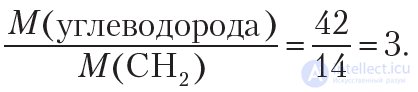
Consequently, to obtain the true formula, the indices in the simplest formula CH2 must be increased 3 times. Then the true formula of the hydrocarbon — C3H6.
Answer: C3H6.
In organic compounds, alongside carbon and hydrogen, oxygen is often present. Let us derive the molecular formula of an oxygen-containing compound.
Example 4. Determine the simplest formula of a substance containing 37,50 % carbon, 12,50 % hydrogen and 50,00 % oxygen (by mass).
The simplest whole-number ratio of the indices in the substance's formula:

The simplest formula of the substance is CH4O. This molecular formula corresponds to methyl alcohol 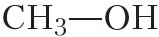 .
.
Answer: CH4O or .
In the examples considered, we used information about the mass fractions of the elements in the substance to establish the formulas. The formula of an organic substance can also be derived on the basis of experimental data from burning a certain mass of the organic substance.
Example 5. Burning 1,50 g of an organic substance produced 2,20 g of carbon dioxide and 0,90 g of water. The molar mass of the substance is 60 g/mol. Determine the formula of the substance.
Since only carbon dioxide and water were formed when the substance was burned, the substance could only contain carbon, hydrogen, and oxygen atoms. Then the formula of the substance — CxHyOz. We will find the ratio of the indices in the formula from the condition:
x : y : z = n(C) : n(H) : n(O).
Let us write the reaction scheme:

From the reaction scheme it can be seen that carbon from the organic substance passes into CO2, and hydrogen — into H2O. Thus the amounts of carbon and hydrogen in CO2 and H2O will be the same as in the organic substance.
Let us find the amount of carbon in CO2:

A water molecule contains two hydrogen atoms, so the amount (mol) of hydrogen is twice the amount of water:

Let us determine the amount (mol) of oxygen atoms in the substance. To do this, we calculate the masses of carbon and hydrogen in this portion of the substance:
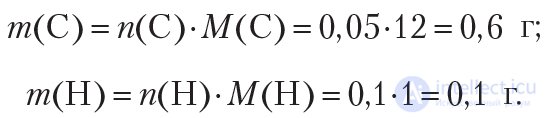
Let us calculate the mass and amount of oxygen in the substance:

The simplest whole-number ratio of the indices in the substance's formula:
x : y : z = n(C) : n(H) : n(O) = 0,05 : 0,1 : 0,05 = 1 : 2 : 1.
Thus, the simplest formula of the organic substance is CH2O.
To establish the true formula, let us compare the molar mass of the substance with the molar mass of the simplest formula — CH2O:
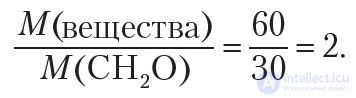
Consequently, to obtain the true formula, the indices in the simplest formula CH2O must be increased by a factor of two. Then the true formula of the substance — C2H4O2. One of the substances having this molecular formula is acetic acid CH3 — COOH.
Answer: C2H4O2.
Let us summarize the above. Knowing the amounts (mol) of the elements in a substance, one can establish the simplest formula of the substance. To derive the true formula, additional data is often needed, for example information about the molar mass of the substance.
|
Deriving the formula of an organic substance usually consists of the following stages: a) calculating the amount (mol) of the elements in the substance; b) determining the simplest whole-number ratio between the calculated amounts of the elements — establishing the simplest formula of the substance; c) establishing the true formula of the substance. To establish the simplest formula, it is enough to know the amounts (mol) of the elements in the substance. Determining the true formula often requires additional data, for example information about the molar mass of the substance. |
1. A hydrocarbon contains 81,8 % carbon by mass. Determine the formula of the hydrocarbon.
2. A gaseous hydrocarbon has a density of 0,714 g/dm3 (STP). Determine the molar mass of the hydrocarbon. Derive its molecular formula.
3. A hydrocarbon contains 83,72 % carbon and 16,28 % hydrogen by mass. Determine its simplest and true formulas. Write the structural formulas of all substances satisfying the conditions of the problem.
4. The molar mass of substance A is 72 g/mol. When 1,44 g of this substance was burned in excess oxygen, 4,4 g of carbon dioxide and 2,16 g of water were obtained. Determine the molecular formula of substance A and give the structural formulas of all substances having this molecular formula.
5. Burning 1,38 g of an organic compound in oxygen produced 2,64 g of CO2 and 1,62 g of water. Determine the molecular formula of the organic compound, given that its molecule contains one oxygen atom. Write the possible structural formulas of this compound.
6*. A hydrocarbon was burned in excess oxygen. After removing the excess oxygen, the gaseous mixture of combustion products has an average molar mass of 30 g/mol (110 °C, atmospheric pressure). Determine the molecular formula of the hydrocarbon.

Comments