
Lecture
In organic chemistry, substances are classified according to the structure of their molecules.
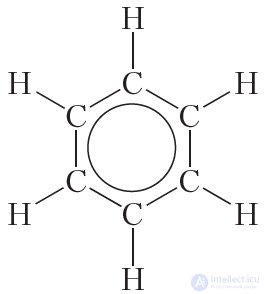
Hydrocarbons are the simplest organic compounds in terms of composition. Hydrocarbon molecules consist of only two elements: carbon and hydrogen. Hydrocarbons include alkanes, alkenes, alkadienes, alkynes, and arenes. Alkane molecules contain only single bonds. Alkene molecules have one double bond, while alkadiene molecules have two double bonds. Alkyne molecules contain one triple bond. Aromatic hydrocarbons contain a benzene ring in their molecules (Table 26.1).
Table 26.1. Classes of Hydrocarbons
|
Class Name |
Structural Formula of a Class Representative |
General Formula |
|
Alkanes |
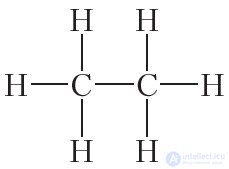 |
CnH2n+2 |
|
Alkenes |
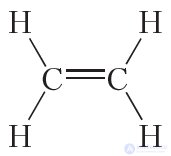 |
CnH2n |
|
Alkynes |
|
CnH2n–2 |
|
Alkadienes |
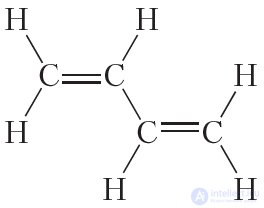 |
CnH2n–2 |
|
Arenes |
|
CnH2n–6 |
Knowledge of the chemical properties of organic substances makes it possible to propose ways of obtaining compounds of one class from compounds of another class. For example, alkanes can be obtained from alkenes and alkynes by means of a hydrogenation reaction: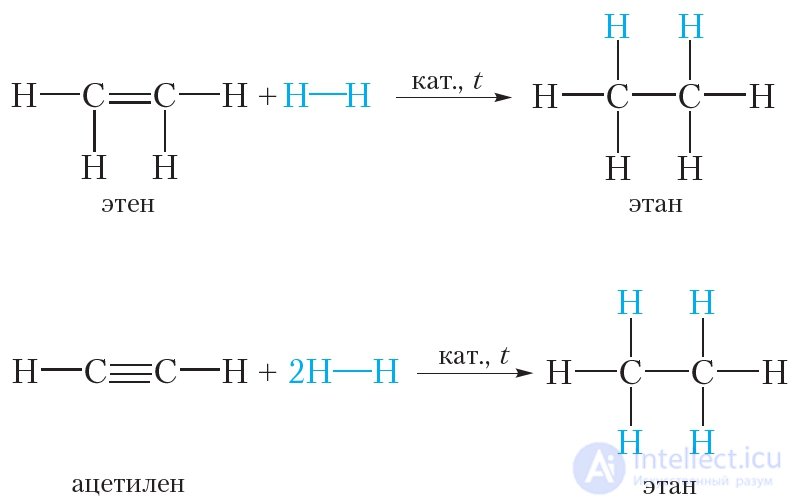
Let us give examples of problems that can be solved using knowledge of the relationships between compounds of different classes.
Example 1. Propose a method for obtaining ethyl alcohol from ethane. Write the equations for the corresponding reactions and indicate the conditions under which they proceed.
Let us consider the structural formulas of ethane and ethyl alcohol:
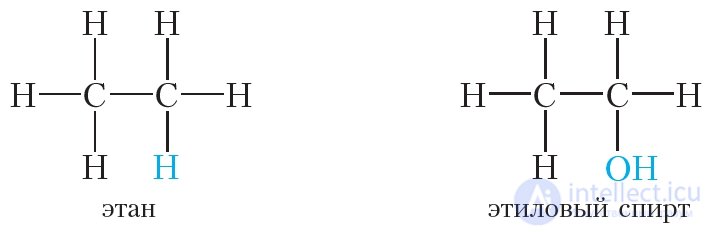
It can be seen that ethyl alcohol can be regarded as the product of substituting a hydrogen atom in the ethane molecule with a hydroxyl group —OH. However, we do not know of chemical reactions that allow a hydrogen atom in a hydrocarbon molecule to be directly substituted with a hydroxyl group. Therefore, obtaining ethanol from ethane will require several stages.
In the first stage, we obtain bromoethane from ethane: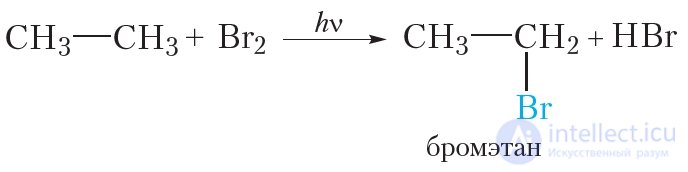
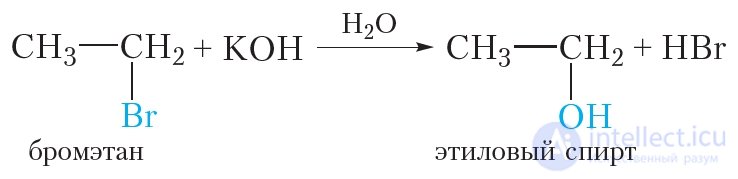
Unlike a hydrogen atom, the bromine atom in a bromoethane molecule can be substituted with an —OH group by the action of an aqueous alkali solution:
Example 2. Write the equations for the reactions by which it is possible to obtain ethyl alcohol from methane.
Let us consider the structural formulas of methane and ethyl alcohol: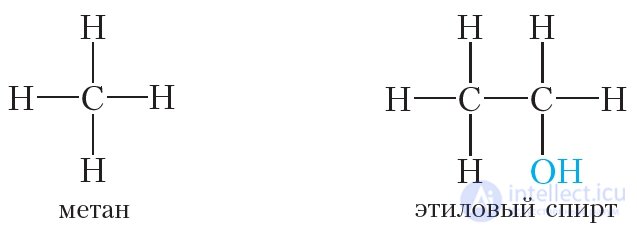 The molecule of ethyl alcohol contains two carbon atoms, whereas the methane molecule contains only one. Therefore, methane must first be converted into an organic substance whose molecule contains two carbon atoms. This conversion occurs during the pyrolysis of methane:

As a result of the reaction, acetylene is formed. The acetylene molecule contains two carbon atoms. However, we do not know of ways to obtain ethyl alcohol directly from acetylene, so in the next stage we will carry out the hydrogenation of acetylene to ethylene:
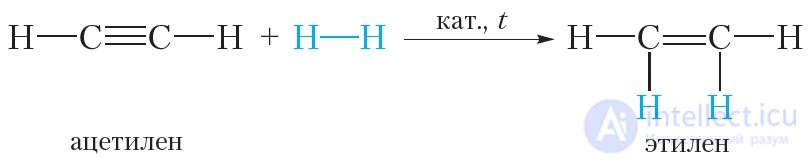
By adding water to ethylene, we obtain ethyl alcohol: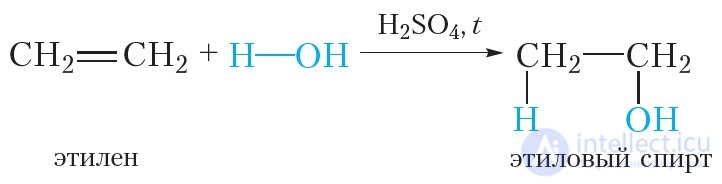
Example 3. Write the equations for the reactions by which it is possible to obtain 1,2-dichloropropane from propan-2-ol.
Let us consider the structural formulas of propan-2-ol and 1,2-dichloropropane:
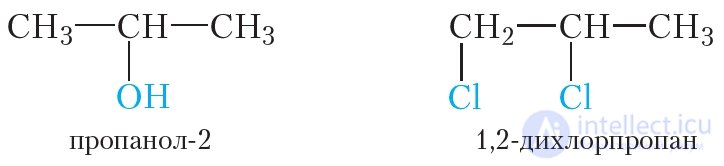
1,2-Dichloropropane can be obtained by adding chlorine to propylene.
Propylene can be obtained by eliminating a water molecule from propan-2-ol. Thus, in the first stage we obtain propylene from propan-2-ol:

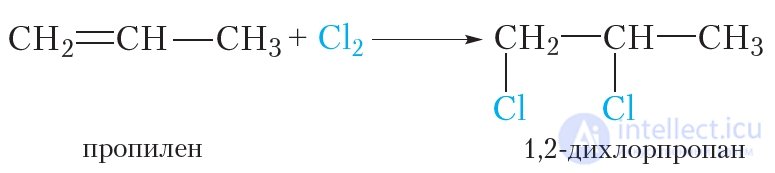
In the next stage, we obtain 1,2-dichloropropane by adding chlorine to propylene:
|
Knowledge of the chemical properties of organic substances makes it possible to propose ways of obtaining compounds of one class from compounds of another class. Saturated alcohols can be regarded as the products of substituting hydrogen atoms in alkane molecules with hydroxyl groups —OH. However, it is quite difficult to directly substitute a hydrogen atom in an alkane molecule with a hydroxyl group. In practice, alcohols can be obtained from alkanes via halogen derivatives or via unsaturated hydrocarbons. |
1. Write the equations for the reactions by which methanol can be obtained from methane.
2. Write the equations for the reactions by which polyethylene can be obtained from methane.
3. Propose a two-stage synthesis of propylene from propane. Write the equations for the reactions that take place.
4. Propose a method for obtaining acetylene from ethanol without using a dehydrogenation reaction. Write the equations for the reactions that take place.
5. Write the equations for the reactions by which the following transformations can be carried out:



Comments