
Lecture
In the previous section, we examined the structural formulas of some alkanes. Structural formulas reflect not only the composition but also the sequence in which the atoms are connected in the molecule. At the same time, structural formulas may not show the spatial structure of the molecule.
For example, the structural formula of methane is often depicted as follows:
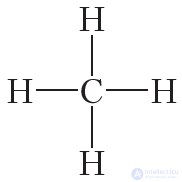
It has been established experimentally that the methane molecule is not flat, but has the shape of a regular tetrahedron, at the center of which is a carbon atom, and at the vertices — hydrogen atoms:
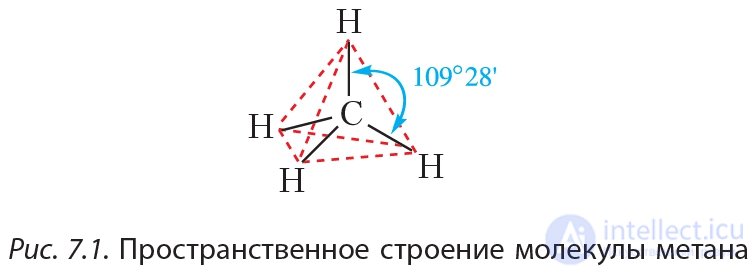
The angle between the bonds (the bond angle) in the methane molecule equals 109°28'. In the structural formula of methane, the bonds are often shown at an angle of 90°.
Other variants are also possible, for example:
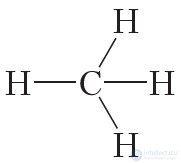
All of these variants of structural formulas are correct, since they correctly show the sequence in which the atoms are connected in the molecule.
Let us examine the structure of the methane molecule in more detail. Bonds in molecules form as a result of the overlap of atomic orbitals. The structure of the electron shell of a carbon atom in the excited state is shown by the electron configuration diagram:
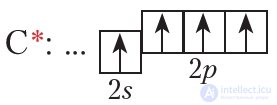
In the excited state, the carbon atom has one electron in an s-orbital and three electrons in p-orbitals. When covalent bonds with hydrogen atoms are formed, two ways of overlapping the electron clouds are possible (fig. 7.2 and 7.3).
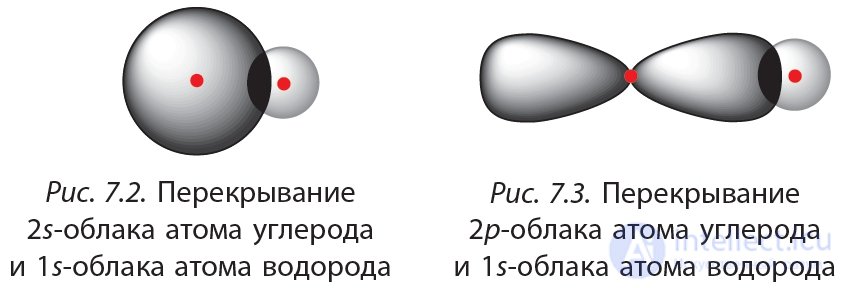 A bond formed by the overlap of the 2s-orbital of the carbon atom and the 1s-orbital of the hydrogen atom (fig. 7.2) should differ from the three other bonds, which form as a result of the overlap of the 2p-orbitals of the carbon atom and the 1s-orbital of the hydrogen atom (fig. 7.3). In reality, all four bonds in the methane molecule are completely identical. The concept of hybridization of atomic orbitals is used to explain this fact.
When covalent bonds form in the methane molecule, the four valence orbitals of the carbon atom mix and form four orbitals of identical shape (hybrid orbitals):
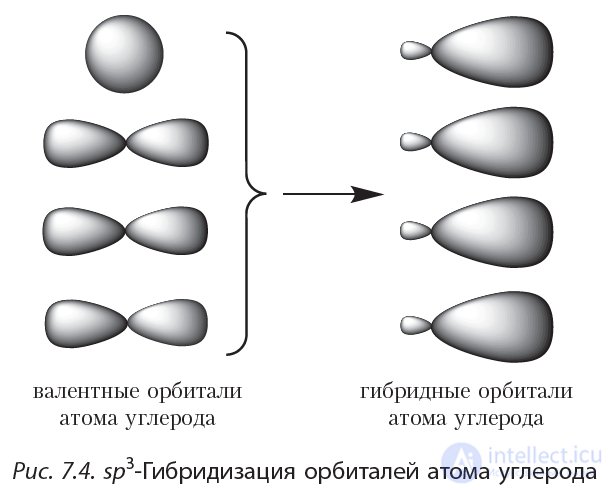 Let us consider how the four hybrid orbitals of the carbon atom are arranged in space. Electron clouds carry a negative charge, and therefore the hybrid orbitals must be arranged so that the electrostatic repulsion between like-charged electrons is minimized. This condition is met when the hybrid orbitals are arranged at an angle of 109°28' (fig. 7.5):
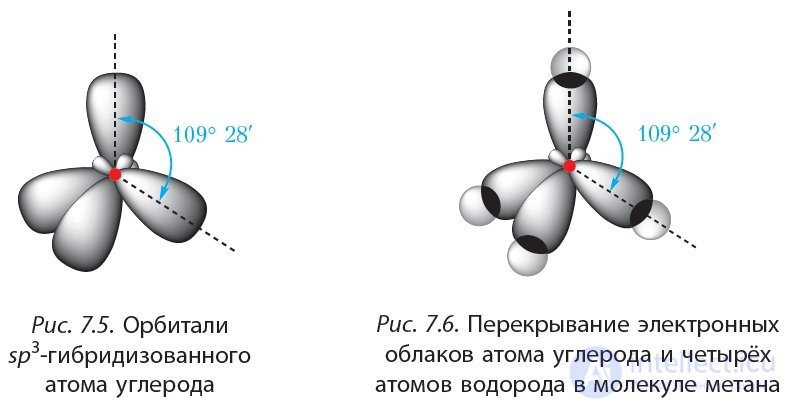
These conclusions are confirmed by the results of research using physicochemical methods. Indeed, the methane molecule has a tetrahedral shape, and the angle between the bonds  is 109°28' (fig. 7.6).
From the diagram of the overlap of electron clouds in the methane molecule, it is evident that the hybrid electron clouds of the carbon atom are elongated toward the hydrogen atoms. Such clouds can overlap more strongly with the electron clouds of the hydrogen atoms and, consequently, form stronger bonds.
 Four orbitals of the carbon atom participate in sp3-hybridization — one s- and three p-orbitals. sp3-Hybrid orbitals are arranged in space at an angle of 109°28'.
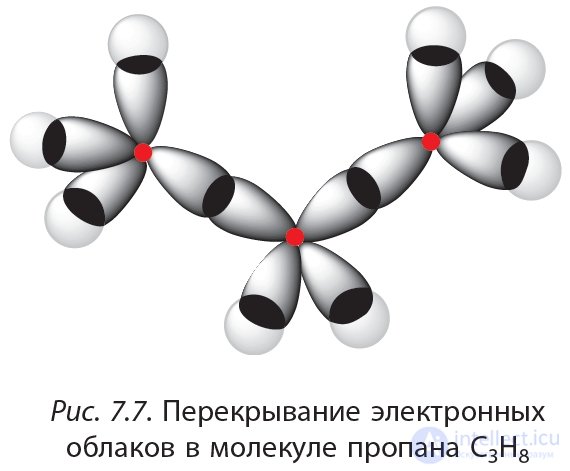
The molecules of other alkanes, like the methane molecule, are built from sp3-hybridized carbon atoms. Each sp3-hybridized carbon atom forms four covalent bonds. The angle between these bonds is approximately 109° (fig. 7.7).
The spatial structure of organic molecules can be clearly illustrated using ball-and-stick models.
Models of carbon atoms are gray balls with four holes; models of hydrogen atoms — white balls with one hole. Models of covalent chemical bonds — plastic rods. Figure 7.8 shows ball-and-stick models of the molecules of methane, propane, and n-butane.
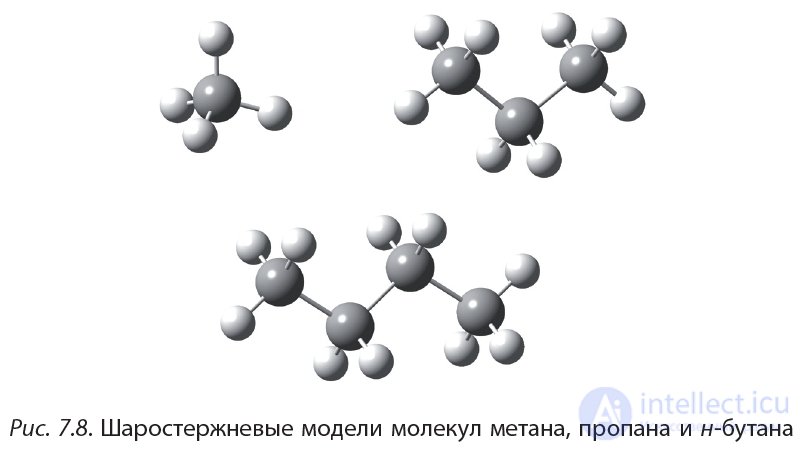
It can be seen that the carbon atoms in the molecules of propane and n-butane do not lie on a single straight line. For example, the carbon chain of the n-butane molecule has the shape of a zigzag line. This is because the angle between the bonds  in alkane molecules is approximately 109°.
To depict the structure of alkanes and other organic substances, formulas that do not show the chemical symbols for carbon and hydrogen at all are often used. In this case, the formulas of alkanes are zigzag lines representing the carbon skeleton of the molecule. Such formulas are called skeletal formulas. Obviously, skeletal formulas can be written for alkanes starting with ethane; the formula of ethane takes the form of a single line segment, while the formula of propane is a zigzag line made up of two segments, and so on:

Skeletal formulas of organic compounds are widely used alongside conventional structural formulas. The advantage of these formulas — compactness and speed of writing. In addition, unlike structural formulas, skeletal formulas give an idea of the spatial structure of organic molecules.
|
The molecules of alkanes are built from sp3-hybridized carbon atoms. Each sp3-hybridized carbon atom forms four covalent bonds. The angle between these bonds is approximately 109°. The carbon chain of alkane molecules has the shape of a zigzag line. |
1. Why is the methane molecule not flat?
2. Depict the overlap of electron clouds in the ethane molecule. Indicate the approximate values of the bond angles in this molecule.
3. An alkane with an unbranched chain of six carbon atoms is called n-hexane. Write the structural formula of n-hexane. Why is the carbon chain of the n-hexane molecule not a straight line, but has the shape of a zigzag line? Can the carbon chain of the n-hexane molecule take on other spatial shapes?
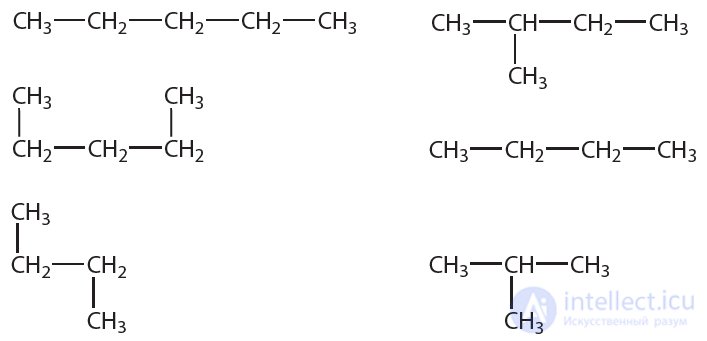
4. Indicate how many different substances are represented by the following structural formulas:
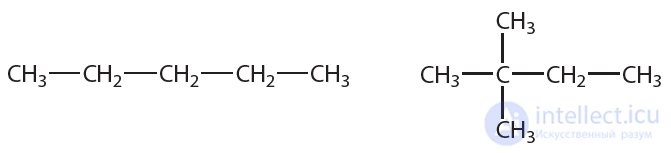
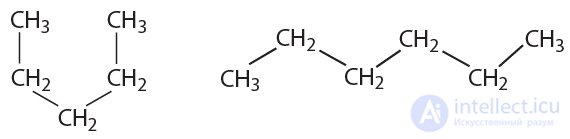
5. Find the isomers among the substances whose formulas are given below:
6. What are the values of the bond lengths  and bond angles in alkane molecules?

Comments