
Lecture
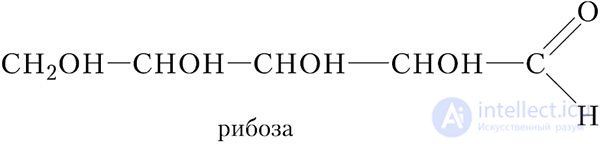
Glucose is one of the most widespread carbohydrates in nature. The carbohydrate ribose is of great biological significance, since this carbohydrate is a component of ribonucleic acids (RNA). Ribose, like glucose, is a white powder, readily soluble in water, sweet to the taste. The molecular formula of ribose is C5H10O5. Like glucose, it is an aldehyde alcohol. The structural formula of ribose:
Like glucose, ribose forms cyclic forms, and five-membered rings are characteristic of it:
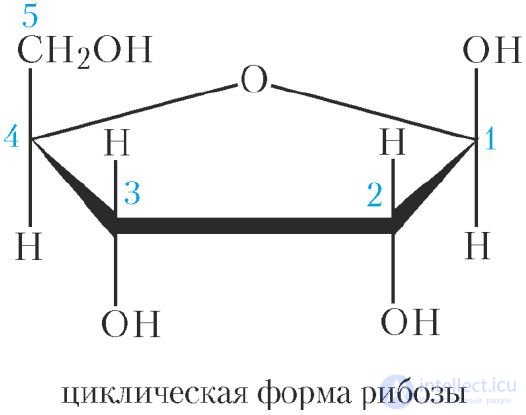
In the form of a five-membered ring, ribose is a component of RNA.
Another carbohydrate of great biological significance is deoxyribose. Let us give the structural formula of deoxyribose:
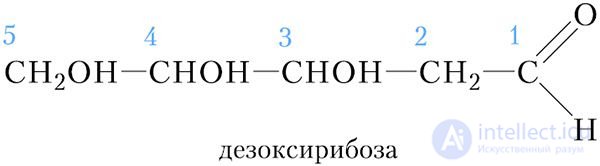
As can be seen, unlike ribose, the deoxyribose molecule lacks a hydroxyl group at the second carbon atom, hence the name — deoxyribose («ribose without oxygen»). The molecular formula of deoxyribose, C5H10O4, does not conform to the general formula Cn(H2O)m, which reflects the composition of most carbohydrates. Let us give the cyclic form of deoxyribose:
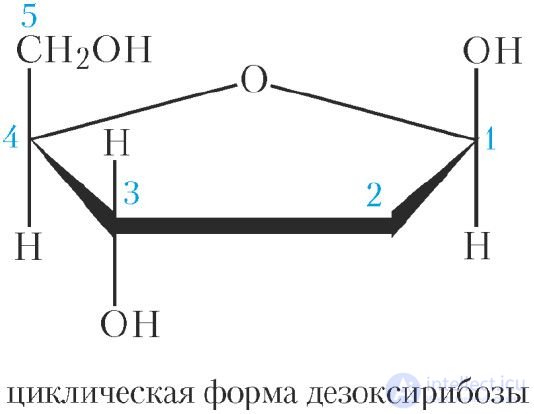
The cyclic form of deoxyribose is a structural element of deoxyribonucleic acid (DNA) molecules.
Ribose, C5H10O5, is an aldehyde alcohol.
In the deoxyribose molecule, C5H10O4, there is no hydroxyl group at the second carbon atom.
Ribose and deoxyribose, in the form of five-membered rings, are components of RNA and DNA.
1. Write the molecular and structural formulas of ribose. Is ribose a homolog of glucose?
2. Write the molecular and structural formulas of deoxyribose. Is deoxyribose a homolog of ribose?
3. In what natural objects are residues of ribose and deoxyribose found?

Comments