
Lecture
In previous sections, we studied hydrocarbons — organic substances made up of two chemical elements — carbon and hydrogen. Organic substances can also contain other elements. In this section, we will study the structure and properties of alcohols. In addition to carbon and hydrogen, alcohols contain oxygen atoms.
One representative of the class of alcohols — ethyl alcohol — has the molecular formula C2H6O. Let us try to construct the structural formula of ethyl alcohol. The outer electron shell of the oxygen atom has two unpaired electrons:
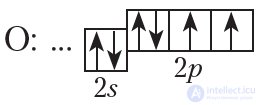
Therefore, the valence of oxygen equals two, so two dashes should be drawn from the symbol O in structural formulas.
Then two substances can be proposed that have the molecular formula C2H6O:
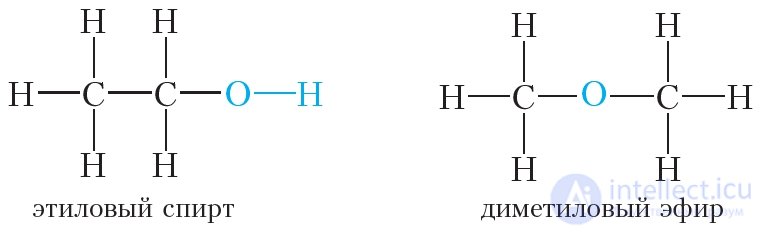
The first compound belongs to the class of alcohols. Alcohol molecules contain the OH group, which is called the hydroxyl group. To emphasize that the ethyl alcohol molecule contains a hydroxyl group, its molecular formula is usually written as: C2H5OH. The presence of a hydroxyl group in alcohol molecules determines their characteristic chemical properties, so the —OH group is called the functional group. Alcohol molecules can contain not one, but two or more hydroxyl groups.
Alcohols — organic compounds whose molecules contain one or more hydroxyl groups bonded to a hydrocarbon radical.
The second compound belongs to the class of ethers. Ether molecules do not have a hydroxyl group. The oxygen atom in ether molecules is bonded to two hydrocarbon radicals.
Ethyl alcohol and dimethyl ether have the same molecular formula but different structures. Therefore, they are isomers.
Saturated monohydric alcohol molecules have one hydroxyl group —OH bonded to an alkyl radical.
The simplest representative of saturated monohydric alcohols is methyl alcohol. Its formula is CH3—OH. Methyl alcohol is a colorless liquid with a characteristic odor and a boiling point of 65 °C. Methyl alcohol is extremely poisonous. Ingestion of just 30 mL of methyl alcohol by a human can be fatal. An even smaller amount of methyl alcohol causes loss of vision. The nearest homolog of methyl alcohol — ethyl alcohol — has the formula CH3—CH2—OH, or C2H5—OH.
Ethyl alcohol is a colorless liquid with a characteristic odor and a boiling point of 78 °C. Ethyl alcohol is a component of alcoholic beverages. Unfortunately, many people abuse alcoholic beverages, causing irreparable harm to their health. Abuse of ethyl alcohol leads to a severe disease — alcoholism.
Methyl and ethyl alcohol are practically impossible to distinguish by appearance and smell. At the same time, methyl alcohol is significantly more toxic than ethyl alcohol. This is the particular danger of methyl alcohol. It can be present in various technical alcohol-containing liquids. Household poisonings with methyl alcohol are often associated with the consumption of such liquids.
Let us derive the general formula of the homologs of methyl alcohol. In their molecules, the —OH group is bonded to an alkyl radical. An alkyl radical is formed by removing one hydrogen atom from an alkane molecule. The general formula of alkanes is CnH2n+2. If one hydrogen atom is removed from the molecule, the formula of the alkyl radical is obtained: CnH2n+1—. Then the general formula of the homologs of methyl alcohol is:
CnH2n+1—OH
Methyl alcohol has no isomers. Ethyl alcohol also has no isomers belonging to the class of alcohols. The only isomer of ethyl alcohol — dimethyl ether — is an ether.
The next representatives of the series of saturated monohydric alcohols contain three carbon atoms in the molecule (C3H7OH). In this case, the hydroxyl group can be bonded to the first or second carbon atom. Structural formulas of the isomeric alcohols:
These compounds are positional isomers of the functional group. Alcohols containing four carbon atoms in the molecule (C4H9OH) can also differ in the position of the functional group:

In addition, isomerism of the carbon skeleton is possible for them:

Taking into account the types of isomerism considered, formulas can be drawn up for four isomeric alcohols with the composition C4H9OH:
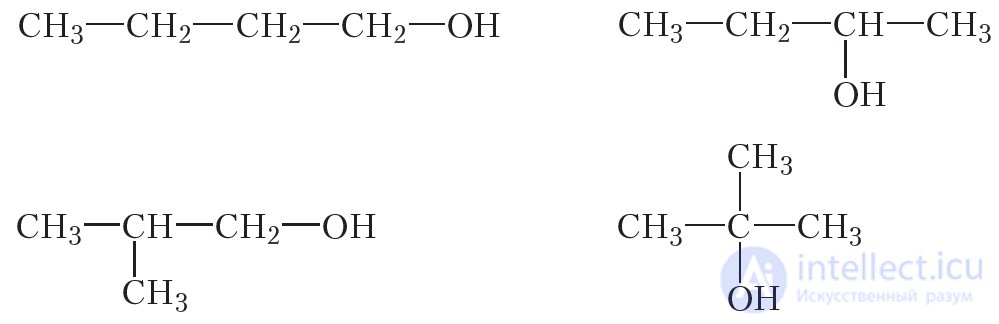
It is obvious that as the number of carbon atoms in the molecule increases, the number of isomers will increase.
The name of a saturated monohydric alcohol consists of the name of the corresponding hydrocarbon and the suffix -ol, denoting the hydroxyl group. The carbon atoms of the main chain are numbered starting from the end closer to the hydroxyl group. At the end of the name, the position of the hydroxyl group in the main chain is indicated.
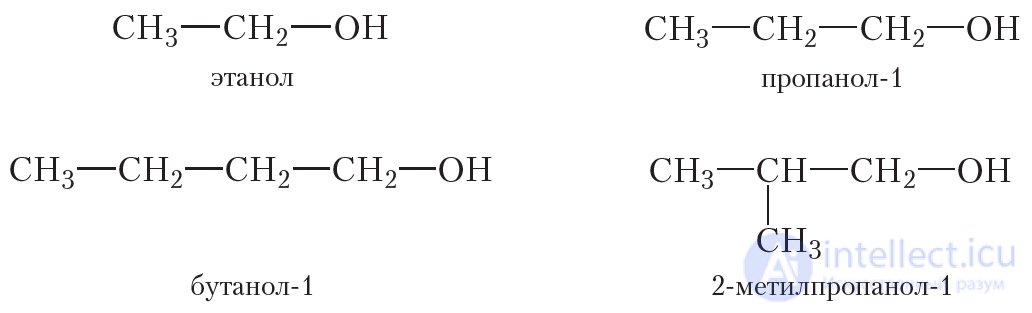
Let us name all the alcohols we have mentioned. The trivial names of some alcohols, which are widely used alongside the systematic names, are given in parentheses.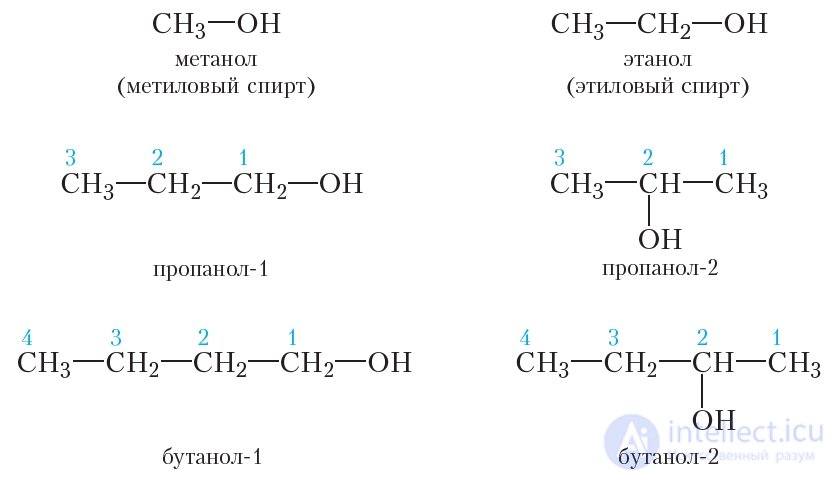
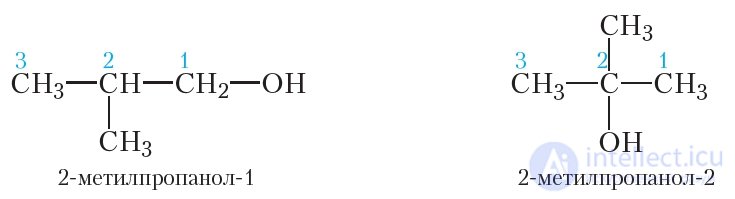
Carbon atoms in molecules of organic substances can be primary, secondary, tertiary, and quaternary (§ 6). A primary carbon atom is bonded to only one carbon atom, a secondary one — to two, a tertiary one — to three, and a quaternary one — to four carbon atoms. Depending on which carbon atom (primary, secondary, or tertiary) the —OH group is attached to, primary, secondary, or tertiary alcohols are distinguished.
Of the alcohols listed above, ethanol, propanol-1, butanol-1, and 2-methylpropanol-1 are primary:
Secondary alcohols — propanol-2 and butanol-2:

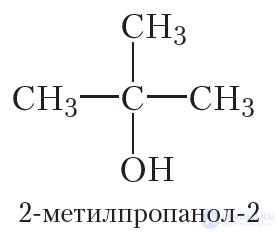
A representative of tertiary alcohols is 2-methylpropanol-2:
 You can learn about unsaturated alcohols by following the link in the QR code.
|
Alcohols — organic compounds whose molecules contain one or more hydroxyl groups bonded to a hydrocarbon radical. The presence of a hydroxyl group in alcohol molecules determines their characteristic chemical properties. Therefore the group —OH is called the functional group. The general formula of saturated monohydric alcohols is CnH2n+1—OH. Depending on which carbon atom (primary, secondary, or tertiary) the group —OH is attached to, primary, secondary, or tertiary alcohols are distinguished. |
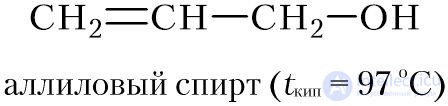
In addition to saturated alcohols, there are also unsaturated alcohols. It should be noted that alcohols in which the hydroxyl group is bonded to a carbon atom forming a double bond are extremely unstable. Therefore, the hydration of alkynes first leads to unstable unsaturated alcohols, which isomerize — in the case of acetylene, into acetaldehyde, and in the case of propyne, into acetone (§ 81-1). At the same time, there are also stable unsaturated alcohols, for example allyl alcohol:
Alcohol molecules can contain rings. For example, cyclohexanol:
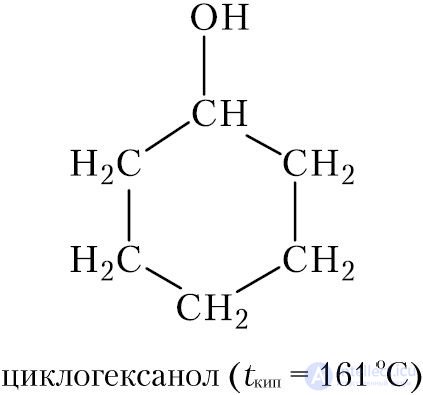
Alcohol molecules can contain a benzene ring. Such alcohols are called aromatic. The simplest aromatic alcohol — benzyl alcohol:
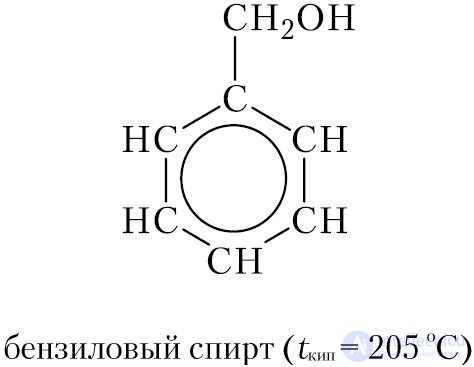
It should be noted that in aromatic alcohols, the hydroxyl group is not bonded directly to the benzene ring but is located in the side chain. Compounds in which the hydroxyl group is bonded directly to the benzene ring belong to the class of phenols. We will study the properties of phenol later.
1. Write the general formula of the homologous series to which methyl and ethyl alcohol belong. What is the danger of these alcohols to the human body?
2. One representative of the class of ethers is diethyl ether C2H5—O—C2H5. Diethyl ether is a colorless liquid with a characteristic odor, with a boiling point of 35 oC. It is used in medicine for anesthesia and used as a solvent. Give the formulas of alcohols isomeric to diethyl ether.
3. Give the names of the alcohols whose formulas are:

Find the primary, secondary, and tertiary alcohols among the substances named. Do quaternary alcohols exist?
4. Give the names of the alcohols whose ball-and-stick models of molecules are:
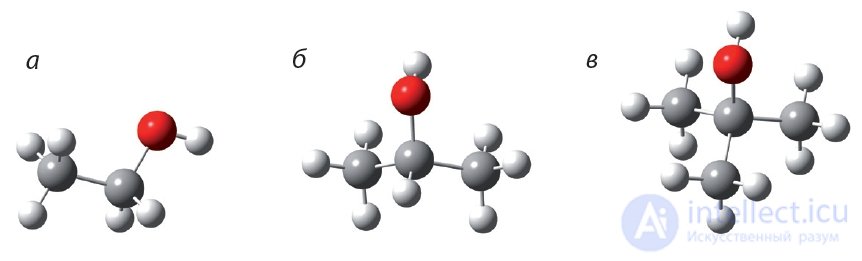
Find the primary, secondary, and tertiary alcohols among the substances named.
5. Write the structural formulas and names of eight isomeric alcohols with the composition C5H11OH. Classify each of them as primary, secondary, or tertiary.
6*. Saturated monohydric alcohols and ethers are cross-class isomers. Write the structural formulas of alcohols isomeric to propyl ethyl ether, name them according to IUPAC nomenclature, and indicate the primary, secondary, and tertiary alcohols.

Comments