
Lecture
As you know, substances can exist in solid, liquid, and gaseous states. The molecules of a liquid and a solid are located close to one another. This is possible because the molecules attract each other. That is, there are forces that hold the molecules of a liquid or solid together. From the 8th-grade chemistry course, you know that these forces are called intermolecular interaction forces. Gas molecules are located at a considerably greater distance from one another than in the case of liquids and solids. At such a distance, the molecules practically do not interact with each other. Therefore, to turn a liquid or solid into a gas, it is necessary to overcome the intermolecular interaction forces by moving the molecules apart.
The transition to the gaseous state occurs as a result of heating substances that are in the solid or liquid state (boiling of liquids, sublimation of solids).
Since the distance between gas molecules is considerably greater than the size of the molecules themselves, the volume occupied by a gas is, in essence, the volume of free space between the chaotically moving gas molecules. The size of this space is determined by the conditions under which the gas exists, i.e., temperature and pressure. This value is approximately the same for all gases. In this case, the volume occupied by the molecules themselves can be neglected. From this follows Avogadro's law — equal volumes of different gases under the same conditions contain the same number of molecules.
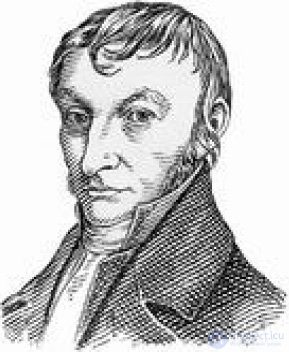
Fig. 8-1. Amedeo
Avogadro (1776—1856)
Interesting to know
From the 8th-grade chemistry course, you are already familiar with Avogadro's constant, equal to 6,02 ∙ 1023 mol–1, which shows how many particles are contained in one mole of a substance. This value is named in honor of the outstanding Italian scientist Amedeo Avogadro, who made a significant contribution to the development of molecular physics, electrochemistry, and other fields of natural science. Based on research into the ratio of volumes of reacting and resulting gases, such as hydrogen and chlorine, oxygen and nitrogen, Avogadro first proposed that molecules of nitrogen, oxygen, hydrogen, and chlorine consist of two atoms. This assumption, which for a long time did not find understanding among the scientists of that era, was later brilliantly confirmed.
From Avogadro's law follow two main corollaries.
First corollary. One mole of any gas under the same conditions occupies the same volume. This volume is called the molar volume of a gas (Vm), and is measured in dm3/mol. The molar volume of a gas equals the ratio of the volume of the gas to its amount:
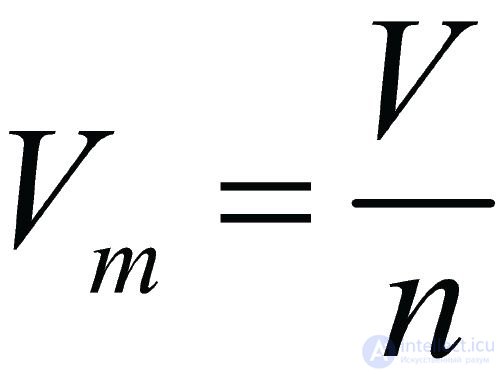 .
.
The value of Vm depends on temperature and pressure. For example, gases expand when heated. This means that the molar volume of a gas increases upon heating. In this regard, comparison of the characteristics of different gas mixtures must be carried out under the same conditions — temperature and pressure. Standard conditions (STP) are adopted as the reference for such conditions: the melting temperature of ice (0 °C or 273,15 K) and atmospheric pressure (101,3 kPa). Under standard conditions Vm = 22,4 dm3/mol.
Thus, it follows from Avogadro's law that 22,4 dm3 of any gas under standard conditions contain 6,02 ∙ 1023 molecules.
Second corollary. The densities of gases are related to each other as the molar masses of the gases.
This can be seen from the following considerations. Suppose there are two portions of different gases. Let us calculate their densities:
gas 1: 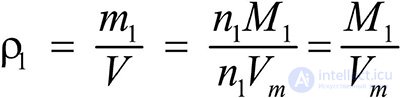 ;
;
gas 2: 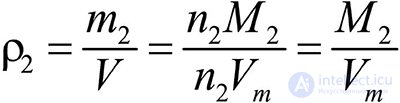 .
.
Dividing the density of the first gas by the density of the second, we obtain: 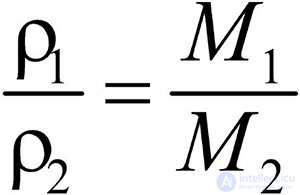 .
.
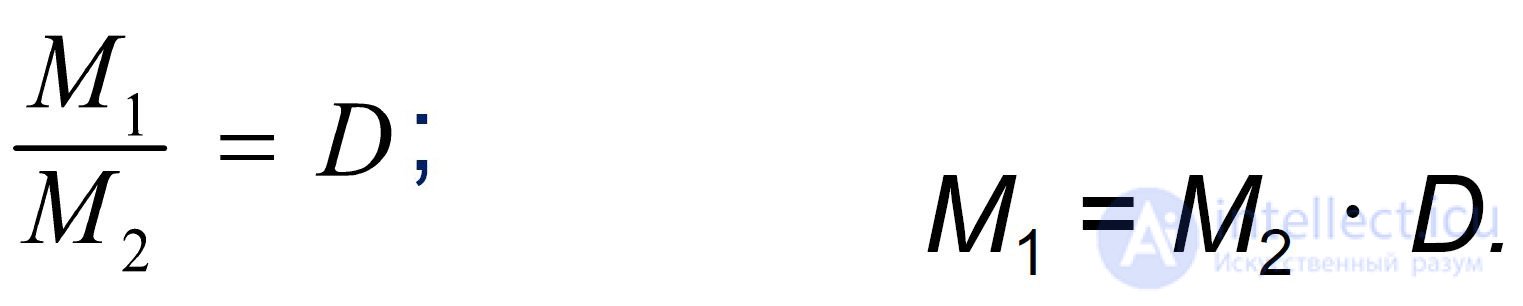
The ratio of the densities of gases, equal to the ratio of the molar masses, is called the relative density of one gas with respect to another (D). D is a dimensionless quantity.
Knowing D and the molar mass of one gas, it is easy to find the molar mass of the other gas:
Example 1. The relative density of a gas with respect to hydrogen is 8. Determine the molar mass of the gas.
M(X) = M(H2) ∙ D = 2 ∙ 8 = 16 g/mol.
The gas with this molar mass is methane CH4.
Example 2. The relative density of a certain gaseous hydrocarbon with respect to air is 2. Determine the molar mass of the hydrocarbon.
The average molar mass of air is 29 g/mol;
M(X) = M(air) ∙ D = 29 ∙ 2 = 58 g/mol.
The hydrocarbon with this molar mass is butane C4H10.
It should be noted that gases with a molar mass less than 29 are lighter than air, and those greater than 29 are heavier.
In calculation problems, the relative densities of an unknown gas with respect to nitrogen, oxygen, and other gases may be given. In this case, to find the molar mass of the unknown gas, the relative density must be multiplied by the molar mass of nitrogen (28 g/mol), oxygen (32 g/mol), etc., respectively.
Avogadro's law is widely used in chemical calculations. Since, for gases, volumes are proportional to the amounts (moles) of substances, the coefficients in the equation of a reaction between gaseous substances, which reflect the quantitative ratio of the reacting substances, are proportional to the volumes of the interacting gases. Obviously, the volumes must be measured under the same conditions.
Example 3. What volume of oxygen is required to burn 2 dm3 of propane? Volumes are measured at STP.
The equation of the combustion reaction of propane:
C3H8 + 5O2  3CO2 + 4H2O
It follows from Avogadro's law that equal volumes of different gases contain the same amount (moles) of substances. Let the volume of propane be 1 dm3. Then, according to the equation above, burning 1 dm3 of propane will require 5 dm3 of oxygen. Consequently, burning 2 dm3 of propane will require:
1 dm3 C3H8 — 5 dm3 O2,
2 dm3 C3H8 — 10 dm3 O2
Answer: V(O2) = 10 dm3.
Gas mixtures
Consider two flasks with a volume of 0,5 dm3. One flask is filled with nitrogen, and the other with methane. The pressure and temperature in the flasks are the same. If the contents of these flasks are mixed, the resulting mixture will occupy a volume of 1 dm3 under the same conditions.
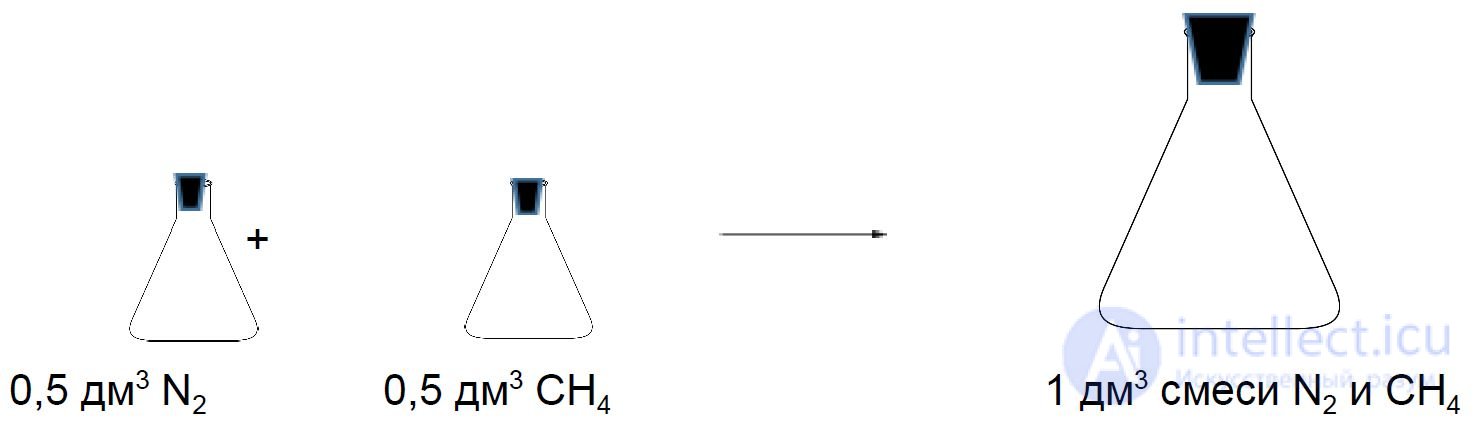
The composition of a gas mixture is often expressed in volume fractions. The volume fraction of a gas is denoted by the Greek letter φ (phi) and equals the ratio of the volume of the given gas to the volume of the mixture. Let us calculate the volume fraction of nitrogen in the gas mixture obtained above:
φ = 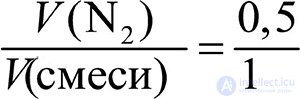 = 0,5, or 50 %.
Example 4. As a result of passing 150 dm3 (STP) of air through an excess of limewater, 0,201 g of precipitate formed. Find the volume fraction (%) of carbon dioxide in this air sample.
The equation of the reaction between carbon dioxide and limewater:
CO2 + Ca(OH)2 = CaCO3 + H2O
+ H2O
Let us find the amount (moles) of calcium carbonate precipitate (M(CaCO3) = 100 g/mol):
n(CaCO3) = 0,201/100 = 0,00201 mol.
According to the reaction equation:
n(CaCO3) = n(CO2).
Let us calculate the volume fraction of carbon dioxide in the air:
V(CO2) = 0,00201 ∙ 22,4 = 0,045 dm3;
φ(CO2) = 0,045/150 = 0,0003, or 0,03 %.
Answer: φ(CO2) = 0,03 %.
Example 5. The volume of a mixture of hydrogen and chlorine is 50 cm3. After the gases reacted, 10 cm3 of chlorine remained. Find the composition of the initial mixture in volume fractions. All volumes are measured at STP.
The equation of the reaction between hydrogen and chlorine:
H2 + Cl2 2HCl
Since 10 cm3 of chlorine remained after the reaction, 40 cm3 of the initial mixture reacted. Chlorine and hydrogen react with each other in equal volume ratios. Based on this reasoning, 20 cm3 each of chlorine and hydrogen entered into the reaction. Since 10 cm3 of chlorine remained, the initial mixture contained 20 cm3 of hydrogen and 30 cm3 of chlorine.
Let us calculate the volume fractions of the gases in the initial mixture:
φ(H2) = 20/50 = 0,4, or 40 %;
φ(Cl2) = 30/50 = 0,6, or 60 %.
Answer: φ(H2) = 40 %; φ(Cl2) = 60 %.
According to Avogadro's law, equal volumes of different gases under the same conditions contain the same number of molecules.
One mole of any gas under standard conditions (the melting temperature of ice, atmospheric pressure) occupies a volume of
22,4 dm3. This value is called the molar volume of a gas (Vm).
The densities of gases, measured under the same conditions, are related to each other as their molar masses. This ratio is called the relative density of one gas with respect to another gas.
Gases with a molar mass greater than 29 g/mol are heavier than air, and less than 29 g/mol — lighter than air.
The volume fraction of a gas in a mixture equals the ratio of the volume of the given gas to the total volume of the mixture.
1. State Avogadro's law. Why does it hold for gaseous substances but not for substances in the solid or liquid state?
2. What is the molar volume of a gas? How does it change with increasing temperature and pressure?
3. How did the results of experiments measuring the volumes of gases involved in the reactions of chlorine with hydrogen and nitrogen with oxygen allow Avogadro to conclude that nitrogen, oxygen, chlorine, and hydrogen consist of diatomic molecules? Note that the reaction of nitrogen with oxygen, which proceeds only at an extremely high temperature, produces nitrogen(II) oxide.
4. The relative density of a certain hydrocarbon with respect to hydrogen is 15. Determine the molar mass of the hydrocarbon and give its formula.
5. As a result of the explosion of a mixture consisting of 1 dm3 of an unknown gas and 2 dm3 of oxygen (the starting substances reacted completely), 2 dm3 of carbon dioxide and 1 dm3 of nitrogen were formed. All volumes are measured under the same conditions. Determine the formula of the unknown gas. (Answer: C2N2.)

Comments