
Lecture
Hydrocarbons with two double bonds in the molecule are known. Recall that the presence of a carbon-carbon double bond is denoted by the suffix -ene, and the corresponding class of compounds is called alkenes. The presence of two double bonds in a molecule is denoted by -diene, and the corresponding class of compounds is called alkadienes.
Let us derive the general molecular formula for the class. Recall that the general formula for the class of alkanes is CnH2n+2. From the previous section you learned that an alkene molecule is formed as a result of the elimination of two hydrogen atoms from an alkane molecule. Thus, the formation of one double bond leads to a decrease in the hydrogen content of the molecule by two atoms, so the general formula of alkenes is CnH2n. The formation of another double bond will decrease the number of hydrogen atoms in the molecule by two more; therefore, the general formula of alkadienes is CnH2n–2.
The names of alkadienes are formed according to the same rules as those of alkenes, except that the suffix -ene is replaced by -diene.
Let us give a few examples of the formulas and names of alkadienes:
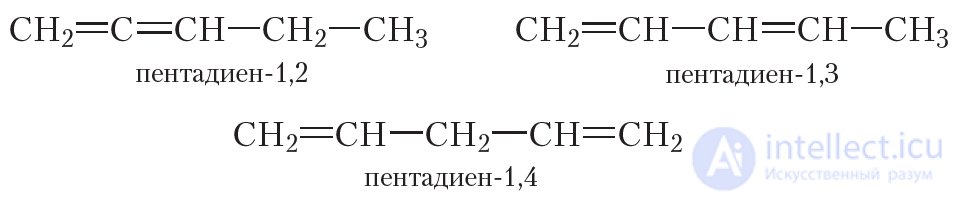
As can be seen, the relative arrangement of the double bonds in alkadiene molecules can vary.
Of greatest practical interest are alkadienes in whose molecules the double bonds are separated by one single bond. Such alkadienes are called conjugated alkadienes. The simplest representative of conjugated dienes is buta-1,3-diene:

It is a colorless gaseous substance with a pungent odor (tb.p. = –4 °C).
Let us examine its structure in more detail.
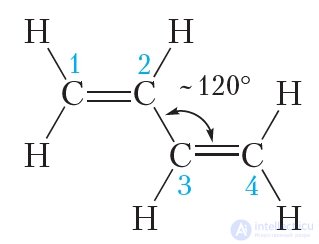
All four carbon atoms in the buta-1,3-diene molecule are in a state of sp2 hybridization. The three hybrid orbitals of each carbon atom lie in the same plane at angles of 120°. Accordingly, the atoms in the buta-1,3-diene molecule also lie in the same plane, with bond angles approximately equal to 120°:
The non-hybrid p-orbitals of each carbon atom are oriented perpendicular to the plane of the molecule. Overlap of the non-hybrid p-orbitals forms π-bonds:
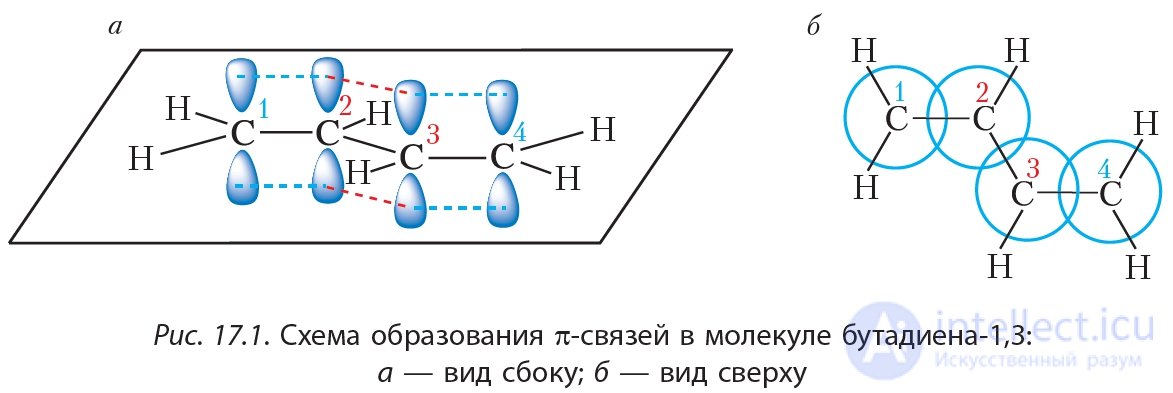
From Figure 17.1, b it can be seen that the overlap of the non-hybrid p-orbitals occurs between the carbon atoms joined by double bonds 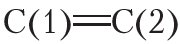 and
and 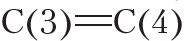 . But, in addition, this molecule also has an overlap of p-orbitals between the second and third carbon atoms. Thus, the π-bonds in the buta-1,3-diene molecule are not isolated; they form a single conjugated system spanning all four carbon atoms. In other words, the π-electrons in the butadiene molecule do not belong to individual bonds. In this case, the π-electrons are said to be delocalized.
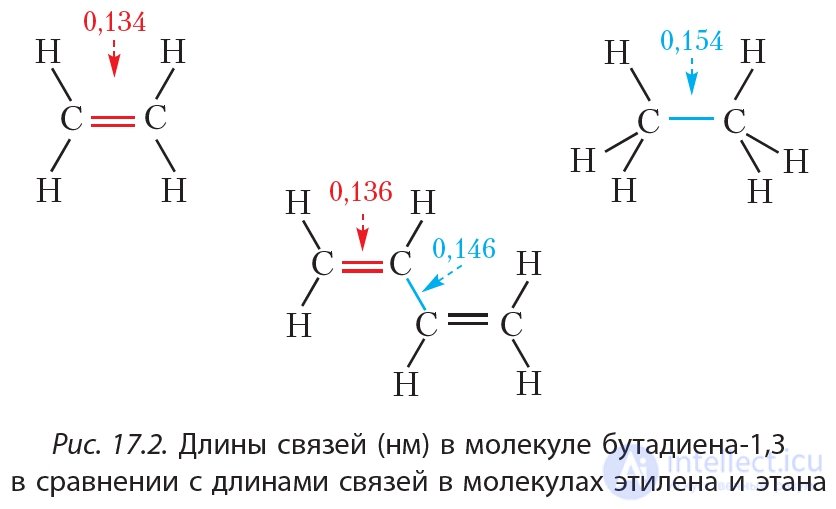
Conjugation leads to a certain equalization of the lengths of the double and single bonds in the buta-1,3-diene molecule.
Figure 17.2 shows that the double bonds in the buta-1,3-diene molecule are somewhat longer than in the ethylene molecule, while the bond 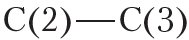 in the buta-1,3-diene molecule is significantly shorter than in the ethane molecule. The conjugation effect also influences the chemical properties of dienes, which will be discussed below.
1. Halogenation. Addition of Halogens
Since alkadiene molecules contain double bonds, addition reactions are characteristic of them, just as they are for alkenes. Alkadienes decolorize bromine water and add hydrogen halides, hydrogen, etc. However, owing to the conjugation effect, addition reactions here have their own peculiarities. Thus, when one molecule of bromine adds to a buta-1,3-diene molecule, two products can be obtained. One of them is formed as a result of the addition of a bromine molecule across either of the double bonds (the product of 1,2-addition). In this case, buta-1,3-diene behaves like an alkene. The other product is obtained as a result of 1,4-addition: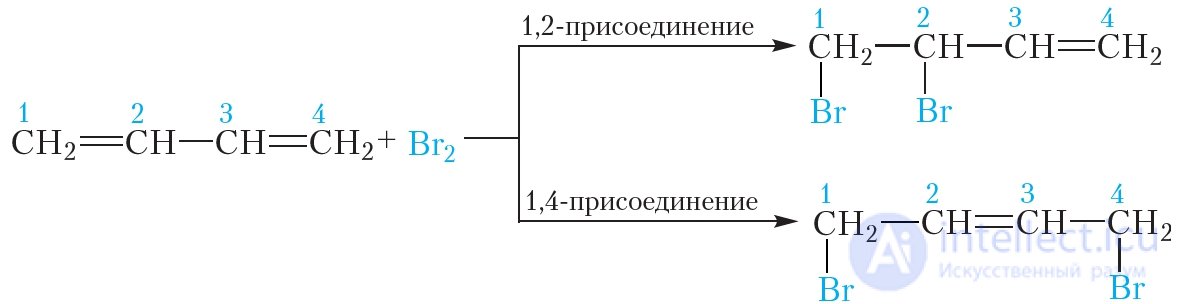
The process of 1,4-addition can be represented schematically as follows. The bromine atoms add to the terminal carbon atoms:
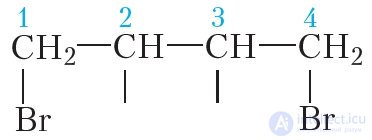
In this process, free valences appear at the second and third carbon atoms, and a π-bond forms between them in the middle of the molecule:
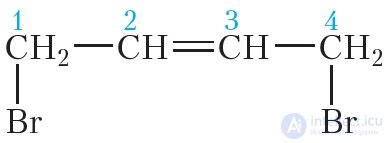
 The molecules of the 1,2- and 1,4-addition products contain a double bond, so each such molecule can add one more molecule of bromine. If enough bromine is present, a substance containing four bromine atoms per molecule is formed:

2. Polymerization
Owing to the presence of double bonds, alkadienes, like alkenes, can undergo the polymerization reaction. Polymerization of conjugated alkadienes is of great industrial importance, since the production of rubbers — polymers with high elasticity and wide practical application — is based on this process.
In addition to synthetic rubbers, produced industrially by the polymerization of conjugated dienes, there is also natural rubber. Natural rubber occurs in nature and is the product of the polymerization of 2-methylbuta-1,3-diene, or isoprene:
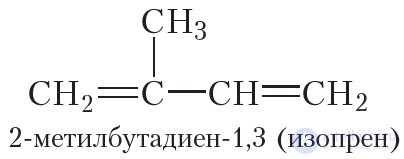
Owing to the widespread use of rubber-based products, by the early 20th century the volumes of natural rubber production had become insufficient, so intensive development of methods for producing synthetic analogues began. The industrial-scale synthesis of rubber by polymerization of buta-1,3-diene was first carried out in the world in the USSR in 1930, based on a method developed by S. V. Lebedev.
Let us consider the polymerization reaction of buta-1,3-diene, which produces synthetic rubber. The polymerization process can be represented as a repeatedly occurring addition reaction of buta-1,3-diene molecules to one another. As you already know, conjugated alkadienes can undergo 1,2- and 1,4-addition reactions. Only the products of the polymerization reaction proceeding as 1,4-addition — 1,4-polymerization — possess the properties of rubber. Let us represent this process schematically.
First, as a result of the breaking of the double bonds, two molecules of buta-1,3-diene combine:

In this process, owing to the free valences that appear at the second and third carbon atoms, π-bonds form in the middle of the molecules.
The next molecule of buta-1,3-diene adds to the particle that has formed:

As the 1,4-addition process is repeated many times, a polymer molecule is formed. The polymerization process is expressed by the following equation:

The polymerization product is called 1,4-polybutadiene. Polybutadiene is a synthetic rubber.
Let us give the equation for the polymerization reaction of isoprene:
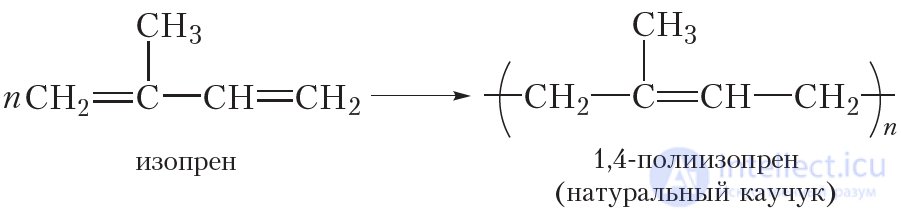
Properties of rubber. The most important property of rubber is elasticity, that is, the ability to stretch and contract and then recover its original shape after the applied force ceases to act. The high elasticity of rubber is explained by the fact that its macromolecules have the shape of coils, which can stretch and contract like springs.
The elasticity of rubber manifests itself only under small loads. If rubber is stretched with a sufficiently large force, not only will the macromolecules straighten out, but they will also shift relative to one another. This will lead to irreversible deformation of the sample.
Vulcanization of rubber. Natural and synthetic rubbers are used mainly in the form of vulcanized rubber, since it possesses considerably greater strength, elasticity, and a number of other valuable properties. To obtain vulcanized rubber, rubber is subjected to vulcanization — heating rubber with sulfur. In this process, sulfur enters into chemical interaction with the coiled rubber molecules, as if «stitching» them together (Fig. 17.3).
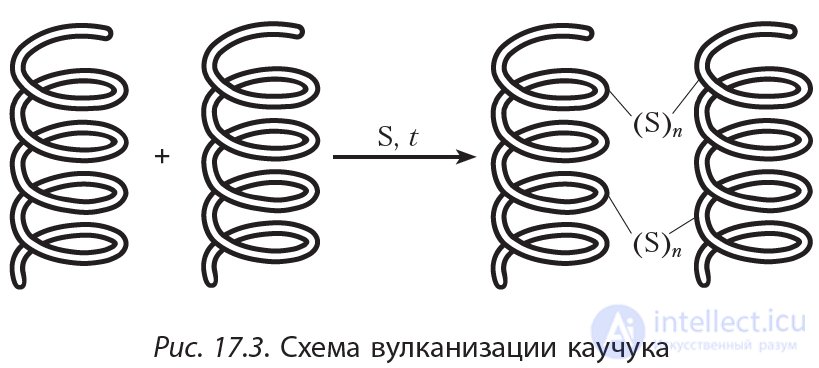
«Stitched» molecules cannot shift relative to one another even under high loads, so as a result of vulcanization the elasticity of the material increases.
The monomers for the production of rubbers — buta-1,3-diene and isoprene — are currently synthesized from petroleum refining products.
Butadiene is formed by dehydrogenation of butane:

Isoprene is obtained by dehydrogenation of 2-methylbutane:

 You can learn about other methods of obtaining conjugated dienes by following the link in the QR code.
|
Non-cyclic hydrocarbons in whose molecules there are two double bonds are called alkadienes. General formula of alkadienes CnH2n–2. Alkadienes in whose molecules the double bonds Conjugated alkadienes are capable of undergoing 1,2- and 1,4-addition reactions. The polymerization reaction of conjugated alkadienes produces rubbers — polymers with high elasticity and great practical significance. Heating rubber with sulfur produces vulcanized rubber. This process is called vulcanization. Buta-1,3-diene and isoprene are obtained by the dehydrogenation reaction of butane and 2-methylbutane, respectively. |
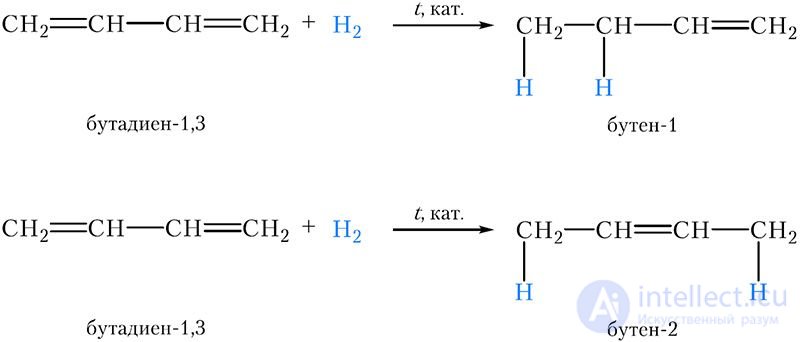
When heated in the presence of a catalyst, one mole of alkadiene can add two moles of hydrogen:

This is the case of complete hydrogenation of a diene. The product of complete hydrogenation of buta-1,3-diene is butane.
Hydrogenation may proceed incompletely, i.e., one molecule of diene can add one molecule of hydrogen, and, as in the case of bromination, products of 1,2- and 1,4-addition can be formed:
Dehydrohalogenation of Dihalogenated Alkane Derivatives
Alkadienes can be obtained by dehydrohalogenation of dihalogenated alkane derivatives with an alcoholic alkali solution:

The Lebedev Reaction
Buta-1,3-diene can be obtained by the simultaneous dehydrogenation and dehydration of ethyl alcohol (the Lebedev reaction). This process is carried out by passing ethyl alcohol vapor over a catalyst based on zinc and aluminum oxides at a temperature of 400–450 °C:

1. Write the structural formulas of two conjugated alkadienes of composition C5H8 and name them. Which of the substances you have given can exist as cis- and trans-isomers?
2. Write the equations for the reactions that take place and name the substances formed as a result of addition to a buta-1,3-diene molecule of: a) one molecule of bromine; b) one molecule of hydrogen; c) two molecules of bromine. Take into account the possibility of forming 1,2- and 1,4-addition products.
3. Write the formulas of the possible products formed by the successive addition to a buta-1,3-diene molecule of first one molecule of bromine, and then one molecule of chlorine.
4. What structural features explain the elasticity of rubber?
5. How can the presence of double bonds in rubber macromolecules be demonstrated experimentally?
6. Give the formulas of natural rubber and synthetic (butadiene) rubber. Are their monomers homologues?
7*. One type of synthetic rubber — butyl rubber — is characterized by such valuable properties as high elasticity, chemical resistance, and gas impermeability. It is used to manufacture automobile inner tubes, membranes, rubberized fabrics, electrical insulation materials, and others. Butyl rubber is synthesized by the copolymerization of 2-methylpropene (isobutylene) and isoprene. The macromolecules of butyl rubber contain units of both monomers.
a) Write the structural formulas of the monomer units of butyl rubber.
b) Butyl rubber with a mass of 26,22 g can decolorize 48 g of a 5% solution of bromine in CCl4. Calculate how many isobutylene monomer units correspond to one isoprene monomer unit in butyl rubber.
8*. Depict the spatial structure of the isoprene molecule. Indicate the type of hybridization of each carbon atom.
9*. Dienes in whose molecules the double bonds are located at one carbon atom (CH2  C CH2), are called dienes with cumulated double bonds. Dienes in whose molecules the double bonds are separated by two or more single bonds (CH2 CH
  CH2 CH CH2), are called dienes with isolated double bonds. Give the structural formulas of the isomeric dienes of composition C5H8. Among them, identify the dienes with cumulated, conjugated, and isolated double bonds, and give names for all the compounds. Indicate the type of hybridization of the carbon atoms in the molecules of these compounds.
10*. Which hydrocarbon is the product of complete hydrogenation of isoprene? Write the equation for the reaction and name the resulting substance.
11*. Write the structural formulas of all the substances that can be obtained by the addition of one or two molecules of bromine to a molecule of isoprene. Give names for these substances.
12*. What mass of rubber can be obtained by the Lebedev method from 1 m3 of technical alcohol with a density of 0,79 g/cm3, containing 96 % ethanol by mass, if the yield of the reaction to obtain buta-1,3-diene is 95 %, and of the polymerization reaction is 98 %?
(Answer: 414,4 kg.)
 are separated by one single bond are called conjugated alkadienes. In the molecules of conjugated alkadienes, the π-electrons are delocalized.
Comments