
Lecture
Starch is a white powder. Unlike glucose, fructose, and sucrose, it has no sweet taste and does not dissolve in cold water. When mixed with hot water, starch forms a viscous, sticky colloidal solution — a paste. This solution can be used to glue paper to various surfaces.
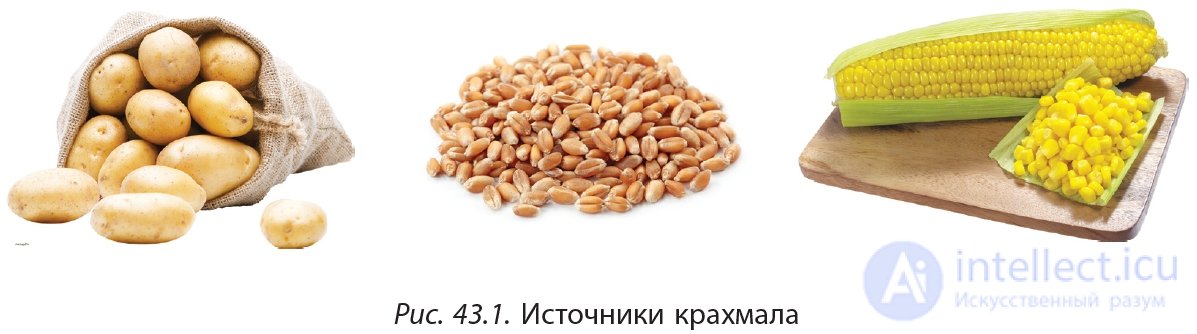
Starch is widespread in nature; it is formed as a result of photosynthesis and accumulates in the seeds, tubers, and fruits of plants (Fig. 43.1). The grains of corn, wheat, and rice are richest in starch (starch content reaches 70–80 %), as are potato tubers (more than 20 %).
Let us consider the composition and structure of starch. The molecular formula of starch is — (C6H10O5)n, that is, starch is a polymer. It has been established that starch macromolecules consist of α-glucose residues. The process of forming starch from glucose can then be represented by the following scheme: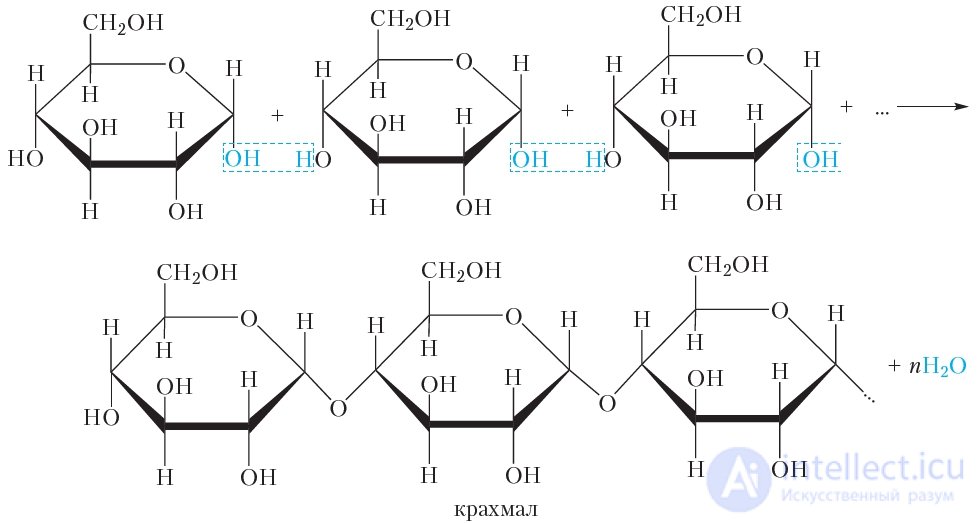
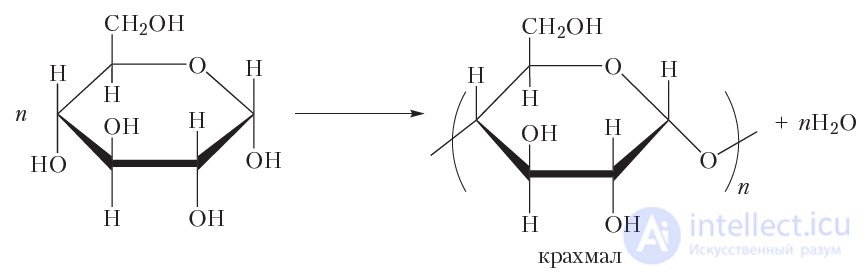
Thus, starch is a product of the polycondensation of glucose. The starch macromolecule consists of a large number of residues of the monosaccharide glucose. Therefore, starch is a polysaccharide.
Starch macromolecules can be linear or branched, that is, starch is a mixture of two polymers called amylose and amylopectin.
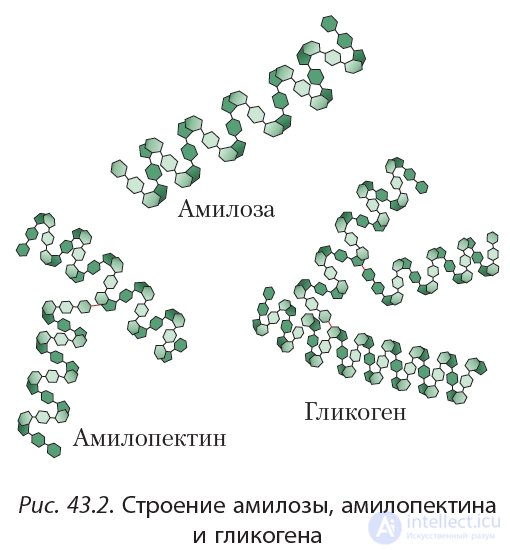
Amylose — is an unbranched polymer (Fig. 43.2). Amylose macromolecules have the shape of a helix. Certain molecules, such as an iodine molecule, can fit inside the helix. This forms what is known as an inclusion compound, in which the iodine molecule is «included» inside the helical amylose macromolecule. This compound has a bright blue color. The formation of a bright blue inclusion compound upon reaction with iodine is a characteristic reaction for starch, and conversely, even small amounts of iodine can be detected using a starch solution.
Starch also contains branched macromolecules. The branched polymer is called amylopectin (Fig. 43.2).
Like plants, animal organisms also contain a polysaccharide made up of α-glucose residues. It is called glycogen. Glycogen is similar in structure to amylopectin, but is even more highly branched (Fig. 43.2).
In the starch macromolecule, the cyclic forms of glucose are fixed, so starch does not exhibit properties characteristic of aldehydes. Starch does not give the «silver mirror» reaction and does not form a red precipitate of copper(I) oxide when heated with copper(II) hydroxide.
At the same time, starch exhibits some chemical properties characteristic of sucrose. We already know that, unlike monosaccharides, the disaccharide sucrose undergoes hydrolysis. In this process, the sucrose molecule is broken down, and two monosaccharide molecules are formed: glucose and fructose (§ 42). Being a polysaccharide, starch also undergoes hydrolysis. If starch paste is heated with a few drops of sulfuric acid, the gradual breakdown of starch macromolecules occurs. In this process, products of partial breakdown of the macromolecules, having a molecular mass lower than that of starch, form first — dextrins. With further breakdown of the molecules, the disaccharide maltose may form. The final product of hydrolysis is glucose:
 You can learn how the hydrolysis of starch is carried out in practice by following the link in the QR code.
Starch is one of the most widespread carbohydrates in the human diet. Under the action of digestive enzymes, starch macromolecules are hydrolyzed to glucose. In cells, glucose is oxidized to carbon dioxide and water. This process is accompanied by the release of a large amount of energy needed for the functioning of the body. Excess glucose is stored «in reserve» in cells in the form of glycogen.
Starch is used in the preparation of a variety of food products: kissel, mousses, jellies, confectionery, and culinary products. It is used for treating fabrics and producing adhesive compounds. In chemical laboratories, starch is used as a sensitive indicator for the presence of iodine.
Partial hydrolysis of starch produces starch syrup — a thick sweet mass that is a mixture of dextrins, maltose, and glucose.
Starch syrup is used in the food industry in the production of confectionery products, among others.
Complete hydrolysis of starch produces glucose. Glucose fermentation reactions are used for the production of ethyl alcohol, lactic acid, and other substances.
Starch is obtained by extraction from natural sources (cereal grains, potato tubers).
|
Starch is a natural polysaccharide; it is formed as a result of photosynthesis and accumulates in plants. The molecular formula of starch is — (C6H10O5)n. Starch macromolecules consist of residues of α-glucose linked to each other by oxygen bridges. Starch is a mixture of two polymers — amylose and amylopectin. A characteristic reaction for starch is the formation of a bright blue inclusion compound upon reaction with iodine. Complete hydrolysis of starch produces glucose. Starch is obtained by extraction from natural sources — potatoes, rice, wheat, and corn. Animal organisms also contain a polysaccharide made up of residues of α-glucose. It is called glycogen. |
1. Give the molecular formula of starch and the equation of the reaction of its complete hydrolysis.
2. Write the scheme for producing starch from glucose. Why is the reaction of producing starch from glucose called polycondensation and not polymerization?
3. The following experiment can easily be carried out at home. If a drop of iodine tincture is applied to a piece of white bread or a fresh cut of a potato tuber, a blue color will appear. Explain the observed effect.
4. A few drops of sulfuric acid were added to starch paste and the mixture was heated. The solution was then neutralized with alkali. Will the resulting mixture give the «silver mirror» reaction? Give the equations of the reactions.
5. Hydrolysis of starch can yield the disaccharide maltose. Give the structural formula of maltose. Write the equation of the hydrolysis reaction of maltose, using the structural formulas of the substances.
6. The average relative molecular mass of starch is 405 000. Determine the average number of glucose residues in a starch molecule.
7. Calculate the masses of: a) wheat, b) potatoes, that would theoretically be required to obtain 100 L of ethanol with a density of 0,79 g/mL. Take the starch content in wheat and potato tubers to be 75 % and 24 % by mass, respectively.
8. The mass fraction of starch in corn is 65 %. The overall yield of ethanol production from corn is 70 % of the theoretically possible yield. Determine the mass of ethanol that will be obtained from 324 g of corn.

Comments