
Lecture
1. Basic properties
In amine molecules, the nitrogen atom has a lone electron pair, so amines can add a hydrogen cation H+:
or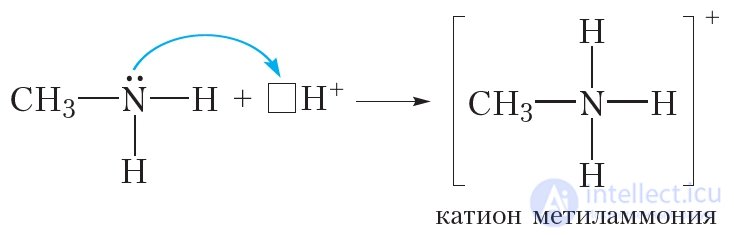
That is, just like ammonia, amines exhibit basic properties.
Thus, when methylamine dissolves in water, a reversible reaction takes place:

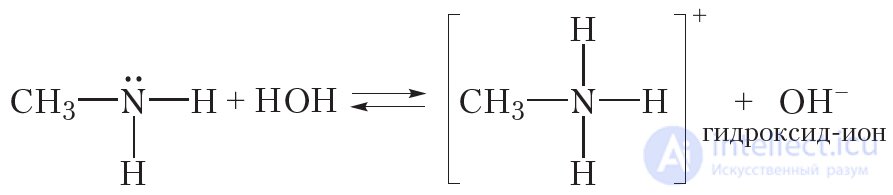
It can be seen that when reacting with water, a methylamine molecule adds a hydrogen cation. This forms the methylammonium ion CH3NH3+ and the hydroxide ion OH–. The presence of OH– ions causes the alkaline reaction of an aqueous methylamine solution, so a solution of methylamine in water turns phenolphthalein crimson.
The basic properties of amines are also manifested in reactions with acids. For example, when methylamine reacts with hydrochloric acid, a salt is formed — methylammonium chloride:
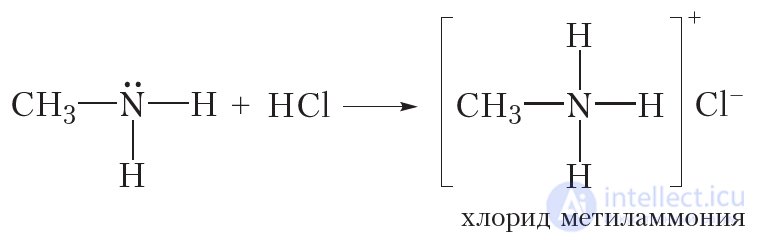
Like all salts, methylammonium chloride has an ionic structure. It consists of the methylammonium cation and the chloride anion. Methylammonium chloride is a solid substance that is highly soluble in water.
Methylamine reacts similarly with other acids:
or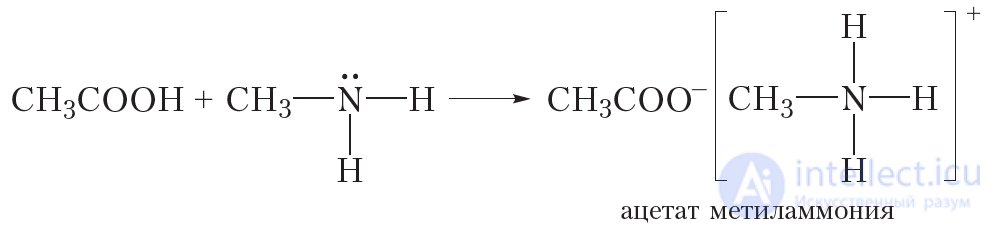
These reactions consist in the addition of a hydrogen cation H+ to a methylamine molecule.
We have examined the reaction of methylamine with water and acids. Obviously, other amines will react in a similar way:
or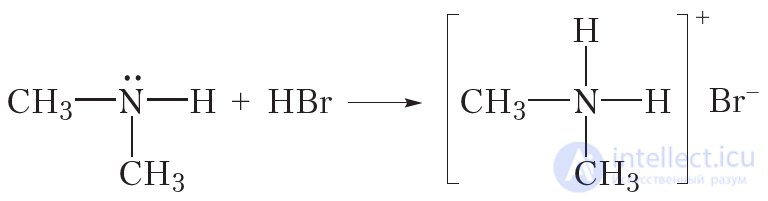 Amine salts are solid substances that are highly soluble in water. Alkalis displace amines from their salts:

You encountered a similar reaction when studying inorganic chemistry, when considering the displacement of ammonia from ammonium salts by alkalis.
2. Combustion
Like most organic compounds, amines burn in oxygen.
This produces carbon dioxide, water, and nitrogen:

Structural formula of aniline: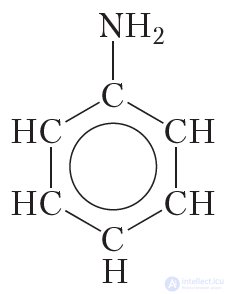 Because of the influence of the benzene ring on the amino group, some properties of aniline differ from the chemical properties of saturated amines. On the other hand, the amino group in the aniline molecule influences the properties of the benzene ring.
Reactions of the amino group
Because of the influence of the benzene ring on the amino group, the basic properties of aniline are weaker than those of saturated amines. Thus, unlike saturated amines, an aqueous solution of aniline does not change the color of indicators. At the same time, like saturated amines, aniline forms salts when reacting with acids: or
or
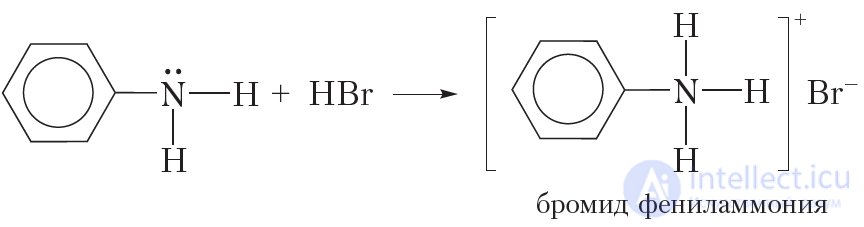
Substitution reactions in the benzene ring
In the aniline molecule, the amino group affects the properties of the benzene ring, facilitating substitution of hydrogen atoms. Thus, when a solution of aniline is mixed with bromine water, the water is observed to decolorize and a white precipitate forms. The equation for the reaction taking place: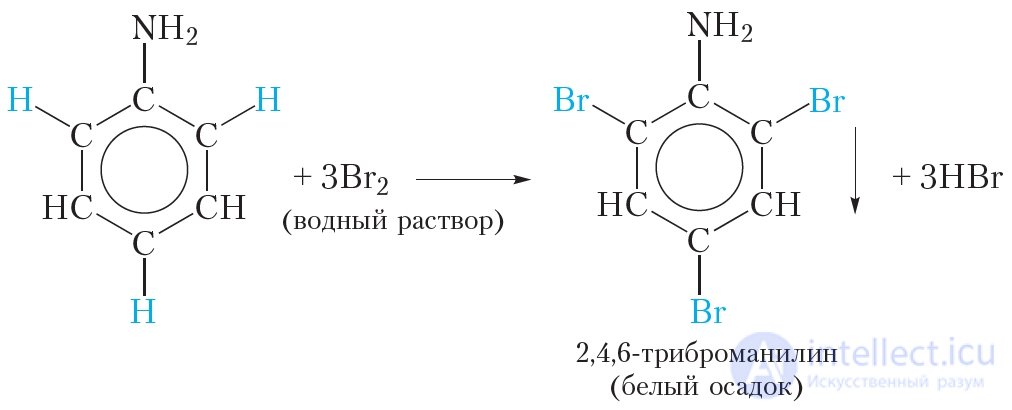 As a result of the reaction, three hydrogen atoms of the benzene ring are replaced by bromine atoms, forming 2,4,6-tribromoaniline. Note that substitution of a hydrogen atom of the benzene ring by a bromine atom is also possible for benzene, but the reaction conditions are much harsher than for aniline. Recall that a similar effect on the benzene ring is exerted by the hydroxyl group in a phenol molecule (§ 27).
Amines can be obtained from nitro compounds, which you became familiar with when studying the nitration of benzene (§ 20). The essence of the reaction for obtaining amines from nitro compounds becomes clear if we compare the formulas of nitro compounds and amines:
As can be seen, to obtain an amine from a nitro compound, the oxygen atoms in the nitro compound molecule must be "replaced" with hydrogen atoms, that is, the substance must be reduced. Let us give the scheme of such a reaction:

The scheme shown does not indicate which substance is used to reduce the nitro compound; the reducing agent here is conventionally denoted [H].
Let us consider which substances are used in practice to reduce nitro compounds.
Reduction of nitro compounds with hydrogen in the presence of a catalyst: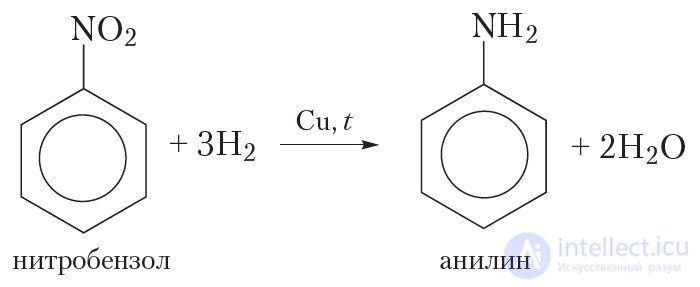
Reduction of nitro compounds with hydrogen at the moment of evolution. To obtain aniline by this method, nitrobenzene, concentrated hydrochloric acid, and iron filings are placed in a flask. Iron reacts with hydrochloric acid to form hydrogen, which is initially evolved in atomic form:

Atomic hydrogen has high reactivity and, without having time to combine into less active H2 molecules, reduces the nitro group of the nitrobenzene molecule:
 The resulting aniline reacts with hydrochloric acid, forming a salt:
The overall equation for the reduction of nitrobenzene by hydrogen at the moment of evolution:
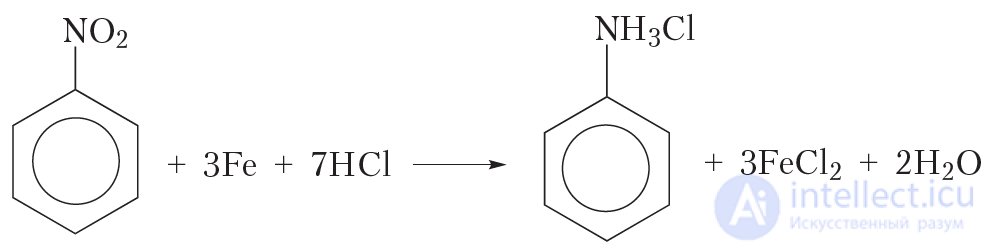
Aniline is displaced from the resulting salt by the action of an alkali: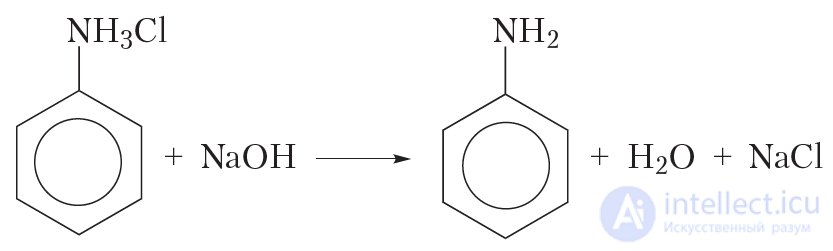
Thus, the process of obtaining aniline by reducing nitrobenzene with hydrogen at the moment of evolution can be represented by the scheme: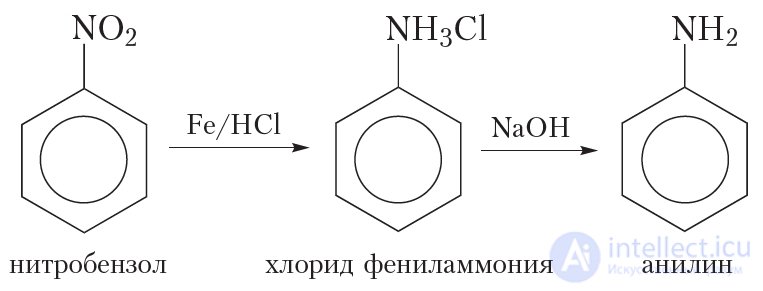
 Interesting to know
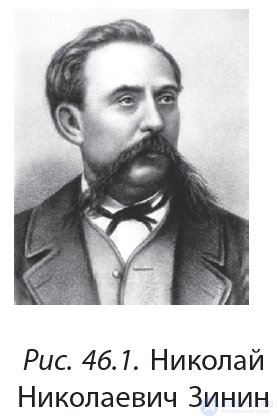
The reaction for obtaining amines by reduction of nitro compounds bears the name of the outstanding Russian chemist Nikolai Nikolaevich Zinin (1812–1880). He not only made a significant contribution to the development of organic chemistry, but also created a brilliant school of Russian organic chemists. His students included Alexander Mikhailovich Butlerov, the founder of the theory of the structure of organic compounds, and Alexander Porfiryevich Borodin, an outstanding chemist and composer — the author of the opera «Prince Igor».
 You can learn about other methods of obtaining amines by following the link in the QR code.
Amines are widely used in organic synthesis. They serve as starting materials for the production of dyes, pharmaceuticals, and many other substances.
|
Like ammonia, amines exhibit basic properties. Aqueous solutions of saturated amines have an alkaline reaction and therefore change the color of indicators. Amines form salts when reacting with acids. Amines burn in oxygen. This produces carbon dioxide, water, and nitrogen. The basic properties of aniline are weaker than those of saturated amines. An aqueous solution of aniline does not change the color of indicators. At the same time, aniline, like saturated amines, forms salts when reacting with acids. The amino group of the aniline molecule affects the benzene ring, facilitating substitution of hydrogen atoms at positions 2, 4, and 6; therefore, unlike benzene, aniline decolorizes bromine water. Amines are obtained by reduction of nitro compounds. |
1. Obtaining amines by reaction of alcohols with ammonia
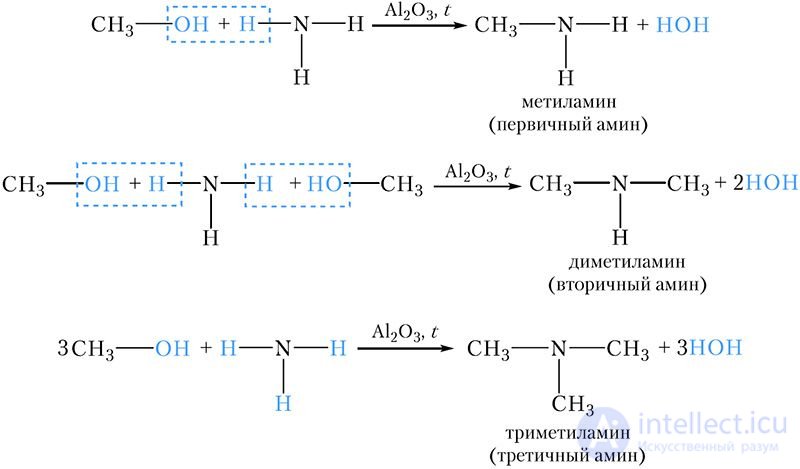
In industry, the simplest amines (methylamine, dimethylamine, and others) are obtained by reacting alcohols with ammonia in the presence of a catalyst at a temperature of 300–500 °C. In this process, the hydroxyl group of the alcohol is replaced by an amino group. Besides primary amines, secondary and tertiary amines are also formed in the reaction:
2. Obtaining amines by reaction of haloalkanes with ammonia
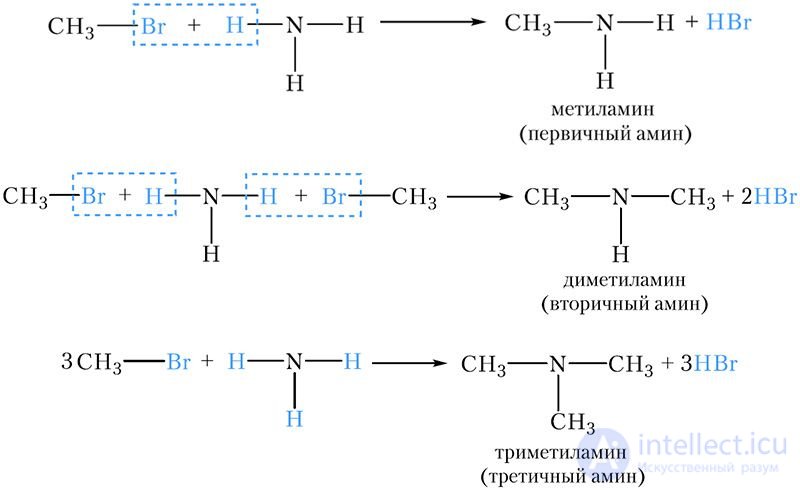
When haloalkanes react with ammonia, the halogen is replaced by an amino group. This reaction was discovered by the German chemist A. W. Hofmann. In this reaction, as with alcohols, besides primary amines, secondary and tertiary amines are also formed:
1. 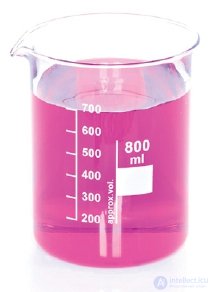 Organic substance A was dissolved in water. A few drops of phenolphthalein were added to the resulting solution. As a result, the solution turned crimson. Indicate the formula of substance A.
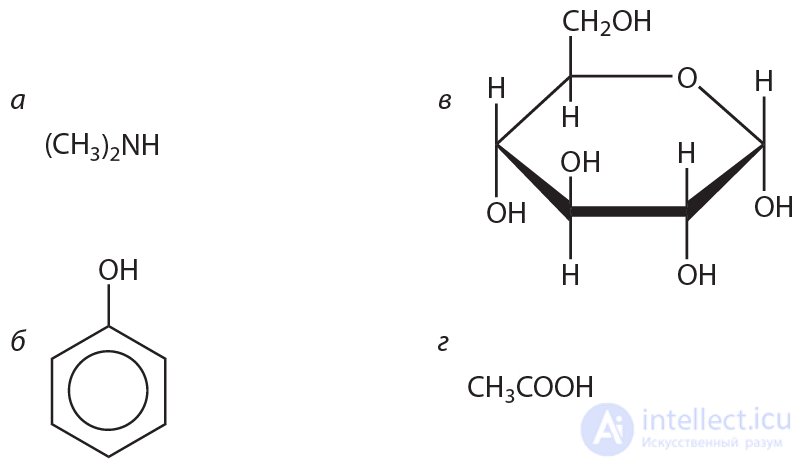
Give the equation for the reaction that occurs when substance A dissolves in water.
2. Write the equation for the reaction between ethylamine (2 mol) and a solution of sulfuric acid (1 mol). Name the product of the reaction.
3. How can aniline be obtained using benzene as the starting substance? Write the equations for the corresponding reactions.
4. Nitrobenzene, hydrobromic acid (excess), and iron filings were placed in a flask. This produced an organic substance X, in which the mass fraction of bromine is 46.0 %.
a) Write the equation for the reaction taking place and name substance X.
b) Write the molecular and ionic equations for the reaction of substance X with sodium hydroxide in aqueous solution.
c) Write the molecular and ionic equations for the reaction of substance X with silver nitrate in aqueous solution.
5. Solid organic substance A, which is soluble in water, forms a white curdy precipitate when reacting with an aqueous solution of silver nitrate. When potassium hydroxide acts on substance A, compound B is formed — a colorless oily liquid, sparingly soluble in water. When bromine water acts on B, a white precipitate of substance C forms. The mass fraction of nitrogen in substance A is 10.8 %. What are substances A, B, and C? Give their formulas and the equations of the reactions described.
6. Given the following transformation scheme:

Write the equations for the reactions taking place.
7. When 0.45 g of an organic substance was burned, 0.448 L (STP) of carbon dioxide, 0.63 g of water, and 0.112 L (STP) of nitrogen were released. The relative density of the vapor of the organic substance with respect to nitrogen is 1.607. Determine the molecular formula of this substance.
8. A certain organic compound, in addition to carbon and hydrogen, contains nitrogen, whose mass fraction is 23.7 %. This compound reacts with hydrochloric acid to form a salt; its molecule contains two hydrocarbon radicals and one nitrogen atom. Based on this data:
a) Determine the molecular formula of the organic compound.
b) Write its structural formula.
c) Give the equation for its reaction with hydrochloric acid.
9*. Can methylamine be obtained by reacting methane with ammonia? Briefly explain your answer.
10*. Propose a scheme for obtaining methylamine starting from methane and inorganic substances. Write the equations for the corresponding reactions.
11*. Propose a scheme for obtaining ethylamine starting from ethylene, water, and ammonia. Write the equations for the corresponding reactions.

Comments