
Lecture
Besides linear and branched chains, carbon atoms can also form rings.
Interesting to know
One of the first to suggest that carbon atoms could form rings was the outstanding German chemist August Kekulé (1829–1896), while puzzling over the structure of the benzene molecule. According to one version of the story, the scientist was prompted toward this idea by the sight of several monkeys at a zoo grabbing each other by the paws and tail. Other historians believe that Kekulé dreamed of a carbon chain as a wriggling snake that seized its own tail and froze in that position… This is reminiscent of the legend that Mendeleev also saw the periodic table in a dream.
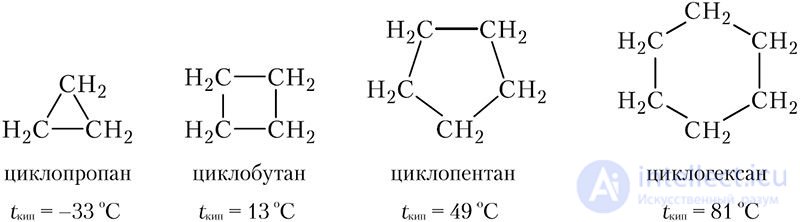
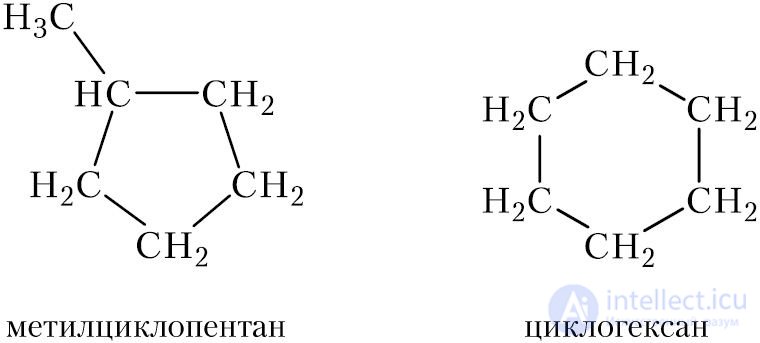
The diagram shows the formulas of substances containing rings of carbon atoms connected to one another by single covalent bonds; these substances are called cycloalkanes:
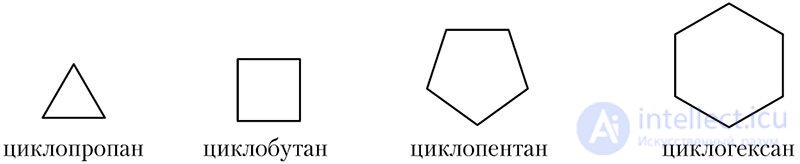
Skeletal formulas of cycloalkanes:
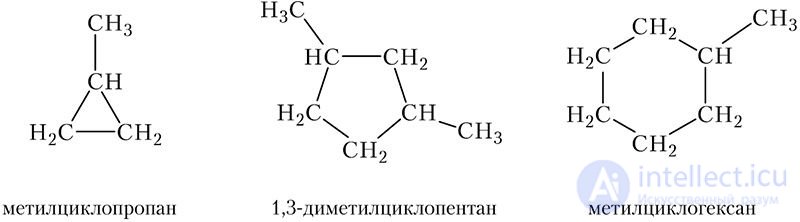
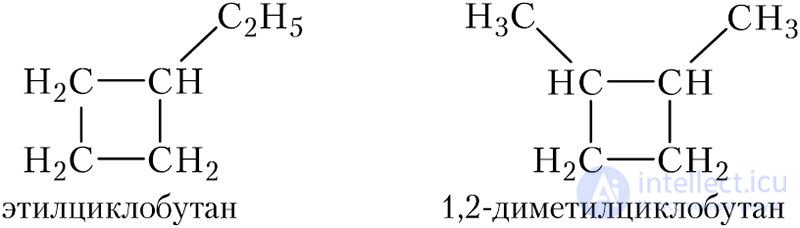
Molecules of cycloalkanes can contain substituents attached to the ring:
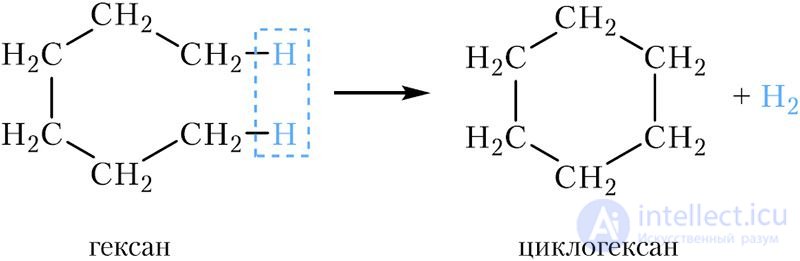
To close an open chain of carbon atoms into a ring, two hydrogen atoms must be removed from the alkane molecule:
Let us recall the general formula of alkanes: CnH2n+2. Cycloalkanes have two fewer hydrogen atoms, so their general formula is CnH2n+2.
Cycloalkanes — organic compounds of composition CnH2n, whose molecules contain a ring of carbon atoms connected to one another by single covalent bonds.
Let us consider the isomerism of cycloalkanes. Isomeric cycloalkanes can differ in the number of carbon atoms in the ring:
in the number of substituents on the ring and their structure:
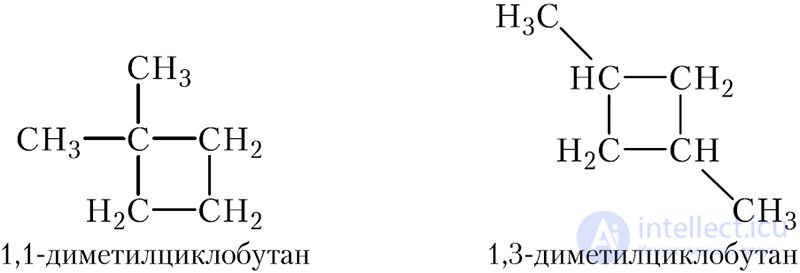
in the position of the substituents on the ring:
Thus, cycloalkanes have wider possibilities for isomerism than alkanes. For example, there are three isomeric alkanes containing five carbon atoms in the molecule:

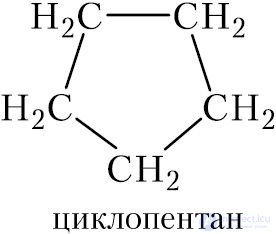
Let us determine the number of isomeric cycloalkanes with the same number of carbon atoms in the molecule, that is, of composition C5H10. From five carbon atoms one can form a five-membered ring:
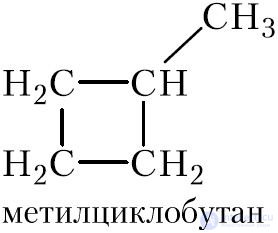
In a cycloalkane molecule of composition C5H10, four carbon atoms can form the ring, and one — be part of a substituent:
There also exist isomeric cycloalkanes of composition C5H10 whose molecules include a ring of three carbon atoms. In this case, the ring bears either two methyl groups (which may be located on the same carbon atom or on neighboring ones) or a single ethyl group:
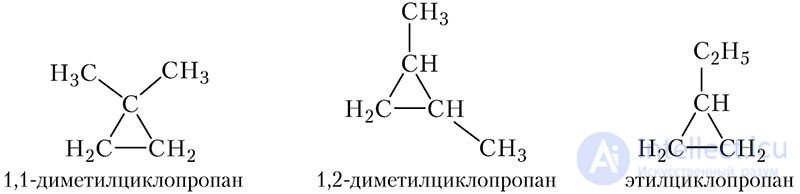
Thus, there are 5 isomeric cycloalkanes of composition C5H12.
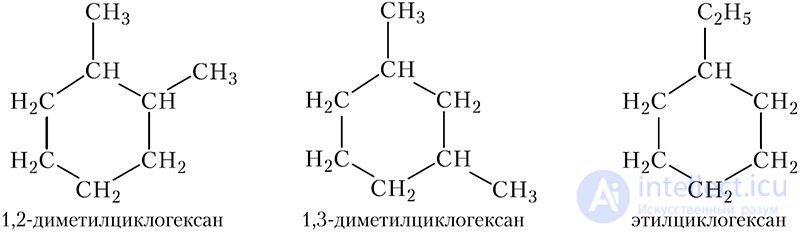
Let us consider the nomenclature of cycloalkanes. The basic principles for constructing the names of cycloalkanes are the same as for alkanes, except that instead of the longest carbon chain, the ring is chosen as the main chain. The carbon atoms in the ring are numbered so that the substituents receive the lowest possible numbers. Membership of a compound in the class of cycloalkanes is indicated by the prefix cyclo- and the suffix -ane. Using these rules, let us name some isomeric cycloalkanes of composition C8H16:
In their physical properties, cycloalkanes are similar to alkanes. At room temperature, cyclopropane and cyclobutane — gases, cycloalkanes from C5H10 to C10H20 — colorless liquids with a characteristic odor, and higher cycloalkanes are solid substances. Cycloalkanes are practically insoluble in water.
The chemical properties of cycloalkanes with different numbers of carbon atoms in the ring differ substantially. For example, addition reactions are typical of cyclopropane and cyclobutane. Cyclopentane and cyclohexane, on the contrary, are close to alkanes in their chemical properties: like alkanes, they do not react with acids and alkalis, but substitution reactions with halogens are typical of them. Let us consider the chemical properties of cyclohexane.
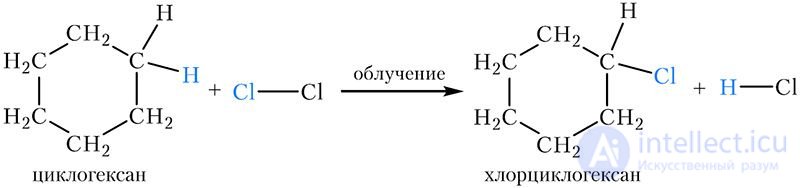
1. Halogenation. Like alkanes, in light cyclohexane undergoes a substitution reaction with chlorine and bromine:
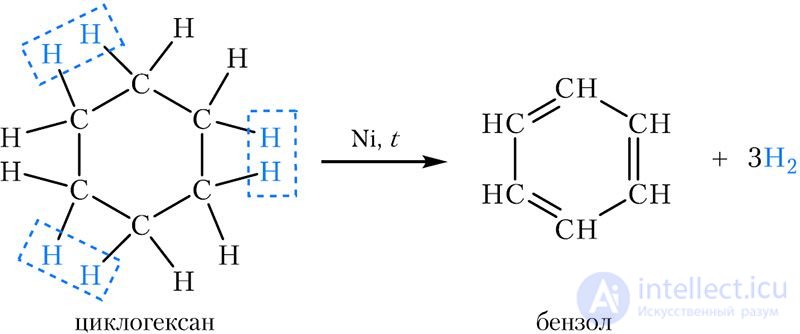
2. Dehydrogenation (removal of hydrogen). When cyclohexane vapor is passed over a heated nickel, platinum, or palladium catalyst, benzene is formed:
3. Oxidation. Like alkanes, cyclohexane burns when ignited:
C6H12 + 9O2  6CO2 + 6H2O
Cycloalkanes occur in nature. They are part of petroleum, which is why this class of hydrocarbons has another name — naphthenes. Cyclohexane is used to obtain caprolactam — the starting material for the synthesis of nylon 6. Cyclopropane is used in medicine as an anesthetic.
Cycloalkanes — organic compounds of composition CnH2n, whose molecules contain a ring of carbon atoms connected to one another by single covalent bonds.
The physical properties of cycloalkanes are similar to those of alkanes.
The chemical properties of cyclopentane and cyclohexane are similar to the properties of alkanes; for example, they undergo substitution reactions with halogens.
Cycloalkanes occur in nature; they are part of petroleum.
1. Write the structural formulas of ethylcyclopropane, 1,1-dimethylcyclobutane, cyclohexane, 1-methyl-2-ethylcyclopropane, and cyclopentane. Find the isomeric substances.
2. Calculate the mass fractions of carbon in cyclopropane and cyclopentane. Explain the results obtained. Is it possible to determine the molecular formula of a cycloalkane knowing only the mass fractions of the elements in its molecule?
3. Determine the molecular formula of a cycloalkane, given that the complete combustion of one volume of its vapor consumes six volumes of oxygen. (Answer: cyclobutane.)
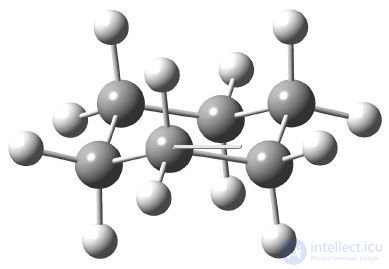
4. Below is a ball-and-stick model of a cyclohexane molecule. What hybridization state are the carbon atoms in this molecule in? Why do you think the carbon atoms in a cyclohexane molecule do not lie in a single plane?

Comments