
Lecture
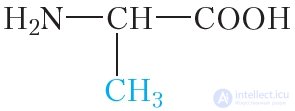
Molecules of proteins are built from α-amino acid residues:
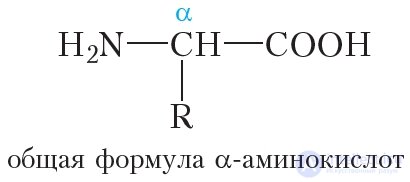
The formation of a protein molecule from α-amino acids can be represented by the following scheme: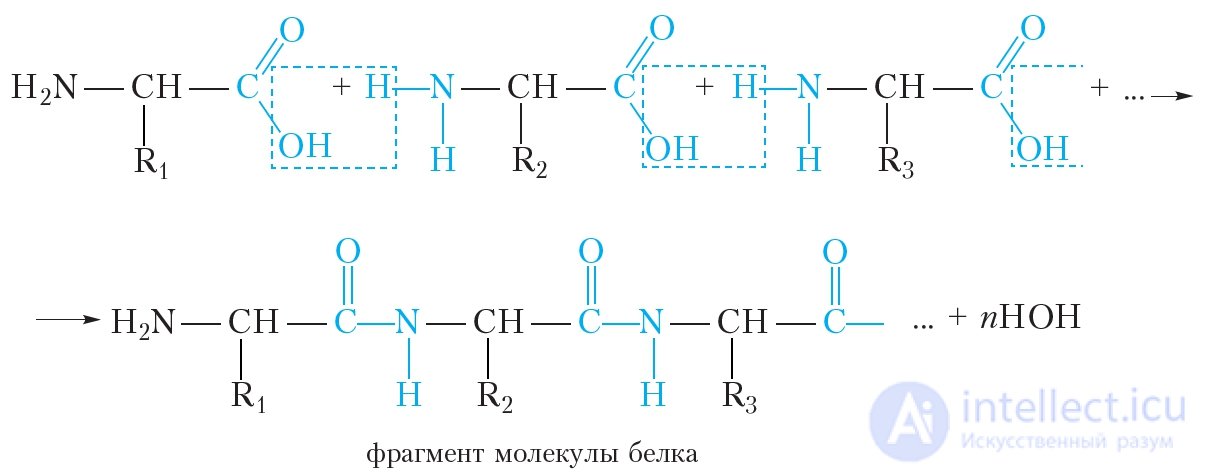
It can be seen that in protein molecules, amino acid residues are joined by peptide bonds; therefore, proteins are polypeptides.
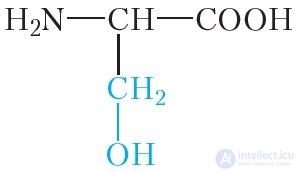
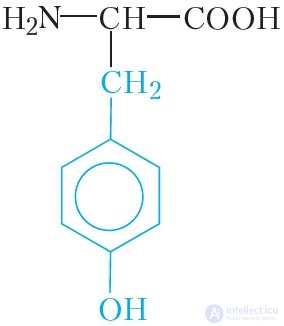
Protein molecules usually contain hundreds or even thousands of amino acid residues. Most often, proteins contain residues of 20 different amino acids (Table 48.1).
Table 48.1. Some amino acids whose residues are part of proteins
|
Formula |
Name |
Abbreviation |
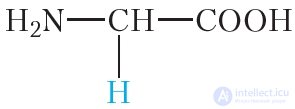 |
glycine | Gly |
|
|
alanine |
Ala |
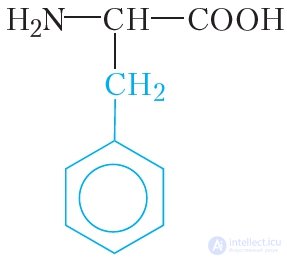 |
phenylalanine | Phe |
 |
serine |
Ser |
|
|
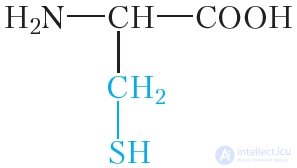
cysteine |
Cys |
 |
tyrosine | Tyr |
The residues of these amino acids are arranged in the protein macromolecule in a strictly defined sequence (Fig. 48.1).
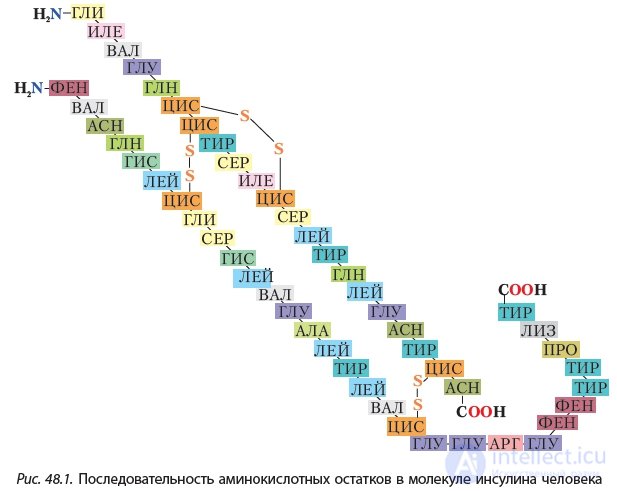 From Figure 48.1 it can be seen that the insulin protein molecule consists of two polypeptide chains connected by two disulfide bridges (—S—S—). Each polypeptide chain is characterized by a strictly defined sequence of amino acid residues, and residues of many amino acids occur several times in the insulin molecule. For example, Figure 48.1 shows that the glycine residue (Gly) occurs twice in the insulin molecule.
At first glance it may seem that using 20 different amino acids to build protein molecules significantly limits the diversity of protein structures. In fact, the number of combinations that can be formed using 20 different amino acids to build polypeptide chains is practically infinite. For example, if a polypeptide chain consists of 100 amino acid residues, then, using 20 different amino acids to build it, one could form 20100 combinations!
As we have already seen, an enormous variety of different proteins can exist. Depending on the structure of the amino acid residues and their sequence in the polypeptide chain, the properties of proteins can differ significantly. For example, albumin, the protein of chicken egg, dissolves in water, while keratin proteins, which make up hair and nails, are insoluble in water. Let us consider some chemical properties of proteins.
1. Hydrolysis
Proteins undergo hydrolysis. This causes gradual breakdown of the protein molecule. First, products of partial breakdown are formed — peptides having a lower molecular mass than the original protein. The final products of hydrolysis are α-amino acids, from which the protein molecule is built. Let us consider the hydrolysis reaction using the example of a tripeptide composed of phenylalanine, alanine, and glycine residues:
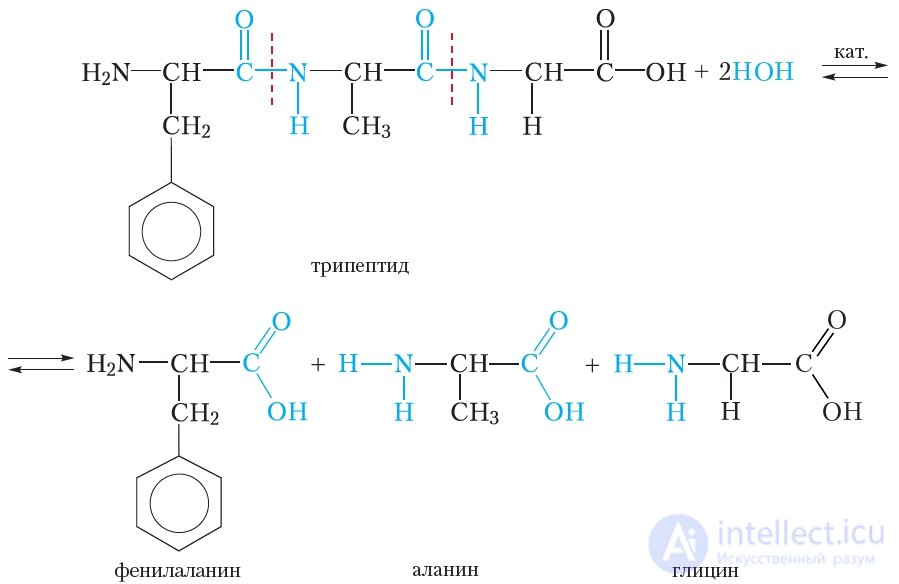
During hydrolysis, peptide bonds in the protein molecule are broken. Acids or alkalis can be used as catalysts for the protein hydrolysis reaction. In living organisms, protein hydrolysis is catalyzed by enzymes.
2. Denaturation
Under the influence of various factors (heating, the action of acids, alkalis, etc.), the spatial structure of the protein molecule may be disrupted (Fig. 48.2). This process is called denaturation. For example, protein denaturation occurs when eggs are boiled. As a result of denaturation, a protein loses its inherent biochemical properties.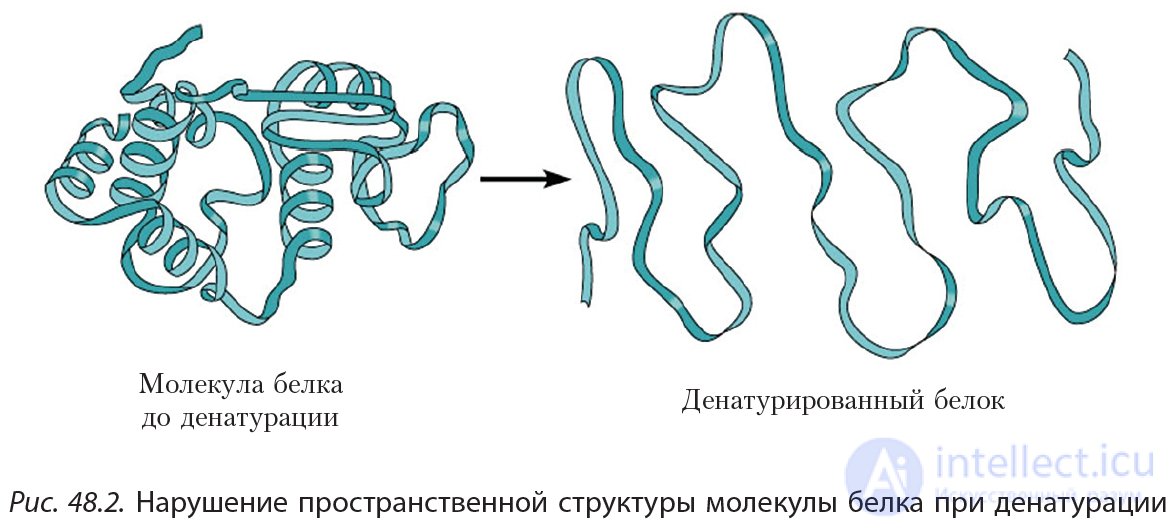
3. Biuret reaction (a qualitative test for proteins)

Video 48.1. Color
reactions of proteins
The biuret reaction is a qualitative test for proteins. If a solution of copper(II) sulfate is added to an aqueous protein solution containing a little alkali, a complex compound is formed and the solution turns red-violet. Substances containing peptide bonds undergo the biuret reaction.
4. Xanthoproteic reaction
The xanthoproteic reaction makes it possible to detect, in proteins, residues of amino acids containing a benzene ring, for example, phenylalanine and tyrosine (Table 48.1). Under the action of concentrated nitric acid, the benzene rings of such amino acid molecules undergo nitration:
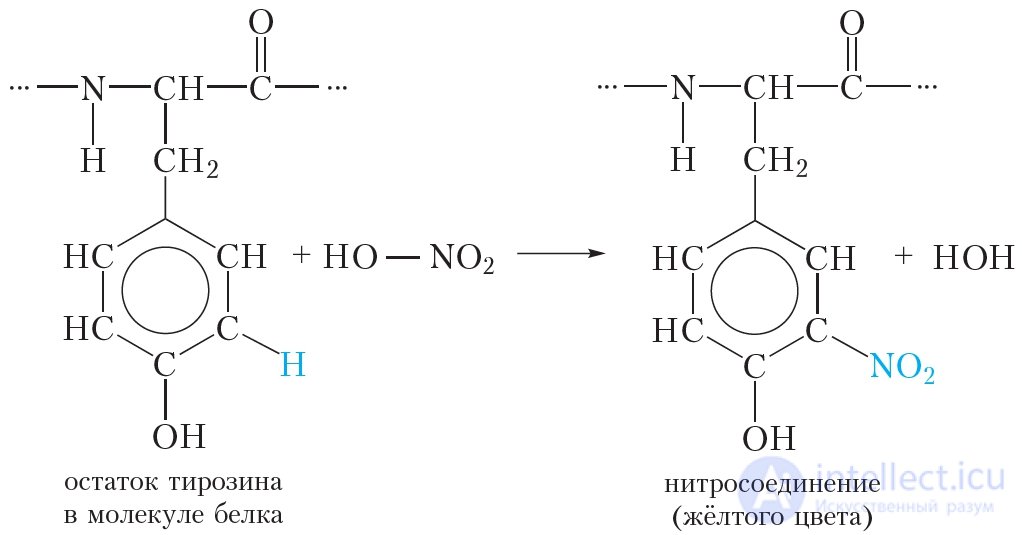
As a result of the reaction, the hydrogen atoms in the benzene rings of phenylalanine and tyrosine are replaced by nitro groups —NO2, and a yellow color appears.
Skin proteins contain a large number of aromatic amino acid residues. Therefore, when nitric acid comes into contact with skin, yellow spots appear on it.
Proteins perform many functions in a living organism. Organ tissues are made up of proteins. Enzymes and hormones — protein molecules, each type of which regulates a separate process — act as catalysts and regulators of biochemical processes. The high selectivity of an enzyme is due to its unique structure.
The protein insulin plays an important role in metabolism — it regulates carbohydrate metabolism. Insufficient production of this protein by the pancreas leads to a serious disease — diabetes mellitus.
Proteins are the most important component of food. While the main sources of energy for a living organism are fats and carbohydrates, the protein component serves primarily as a source of amino acids for protein biosynthesis. In this process, dietary proteins are broken down into individual amino acids, from which biosynthesis is then carried out. In this regard, a distinction is made between nonessential and essential amino acids. Nonessential amino acids can be synthesized in the human body from other food components; essential ones cannot be synthesized and must therefore be obtained from food. Examples of nonessential amino acids are glycine and alanine; examples of essential ones are phenylalanine and cysteine (Table 48.1).
In conclusion, let us note that, in becoming acquainted with organic chemistry, we have traveled the path from the simplest organic substances — hydrocarbons — to proteins. Further study of organic chemistry and biology will allow us to uncover many more secrets of the living world.
|
Molecules of proteins are built from residues of α-amino acids joined by peptide bonds. Protein molecules usually contain hundreds or even thousands of amino acid residues. Most often, proteins contain residues of only 20 different amino acids. Proteins undergo hydrolysis. The final products of hydrolysis are α-amino acids, from which the protein molecule is built. Denaturation of a protein occurs upon heating, the action of acids, alkalis, and other factors. As a result of denaturation, the protein loses its inherent biochemical properties. The biuret reaction is a qualitative test for proteins. Proteins containing residues of aromatic amino acids give a yellow color with nitric acid (xanthoproteic reaction). A distinction is made between nonessential and essential amino acids of proteins. |
1. Indicate the number of peptide bonds in the molecule of the substance whose formula is:

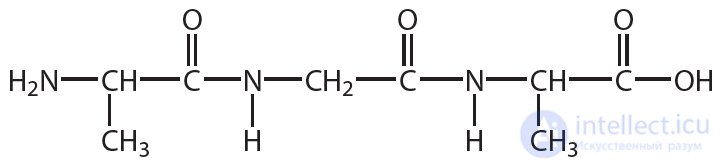
2. Write the equation for the hydrolysis reaction of the substance whose formula is:
3. Complete hydrolysis of a tripeptide yielded a mixture of alanine and phenylalanine in a molar ratio of 2 : 1. Write all possible formulas of the tripeptide.
4. Complete hydrolysis of a tripeptide yielded a mixture of glycine, alanine, and phenylalanine. Write all possible formulas of the tripeptide.
5. The human insulin molecule contains 6 sulfur atoms (Fig. 48.1). The mass fraction of sulfur in insulin is 3,3 %. Estimate the molar mass of insulin.
6. Complete hydrolysis of 16,5 g of a dipeptide produced only one amino acid. Its mass is 18,75 g. Determine the structure of the dipeptide.
7. Alkaline hydrolysis of 16,0 g of a dipeptide produced only one organic substance — the sodium salt of one of the amino acids. The mass of this salt is 22,2 g. Determine the structure of the dipeptide.
8*. Complete acid hydrolysis of a certain pentapeptide produced three amino acids — glycine, alanine, and phenylalanine — in a molar ratio of 3 : 1 : 1. Partial hydrolysis of this same pentapeptide yielded three tripeptides and three dipeptides. Determination of the N-terminal amino acids in the three tripeptides showed that in two of them it is glycine, and in the third it is alanine. Determine the sequence of amino acids in the pentapeptide molecule and write its structural formula.

Comments