
Lecture
1. Oxidation of aldehydes and alcohols
As you already know, carboxylic acids are formed by the oxidation of aldehydes:
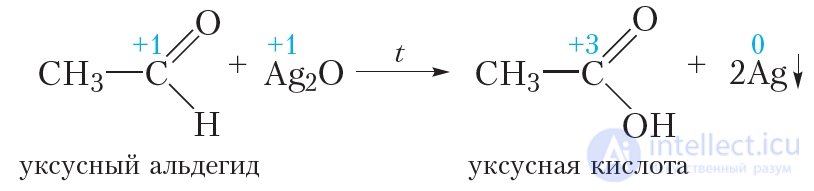
or

In organic chemistry, the symbol for oxygen in square brackets [O] is often used in schemes of oxidation processes. Then the reaction equations given above can be written as the scheme:
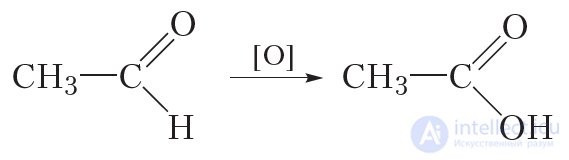
In turn, aldehydes are obtained by the oxidation of alcohols:
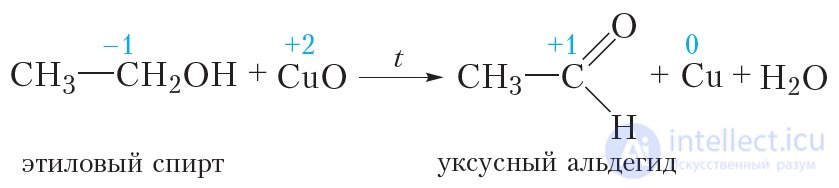
or
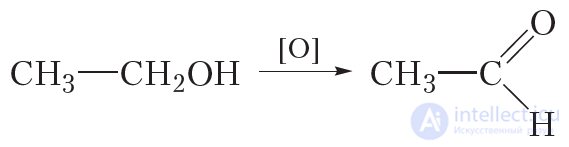
Therefore, acids can be obtained by the oxidation of alcohols without isolating the aldehyde as an intermediate reaction product:
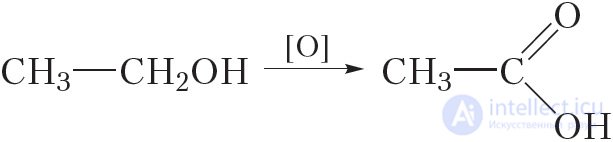
In this case, potassium permanganate KMnO4 is usually used as the oxidizing agent in the presence of sulfuric acid.
2. Catalytic oxidation of butane
Acetic acid can be obtained by the oxidation of butane with atmospheric oxygen over a catalyst:


* Production
of formic acid
As can be seen from the reaction equation, one molecule of butane produces two molecules of acetic acid.
You can learn about the industrial production of formic acid by following the link in the QR code.
Acetic acid has the widest application.
You are probably aware that a dilute aqueous solution of acetic acid, known as table vinegar, is widely used at home as a food seasoning and preservative. In addition, acetic acid is used to produce acetate silk (§ 44) and to synthesize medicines. For example, aspirin is an ester of acetic acid.
Esters of carboxylic acids are used as solvents and fragrances.
Sodium and potassium salts of palmitic and stearic acids have detergent properties and are a component of cleaning agents.
|
Carboxylic acids can be obtained by the oxidation of aldehydes and alcohols. Acetic acid is obtained by the oxidation of butane with oxygen over a catalyst. |
In industry, formic acid is mainly produced by the reaction of carbon(II) oxide with a hot solution of sodium hydroxide under elevated pressure. This produces sodium formate:

Formic acid is then isolated by treating sodium formate with sulfuric acid:

1. Which alcohol should be oxidized to obtain the acid with the formula CH3—CH2—CH2—COOH? Write the scheme of this reaction. Give the names of the organic substances.
2. Give the structural formula and name of carboxylic acid X, which is an isomer of butanoic acid. How can acid X be obtained if you have available the corresponding aldehyde, copper(II) sulfate, a sodium hydroxide solution, and distilled water? Write the equations of all the necessary reactions, indicate the conditions under which they occur, and explain the observed phenomena.
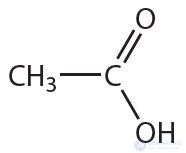
3. Indicate the statements that are true for the substance whose formula is:
|
1. Used in the food industry |
|
2. Displaces carbonic acid from its salts |
|
3. Unlike ethanol, reacts with a sodium hydroxide solution |
|
4. Turns methyl orange red |
|
5. Can be obtained by oxidizing ethanol with a KMnO4 solution in the presence of sulfuric acid |
|
6. Can be obtained by the addition of water to ethyne |
|
7. Reacts with zinc with the release of hydrogen |
|
8. A homolog of acetaldehyde |
4. Heating an aqueous solution of substance A with an ammoniacal solution of silver(I) oxide produced a shiny coating on the walls of the test tube:
Indicate the method of preparation of substance A:
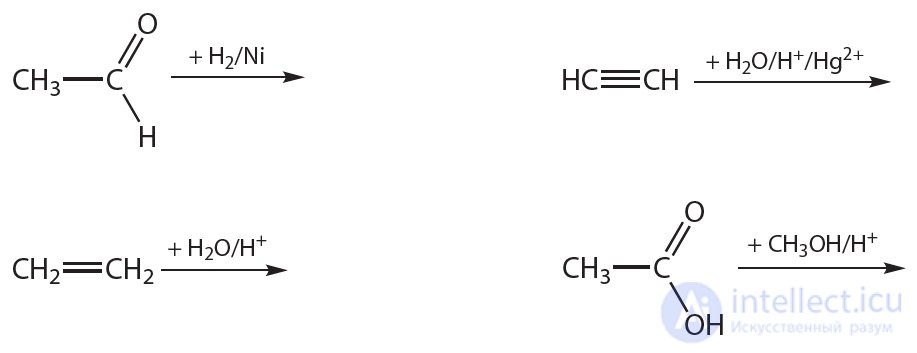
5. Calculate the mass of acetic acid that can be obtained by the catalytic oxidation of 1 m3 of butane (at STP), if the reaction yield is 95%.

Comments