
Lecture
There is an enormous number of different alkanes. Their variety is explained both by the possibility of forming carbon chains of various lengths and by isomerism. Because of this, it is not possible to study the chemical properties of each alkane separately. At the same time, the molecules of different alkanes have a similar structure: carbon atoms are joined to one another and to hydrogen atoms by single covalent bonds. Given this, we can expect that the chemical properties of different alkanes will be largely similar.
All alkanes are characterized by low chemical activity. They do not react with solutions of acids, bases, or salts. They are not affected by such a strong oxidizer as KMnO4, nor by such strong reducing agents as alkali metals. You know that alkali metals are very active and react with almost all substances they come into contact with, including being readily oxidized by atmospheric oxygen. To protect alkali metals from oxidation, they are stored under a layer of kerosene — a mixture consisting mainly of saturated hydrocarbons. In this process, the alkanes that make up kerosene do not react with the alkali metals.
Because of the low chemical activity of alkanes, reactions involving them proceed under harsh conditions (upon heating or irradiation with ultraviolet light).
We will study the reactions of alkanes with halogens (Cl2 and Br2) and oxygen (O2), as well as the transformations they undergo upon heating.
1. Halogenation. Reaction with halogens
The reaction of alkanes with halogens — chlorine and bromine — proceeds upon heating or irradiation with ultraviolet light.
If a glass vessel is filled with a mixture of gaseous methane and chlorine and placed in a dark location, no reaction will take place. However, upon heating the mixture or irradiating it with ultraviolet light, a chemical substitution reaction proceeds in which hydrogen atoms in the methane molecule are replaced by chlorine atoms:
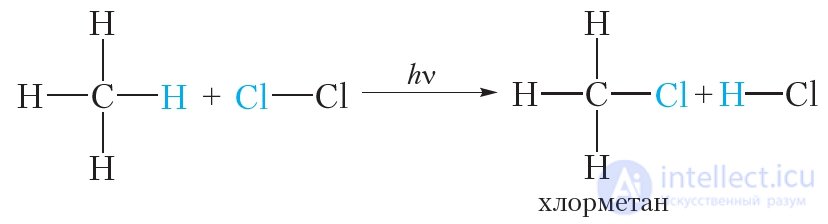
In equations for reactions that proceed under irradiation, the letters hv are written above the arrow. This reaction is called a halogenation reaction and belongs to the substitution reactions.
If only one hydrogen atom in the molecule is replaced by a halogen atom, the reaction is called monohalogenation. The reaction shown above is the monochlorination of methane. In excess chlorine, the remaining three hydrogen atoms of the methane molecule can be successively replaced by halogen:
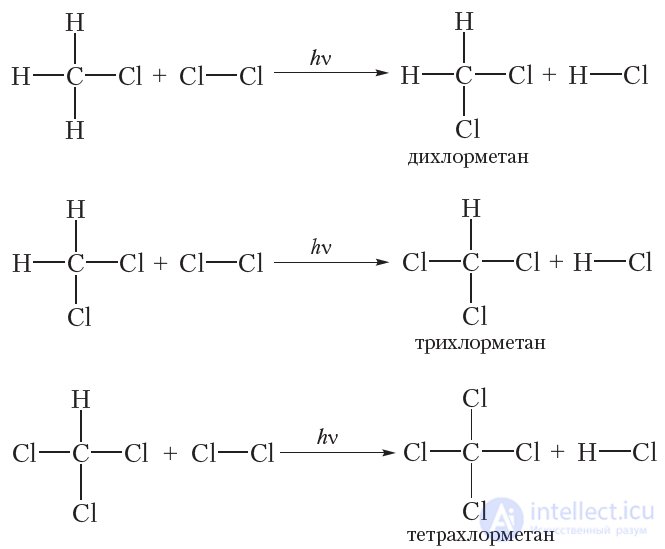
Let us give the equations for all four stages of methane chlorination using molecular formulas:
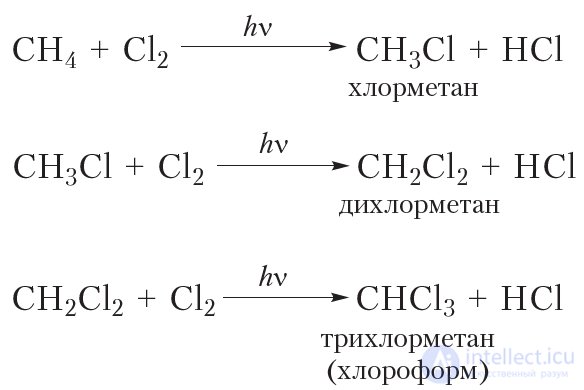
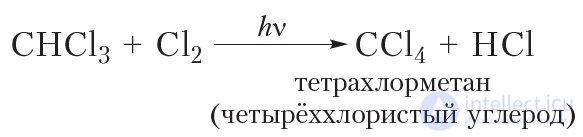
Let us consider the monochlorination reactions of the homologs of methane.
Monochlorination of ethane
For ethane, the reaction equation is as follows:
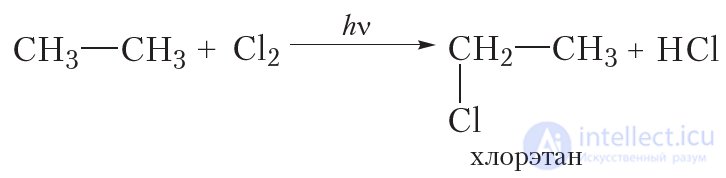
Note that in the name «chloroethane» there is no need to indicate the position of the chlorine atom with a number. This is because replacing any hydrogen atom in the ethane molecule with a chlorine atom produces one and the same substance:
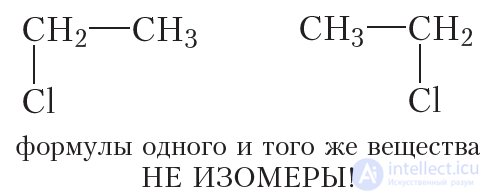
Thus, in the monochlorination of ethane, just as in the case of methane, only one organic substance is obtained — chloroethane.
Monochlorination of propane
In the monochlorination of propane, a mixture of two organic substances is formed:
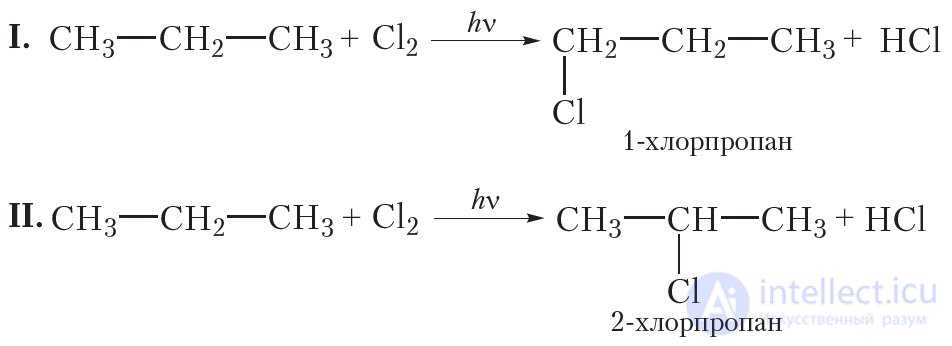
In case I, the hydrogen atom at the first carbon atom is replaced by halogen, and the reaction product is 1-chloropropane. In case II, the hydrogen atom at the second carbon atom is replaced, and the reaction product is 2-chloropropane. Note that when constructing names, the numbering of the carbon atoms begins from the end of the carbon chain closer to which the chlorine atom is located.
As a result of the monochlorination reaction of propane, two products are formed: 1-chloropropane and 2-chloropropane, which have the same molecular formula C3H7Cl. This is not surprising, since 1-chloropropane and 2-chloropropane — are isomers.
If we write the equation for the monochlorination reaction of propane using molecular formulas, it will look as follows:

A reaction equation written in this form not only fails to indicate which specific product (1-chloropropane or 2-chloropropane) is meant, but also leads to the common misconception that only one organic product is formed in the monochlorination of propane — C3H7Cl, whereas in fact there are two. Therefore, in organic chemistry, structural rather than molecular formulas of substances are usually used when writing reaction equations.
As a result of the chlorination of alkanes, one or more hydrogen atoms in the alkane molecule are replaced by halogen atoms. Therefore, the resulting organic substances are called halogen derivatives of alkanes.
Example. Substitution of two hydrogen atoms by chlorine in the ethane molecule.
The reaction proceeds in two stages.
a) The first stage of ethane chlorination. In the first stage, one hydrogen atom is replaced. This produces only one organic substance — chloroethane:
b) The second stage of ethane chlorination. At this stage, a chlorine molecule reacts with a molecule of chloroethane formed in the first stage. Obviously, two organic substances can be formed as a result:
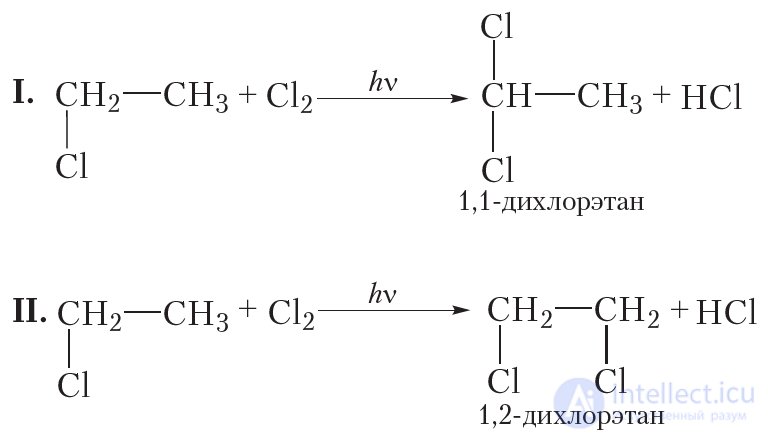
Indeed, chlorination of ethane can produce a mixture of two dichloro derivatives.
Alkanes also undergo substitution reactions with bromine. For example:
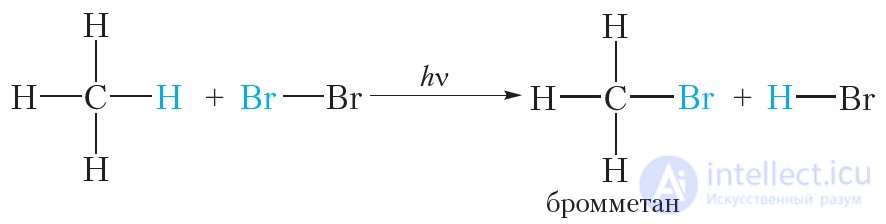
 In conclusion, let us note once again that the reactions of alkanes with chlorine and bromine proceed under harsh conditions: under irradiation or heating.
You can learn about the mechanism of the halogenation reaction of alkanes by following the link in the QR code.
In halogenation reactions, the hydrogen atoms in an alkane molecule are replaced by halogen atoms, while the carbon chain of the molecule is preserved. In other reactions of alkanes, their carbon skeleton is altered or completely destroyed. Let us consider such reactions.
2. Pyrolysis
Upon strong heating of alkanes, bonds in their molecules break:  and
and  . As a result, alkane molecules can be completely broken down to form carbon and hydrogen. The decomposition of substances at high temperatures is called pyrolysis (from the Greek pyro — fire, heat, and lysis — decomposition, breakdown). For example:

General scheme of the pyrolysis reaction of alkanes (n — the number of carbon atoms in the alkane molecule):

This reaction is used industrially to produce carbon black and hydrogen.
3. Isomerization
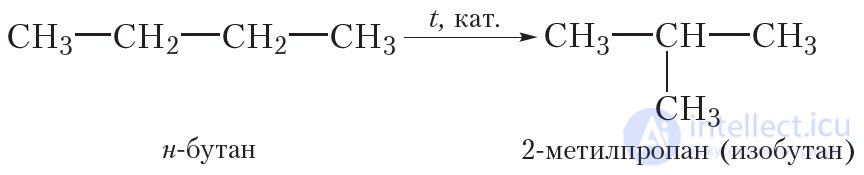
Another chemical property of alkanes is isomerization, that is, the conversion of one isomer into another. This property is possible for alkanes starting from butane, since methane, ethane, and propane have no isomers. The isomerization reaction proceeds by passing an alkane through a reactor heated to a high temperature in the presence of a catalyst. In this process, molecules of linear-structure alkanes are converted into molecules of branched structure, for example the isomerization reaction of n-butane:
4. Combustion. Reaction with oxygen
The most important property of alkanes — combustion. Alkanes ignite when exposed to flame. The equation for the combustion reaction of methane:

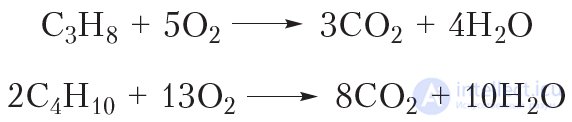
This reaction is well known to you: it proceeds when gas is lit on a kitchen gas stove, since methane — is the main component of natural gas. Gas cylinders are filled with a mixture of propane and isomeric butanes. The equations for the combustion reactions of these alkanes:
Subsequent members of the homologous series of alkanes also burn when ignited. A general equation for the combustion reaction can be written:

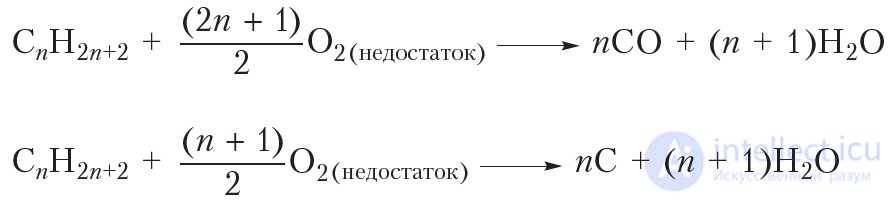
It can be seen that during combustion, the hydrogen atoms from the alkane molecule pass into water molecules, while the carbon atoms — into carbon dioxide molecules. If an alkane burns under conditions of insufficient oxygen, then, along with carbon dioxide (CO2), carbon monoxide (CO) or carbon (C) in the form of soot may be formed:
Note that the ability to burn in oxygen is characteristic of almost all organic compounds. Since all organic substances contain carbon, carbon oxides and soot can form when they burn.
The formation of carbon monoxide (CO) during incomplete combustion of an organic substance is deadly dangerous because of the high toxicity of CO. Carbon monoxide poisoning can occur from improper operation of stoves and fireplaces.
As can be seen, the chemical properties of alkanes are not very diverse. They are mainly characterized by oxidation reactions (in particular, combustion), decomposition and isomerization at high temperature, as well as substitution reactions that produce halogen derivatives of alkanes.

* Other methods
of obtaining alkanes
Alkanes are found in natural gas and petroleum, so the main method of obtaining them — is extraction from natural sources (natural gas and petroleum).
At the same time, alkanes can also be obtained from other organic substances. We will consider these reactions as we continue further study of organic chemistry.
The combustion of alkanes releases a large amount of heat. Because of this, alkanes are used as fuel. We have already mentioned that methane is the main component of natural gas. Gas cylinders are filled with a mixture of propane and isomeric butanes. Liquid alkanes are found in gasoline and diesel fuel.
Another area of alkane use is obtaining various substances from them. That is, alkanes are used as raw materials in the chemical industry. Hydrogen is obtained by the reaction of methane with water vapor:

This process is called methane conversion. The resulting mixture of hydrogen and carbon(II) oxide is called synthesis gas. Ammonia is obtained from the hydrogen extracted from synthesis gas and nitrogen from the air. These processes are carried out on a large scale at the OJSC «Grodno Azot» plant.
Hydrocarbons with double and triple bonds (unsaturated hydrocarbons) are obtained from alkanes. These hydrocarbons are chemically more active, and many useful organic substances are synthesized from them. The methods of preparation and properties of unsaturated hydrocarbons will be considered in the following sections.
|
The molecules of different alkanes have a similar structure, so alkanes have similar chemical properties. At elevated temperature or under irradiation, alkanes undergo substitution reactions with halogens (chlorine and bromine), as a result of which the carbon skeleton of the alkane molecule is preserved while the hydrogen atoms are replaced by halogen atoms. Upon strong heating of alkanes, bonds in their molecules break: By heating unbranched alkanes in the presence of a catalyst, branched alkanes can be obtained (isomerization). Alkanes burn in oxygen. The reaction can produce CO2, CO, C and H2O. Alkanes are found in natural gas and petroleum. Alkanes are mainly used as fuel, as well as for obtaining other substances (hydrogen, unsaturated hydrocarbons). |
For methane to undergo a substitution reaction with chlorine, the mixture must be irradiated with ultraviolet light. Interestingly, this reaction continues even after the irradiation stops.
What effect does ultraviolet radiation have on a mixture of methane and chlorine? First, under the action of the radiation, a chlorine molecule splits into two chlorine atoms, each of which has an unpaired electron. This reaction is called initiation:

Particles that have an unpaired electron are called radicals. Under normal conditions, radicals are extremely unstable and react immediately with other molecules.
Thus, the Cl• radical formed by the splitting of the chlorine molecule reacts with a methane molecule. This produces a hydrogen chloride molecule and a methyl radical •CH3:

(1)
The •CH3 radical, in turn, reacts with the next chlorine molecule, forming chloromethane and a new chlorine radical:

(2)
Transformations (1) and (2) then repeat again. This chain of transformations can repeat hundreds of times, which is why such reactions are called chain reactions. Reactions (1) and (2) are called chain propagation:

The chain can be terminated as a result of the interaction of two radicals. Such a reaction is called chain termination:

It should be noted that irradiating the mixture with ultraviolet light is needed only for splitting the chlorine molecule into atoms — the initiation stage. Since active particles (radicals) participate in the reactions at the chain-propagation stage, no further input of energy is required at this stage. Therefore, the chlorination reaction of methane continues to proceed even after the irradiation stops.
The reaction between hydrogen and oxygen, which you know from your course in inorganic chemistry, proceeds by a chain radical mechanism. Such reactions occur at very high rates and can be accompanied by an explosion.
Heating carboxylic acid salts with alkali
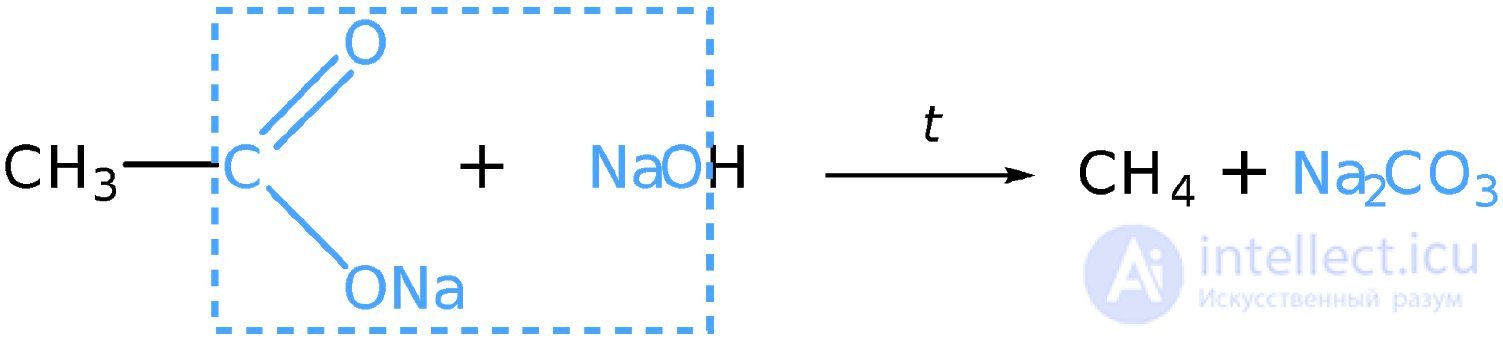
Alkanes can be obtained by heating sodium salts of carboxylic acids with sodium hydroxide. Thus, heating a solid mixture of the sodium salt of acetic acid (sodium acetate) with sodium hydroxide produces methane. The reaction equation:
The Wurtz reaction
One method for preparing alkanes is the Wurtz reaction, which involves the reaction of halogen derivatives of alkanes with metallic sodium. As an example, let us give the reaction for preparing ethane:

Obviously, this reaction should be used to obtain alkanes of symmetrical structure, i.e., consisting of two identical parts.
The reaction is named after its discoverer — the French chemist Charles Adolphe Wurtz (1817–1884).
1. Write the equation for the monobromination reaction of ethane.
2. Write the equations for the reactions that occur when n-butane reacts with chlorine. Assume that only one hydrogen atom in the n-butane molecule is replaced by chlorine. Label the names of the organic substances formed.
3. How many chloro derivatives can be obtained from the chlorination of ethane? Write the equations for the reactions producing all possible chloro derivatives of ethane, and name the chloro derivatives. Can molecular formulas be used when writing the reaction equations in this case?
4. Write the equation for the combustion reaction of butane in excess oxygen. What volume (at STP) of carbon dioxide is formed when 1 mole of butane is burned?
5. Write the equation for the pyrolysis reaction of methane forming hydrogen and carbon. Find the mass of carbon that can be obtained from the complete decomposition of 44,8 dm3 (at STP) of methane.
6. Name the main areas of application of alkanes.
7*. Write the equations for the reactions by which n-butane can be obtained from ethane and inorganic substances.
8*. A small amount of n-butane is formed as a result of the chlorination reaction of ethane. Explain this phenomenon, and write the equations for the corresponding reactions.
9*. Write the structural formula of a substance with the composition C3H6O2, given that its aqueous solution has an acidic reaction, and that heating its sodium salt with NaOH produces ethane. Write the equations for the reactions that occur. (Answer: propanoic acid.)
10*. Propose two possible structural formulas for a substance with the composition C4H8O2, given that its solution has an acidic reaction. Heating the sodium salt of the substance with sodium hydroxide produces propane. (Answer: butanoic acid and 2-methylpropanoic acid.)
11*. Determine the structure of the hydrocarbon C6H14 for which monobromination produces a tertiary bromo derivative. This hydrocarbon can be obtained by the Wurtz method without side products. Write the schemes for the reactions that occur. (Answer: 2,3-dimethylbutane.)
12*. Obtain propane from acetic acid.
13*. In a gaseous mixture of methane and chlorine, there is one molecule of chlorine for every three molecules of methane.
a) Calculate the mass fractions of methane and chlorine in this mixture.
b) The initial mixture, with a volume of 45 L (at STP), was placed in a sealed vessel and irradiated with light. Assuming that only one hydrogen atom in the methane molecule is replaced by chlorine, calculate the masses of all substances in the mixture formed after the reaction has ended.
(Answer:
a) Mass fractions: methane — 40,3 %; chlorine — 59,7 %.
b) m(CH4) = 16 g; m(CH3Cl) = 25,25 g; m(HCl) = 18,25 g.)
 and
and  . As a result, alkane molecules can be completely broken down to form carbon and hydrogen (pyrolysis).
Comments