
Lecture
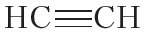
Carbon atoms can be bonded to each other not only by single or double bonds, but also by triple bonds. The simplest hydrocarbon containing a triple bond is ethyne or acetylene  . Let us consider its structure.
Each carbon atom in acetylene forms four chemical bonds. These bonds are formed by means of four atomic orbitals:
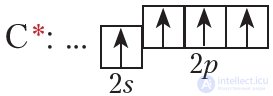
Let us recall the structure of ethylene: 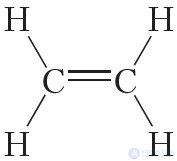
The carbon atoms in this molecule are in a state of sp2-hybridization. Owing to the sp2-hybrid orbitals, each carbon atom forms three σ-bonds: two bonds with hydrogen atoms and one — with the neighboring carbon:
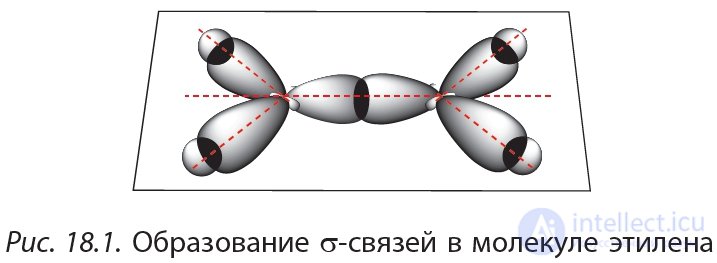
The second bond between the carbon atoms is formed by the lateral overlap of the non-hybrid p-orbitals of the carbon atoms — this is a π-bond:
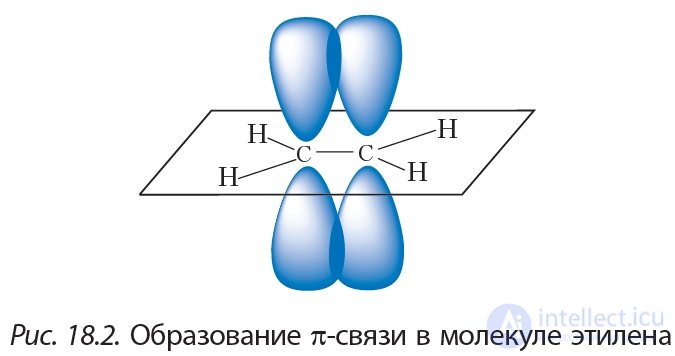
In the acetylene molecule H  C
C  C H there is a triple bond. It consists of one σ- and two π-bonds. Since π-bonds are formed by the overlap of non-hybrid p-orbitals, one s- and one p-orbital of the carbon atoms take part in hybridization. This type of hybridization is called sp-hybridization:
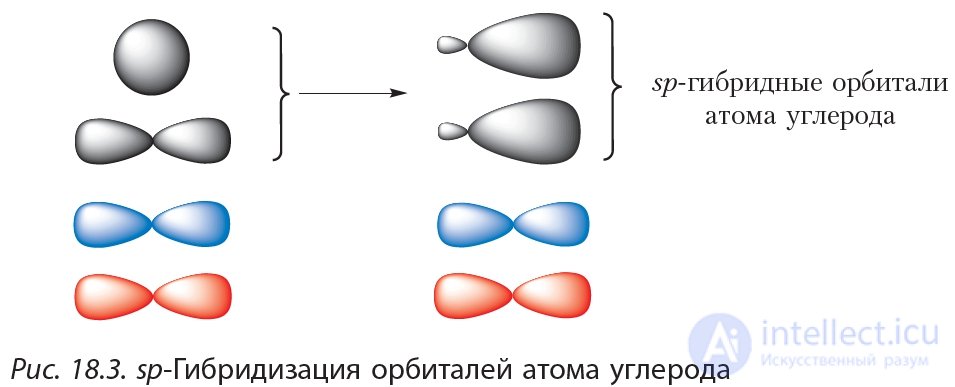
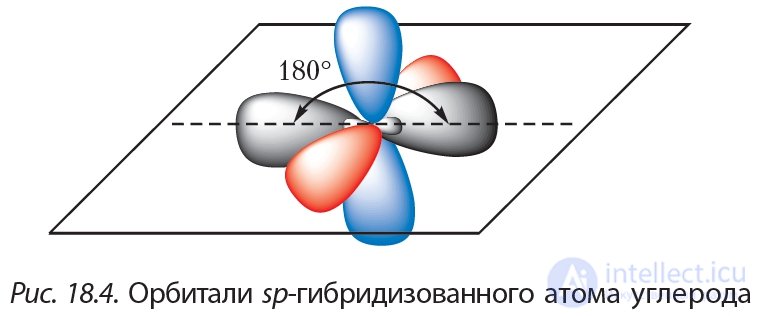
sp-Hybrid orbitals lie along a single straight line, at an angle of 180°. The two p-orbitals of the carbon atom that do not take part in hybridization retain their original shape and are oriented mutually perpendicular:
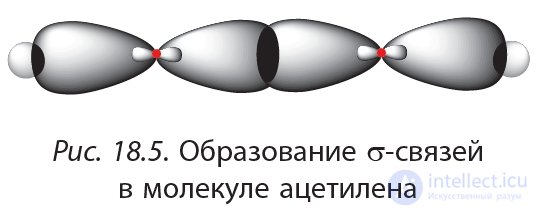
 Owing to the overlap of the hybrid orbitals, each carbon atom forms two σ-bonds — one bond with a hydrogen atom and one — with the neighboring carbon:
 The orbitals not involved in hybridization form two π-bonds between the carbon atoms:
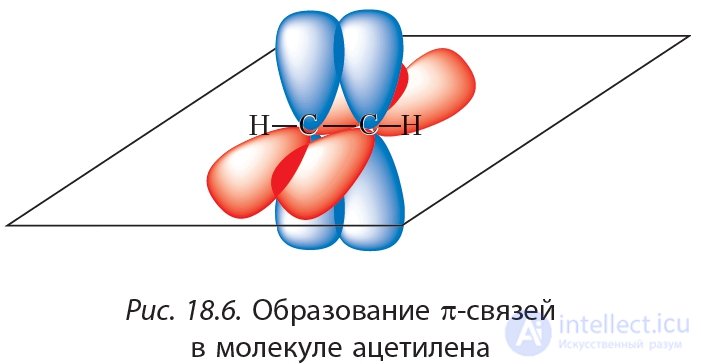
Thus, the acetylene molecule contains three σ-bonds and two π-bonds:
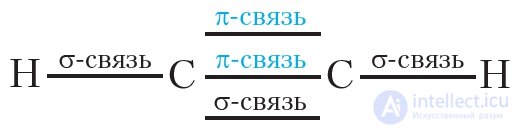
The acetylene molecule is linear, and the bond angle equals 180°. The bond between the carbon atoms is triple:
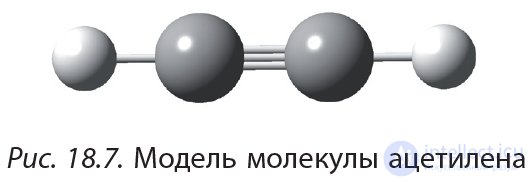
A triple bond is shorter than a double or single bond: in the acetylene molecule, the bond length between the carbon atoms is 0.120 nm. Recall that in the ethylene and ethane molecules, the bond length between the carbon atoms is 0.134 and 0.154 nm, respectively.
Acetylene is the simplest representative of the alkynes — noncyclic hydrocarbons whose molecules contain one triple bond.
The nearest homolog of acetylene is propyne CH3 C CH. The molecular formula of propyne is C3H4. Since neighboring members of the homologous series differ in composition by a CH2 group, it is clear that the next homolog must have the composition C4H6. From this we can easily derive the general formula of the alkynes CnH2n–2. As you already know, the general formula CnH2n–2 also applies to the alkadienes.
Like alkenes, alkynes exhibit isomerism of the position of the multiple bond and isomerism of the carbon skeleton:
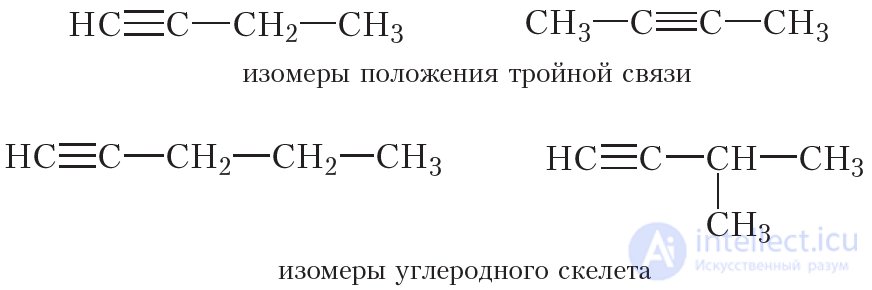
Note that isomerism of the carbon skeleton in alkynes is possible starting with the substance containing five carbon atoms in the molecule. As already mentioned, alkynes and alkadienes have the same general formula CnH2n–2. Therefore, alkynes can be isomeric with alkadienes. Such isomers are called interclass isomers. For example, the formula C4H6 corresponds to the substances:

The names of alkynes are formed in the same way as the names of alkenes, but the suffix -ene at the end of the name is replaced with the suffix -yne (it denotes a single triple bond). A number at the end of the name indicates the position of the triple bond.
Let us give a few examples of formulas and names of alkynes:

Note:
a) in the name «propyne» there is no need to indicate the position of the triple bond;
b) the carbon atoms of the main chain are numbered starting from the end nearest to the triple bond.
The physical properties of alkynes are similar to those of the corresponding alkenes. Thus, alkynes with 2—4 carbon atoms in the molecule are colorless gaseous substances at room temperature. Alkynes with 5 to 16 carbon atoms in the molecule are liquids. Alkynes with more than 16 carbon atoms in the molecule are solids. The boiling points of some unbranched alkynes are given in Table 18.1.
Table 18.1. Boiling points of alkynes
|
Name |
Structural formula |
Boiling point (tb, °C) |
|
Ethyne |
|
–84 |
|
Propyne |
|
–23 |
|
Butyne-1 |
|
8 |
|
Pentyne-1 |
|
39 |
|
Hexyne-1 |
|
71 |
|
Heptyne-1 |
|
100 |
|
Octyne-1 |
|
126 |
Alkynes are insoluble in water, but readily soluble in organic solvents.
The density of liquid and solid alkynes is lower than that of water.
The chemical properties of alkynes are similar to those of alkenes, since molecules of substances in both classes contain a multiple bond. Addition reactions at the triple bond, accompanied by the breaking of π-bonds, since they are weaker than the σ-bond, are characteristic of alkynes. Like alkenes, alkynes can add halogens, hydrogen, and hydrogen halides, and one molecule of an alkyne can add two molecules of the substances in question.
1. Halogenation. Addition of halogens
Like alkenes, alkynes decolorize bromine water:

The resulting 1,2-dibromoethene contains a double bond, so in excess bromine it undergoes an addition reaction. This produces a tetrabromo derivative of an alkane: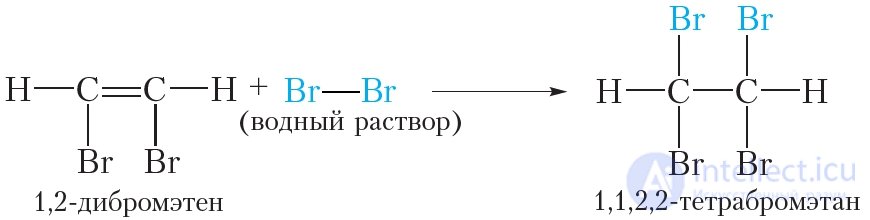
Unlike alkenes, the composition of the reaction products of alkynes with bromine depends on the quantitative ratio of the reactants. When bromine is insufficient, compounds containing a double bond may form, whereas in excess, saturated compounds are formed.
The two preceding reactions can be combined into one:
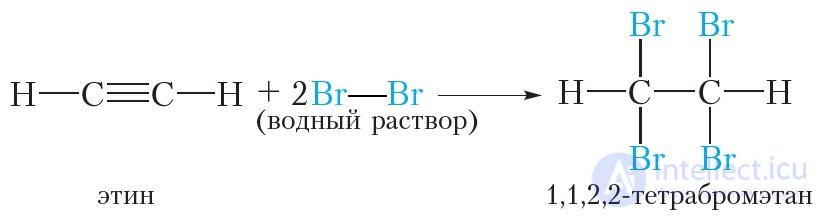
Thus, when acetylene is passed through bromine water, an addition reaction of bromine at the triple bond takes place. As a result, the orange bromine solution is decolorized. A similar phenomenon was also observed for alkenes.
Therefore, the reaction with bromine water is a qualitative test for a multiple (double or triple) bond.
Like ethylene, acetylene decolorizes an aqueous solution of potassium permanganate. Therefore, the reaction with potassium permanganate solution is also a qualitative test for a multiple (double or triple) bond.
2. Hydrogenation. Addition of hydrogen
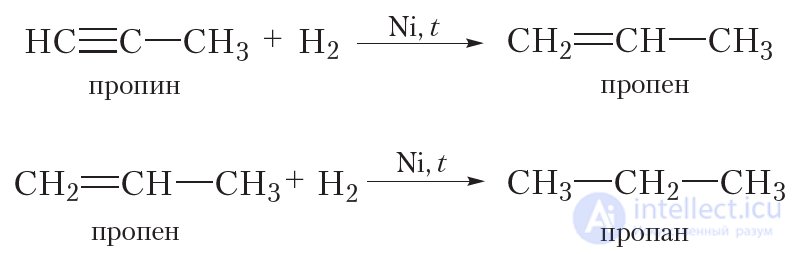
As a result of the hydrogenation of alkynes, alkenes are formed first, and then alkanes. A catalyst (Pt or Ni) is required for the reaction to proceed.
Let us give the equations of the reactions that occur during the hydrogenation of propyne:
3. Hydrohalogenation. Addition of hydrogen halides
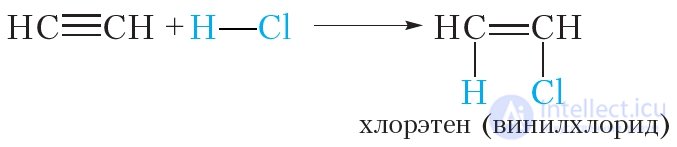
Alkynes can add molecules of complex substances. As a result of the addition of a hydrogen chloride molecule to an acetylene molecule, chloroethene is formed:
 The hydrocarbon radical
  has the trivial name vinyl. Therefore, chloroethene
  is often called vinyl chloride. Vinyl chloride is a colorless gas with a faint sweetish odor, highly toxic, tb = –14 °C.
The vinyl chloride molecule contains a double bond, so, like alkenes, it undergoes a polymerization reaction: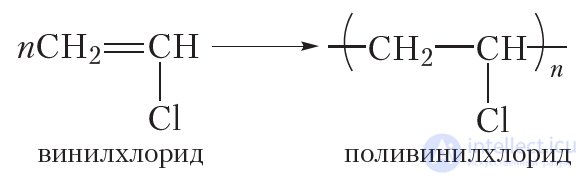
 The product of the polymerization reaction of vinyl chloride — polyvinyl chloride, or PVC for short, is widely used for making window frames, doors, linoleum, wire electrical insulation, artificial leather, and other products.
You can learn about the specifics of the addition of hydrogen halides and water to the homologs of acetylene by following the link in the QR code.
4. Combustion. Reaction with oxygen
Like all hydrocarbons, alkynes burn. The equation for the combustion reaction of acetylene:

When acetylene burns in oxygen, a large amount of heat is released, and the flame temperature is so high that it can be used to weld and cut metals. Therefore, an acetylene flame is used in welding and repairing metal products.
1. Carbide method
Acetylene is obtained by the action of water on calcium carbide CaC2. Pure calcium carbide is a solid white substance without odor. The technical-grade product is gray in color and has an unpleasant smell due to the presence of impurities.
Calcium carbide reacts vigorously with water, releasing acetylene:

Limestone (CaCO3) is used to obtain calcium carbide; calcining it produces calcium oxide. The calcium oxide is then sintered with coal in an electric furnace at a temperature of about 2000 °C:
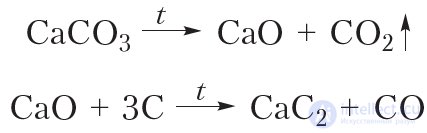
2. Pyrolysis of methane
Another way of obtaining acetylene is the partial thermal decomposition of methane. You already know that if alkanes are heated to a high temperature (subjected to pyrolysis), they decompose into carbon and hydrogen (§ 10). It turns out that acetylene is one of the intermediate products of methane pyrolysis. To prevent the decomposition of the acetylene formed at high temperature (about 1500 °C), the reaction products are rapidly cooled. This process can be represented by the equation:

* Methods
of obtaining alkynes

You can learn about other methods of obtaining alkynes by following the link in the QR code.
|
Noncyclic hydrocarbons whose molecules contain one triple bond are called alkynes. The general formula of alkynes is CnH2n–2. The triple bond in alkyne molecules includes one σ- and two π-bonds. Addition reactions at the triple bond are characteristic of alkynes. This involves the cleavage of π-bonds. Alkynes can add halogens, hydrogen, and hydrogen halides. The decolorization reactions of potassium permanganate solution and bromine water are qualitative tests for a multiple (double and triple) bond. Acetylene is obtained by the action of water on calcium carbide and by the pyrolysis of methane. Alkynes are isomeric with alkadienes. |
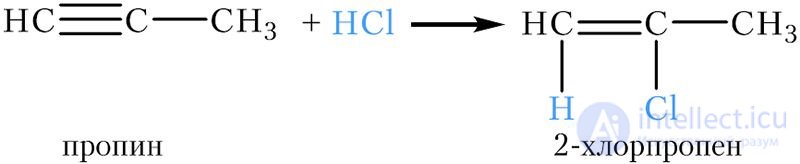
The homologs of acetylene add hydrogen halides and water in accordance with Markovnikov's rule, i.e., hydrogen adds to the more hydrogenated carbon atom of the triple bond.
Addition of hydrogen halides. Hydrohalogenation
Let us give the equation for the reaction of addition of hydrogen chloride to propyne:
Addition of water. Hydration
The addition of water to acetylene occurs in the presence of mercury salts and sulfuric acid. This produces acetaldehyde:
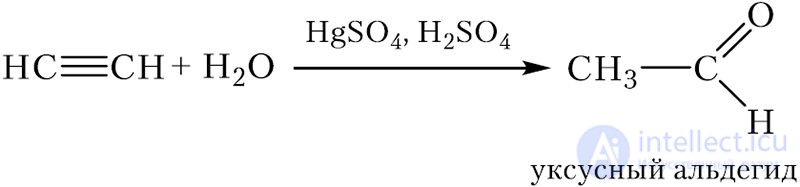
This reaction is named after the Russian chemist Mikhail Grigoryevich Kucherov.
Let us examine in more detail how this reaction proceeds. First, a water molecule adds across one π-bond of the acetylene molecule. This produces unstable vinyl alcohol:
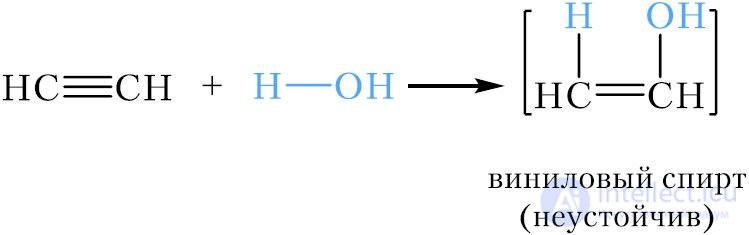
Alcohols in which the hydroxyl group is located at a double bond C  C are unstable, so vinyl alcohol immediately converts into acetaldehyde:
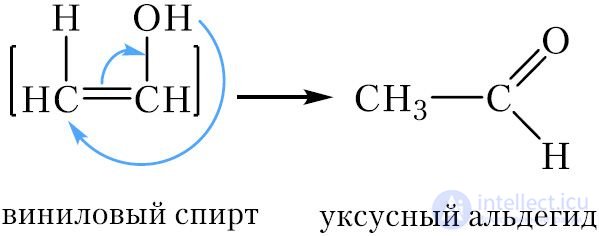
Now let us consider the addition of water to propyne. The reaction proceeds in accordance with Markovnikov's rule, so a ketone is formed in this case. Addition of water to propyne:

Dehydrohalogenation of dihalo derivatives of alkanes
Acetylene can be obtained by dehydrohalogenation of 1,2-dibromoethane with an alcoholic solution of alkali:
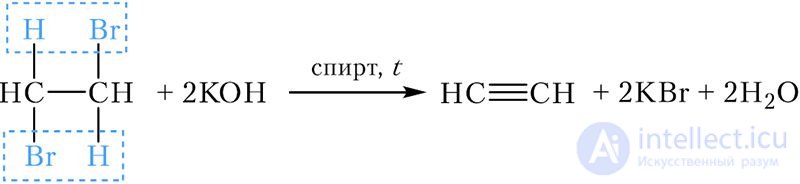
As can be seen, two molecules of hydrogen bromide are eliminated from one molecule of the dihalo derivative, resulting in the formation of acetylene.
Can acetylene be obtained by the action of an alcoholic alkali solution on 1,1-dibromoethane?
1. Draw a ball-and-stick model of the butyne-2 molecule. Indicate the types of hybridization of the carbon atoms in this molecule and the bond angles. Can butyne-2 exist as spatial cis- and trans-isomers?
2. Does a branched hydrocarbon exist that contains four carbon atoms in its molecule and: a) a double bond; b) a triple bond?
3. Write the structural formulas of the isomeric alkynes with the composition C5H8. Give them names. * Write the structural formulas of the interclass isomers of the same composition.
4. Write the equation for the reaction of addition of one molecule of bromine to a molecule of butyne-2. Name the reaction product.
5. Partial hydrogenation of an alkyne yields an alkene, which, upon reaction with bromine water, forms a dibromo derivative of an alkane with the composition C4H8Br2, the molecule of which has a symmetric structure. Give the structural formula of the alkyne and the alkene, as well as the equations of all the reactions that occur.
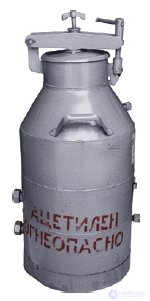
6. When carrying out welding work, acetylene generators are used to obtain acetylene from calcium carbide; one of them is shown in the figure. What volume of acetylene (dm3, STP) can be obtained from 3 kg of technical-grade calcium carbide containing 22% impurities?
7*. A gaseous hydrocarbon with a volume of 400 mL (STP) was mixed with oxygen with a volume of 1000 mL (STP) and ignited. The substances reacted completely, and carbon dioxide with a volume of 800 mL (STP) and water were formed. Determine the formula of the hydrocarbon.
(Answer: acetylene.)







Comments