
Lecture
The glucose molecule contains an aldehyde group and hydroxyl groups, so it exhibits the chemical properties of both aldehydes and polyhydric alcohols.
Let us first consider reactions involving the aldehyde group of the glucose molecule. Since the aldehyde group is present only in the linear form of glucose, we will write the formula of glucose in its linear form in the reaction equations.
1. Addition of Hydrogen. Reduction
The aldehyde group of glucose can add a molecule of hydrogen. This reaction is accompanied by the breaking of the π-bond between the carbon and oxygen atoms of the aldehyde group:
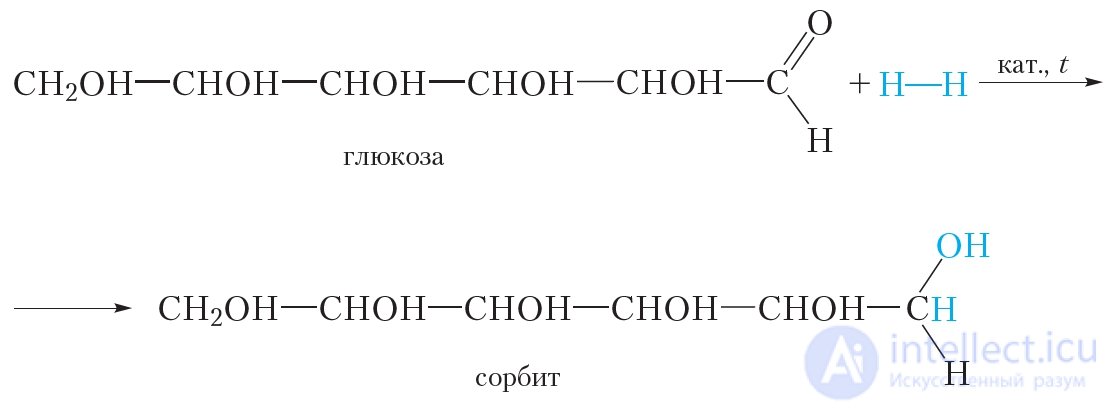
The resulting hexahydric alcohol is called sorbitol. It has a sweet taste and is used as a sugar substitute.
As a result of the addition of hydrogen, the glucose molecule is reduced, so the reaction with hydrogen is also called a reduction reaction.
2. Oxidation by an Ammoniacal Solution of Silver Oxide
Glucose gives a characteristic reaction for aldehydes, reducing silver from an ammoniacal solution of silver oxide (the «silver mirror» reaction). In this process, the aldehyde group of the glucose molecule is oxidized to a carboxyl group: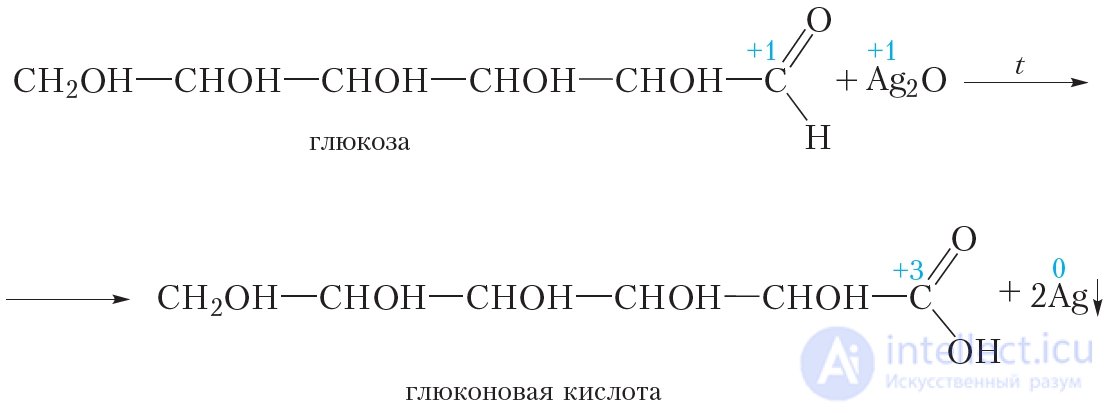
Gluconic acid is formed as a result of the reaction.
3. Reaction with Copper(II) Hydroxide
The reaction with copper(II) hydroxide is a characteristic reaction for both polyhydric alcohols and aldehydes. Glucose exhibits the properties of both polyhydric alcohols and aldehydes. Let us consider what will be observed when glucose reacts with copper(II) hydroxide. We mix solutions of alkali and copper(II) sulfate in a test tube. This produces a blue precipitate of copper(II) hydroxide:

When an aqueous solution of glucose is added to the test tube, the copper(II) hydroxide dissolves and a transparent cornflower-blue solution is formed. The same effect is observed when polyhydric alcohols act on freshly precipitated copper(II) hydroxide. As with polyhydric alcohols, the dissolution of copper(II) hydroxide upon reaction with glucose occurs owing to the formation of a water-soluble complex compound (§ 25). This reaction is a characteristic reaction for polyhydric alcohols.
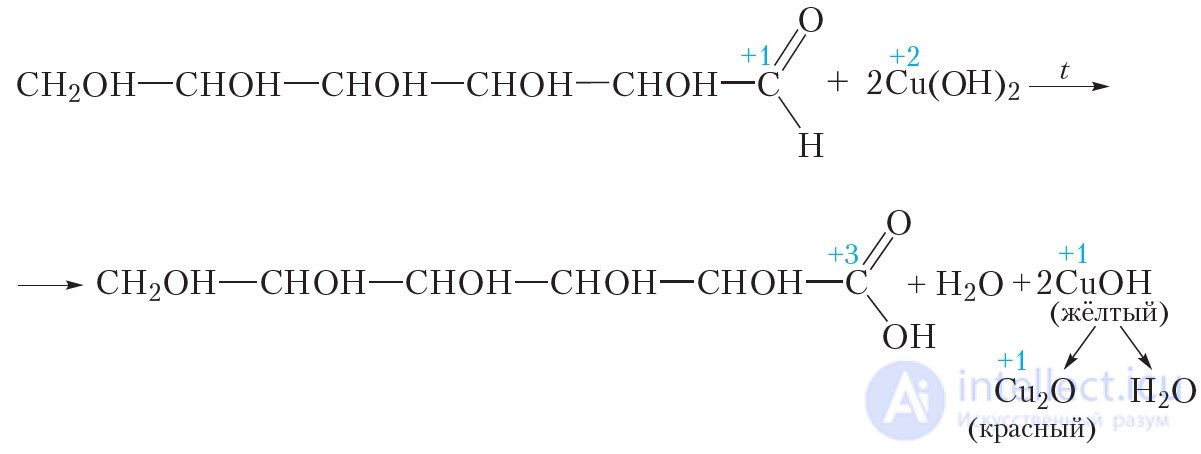
At the same time, the reaction of glucose with copper(II) hydroxide has an interesting feature that makes it easy to distinguish glucose from polyhydric alcohols. Let us heat the contents of the test tube over an alcohol lamp flame. In the case of a polyhydric alcohol, the cornflower-blue solution will boil, but its color will not change. The test with glucose behaves quite differently. When heated, a yellow precipitate first forms in the test tube, which then turns red. The resulting mixture resembles carrot juice. The equation of the reaction taking place:

Video 41.1.
Characteristic reaction
of glucose with
copper(II) hydroxide
The red precipitate is copper(I) oxide Cu2O. In this reaction, copper(II) hydroxide is reduced to copper(I) oxide, and glucose is oxidized to gluconic acid.
In the experiment described, glucose first exhibits the properties of a polyhydric alcohol, dissolving freshly precipitated copper(II) hydroxide. When the mixture is heated, the reaction now involves the aldehyde group of glucose — copper(II) ions oxidize it to a carboxyl group.
4. Alcoholic Fermentation
Some microorganisms, such as yeast, are capable of converting glucose into ethyl alcohol. This process is called the alcoholic fermentation of glucose:
Lactic acid bacteria are capable of converting glucose into lactic acid. This process is called the lactic acid fermentation of glucose:

Lactic acid is a remarkable natural preservative. It is formed when milk turns sour and is present in fermented milk products (soured milk, kefir, cottage cheese, etc.) which, unlike fresh milk, can be stored for quite a long time. The presence of lactic acid accounts for the sour taste of these products. Lactic acid is also formed in the processes of fermenting cabbage, pickling apples, and ensiling green fodder; it prevents the processes of putrefaction and allows products to be preserved for a long time.
Glucose is widely found in nature as a component of many vegetables and fruits. It is especially abundant in grapes, which is why glucose is often called grape sugar.
Glucose is used in medicine as a medicinal preparation, in particular for weakness and intoxication of the body.
In nature, glucose is formed in green plants during photosynthesis:
Industrially, glucose is obtained from cellulose and starch; more on this — in the following sections.
|
The glucose molecule contains an aldehyde group and hydroxyl groups, so it exhibits the chemical properties of both aldehydes and polyhydric alcohols. Glucose gives a characteristic reaction for polyhydric alcohols — the formation of a cornflower-blue solution upon reaction with freshly precipitated copper(II) hydroxide. Glucose gives characteristic reactions for the aldehyde group, being oxidized to gluconic acid on heating with copper(II) hydroxide or an ammoniacal solution of silver oxide. Like aldehydes, glucose adds hydrogen. This reduces the glucose and forms the hexahydric alcohol sorbitol. Under the action of bacteria, glucose undergoes alcoholic fermentation to form ethanol and lactic acid fermentation to form lactic acid. |
Butanoic acid can be obtained as a result of the fermentation of glucose:
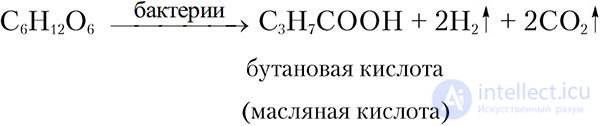
Residues of butanoic acid are found in butter, from which it was first isolated. Therefore, the trivial name of butanoic acid is butyric acid, and the fermentation process that leads to the formation of butyric acid is called butyric acid fermentation.
1. An aqueous solution of organic substance A was mixed with freshly precipitated copper(II) hydroxide. As a result, a cornflower-blue solution formed. When the solution was heated, a brick-red precipitate formed. Propose a possible formula for substance A and write the equations of the reactions that took place.
2. Four test tubes contain aqueous solutions of ethanol, ethanal, ethylene glycol, and glucose. How can a single reagent be used to determine which substance is in which test tube? Describe the course of the experiment and the phenomena observed. Give the equations of the reactions taking place.
3. Glucose, like alcohols, can form esters. Write the formula of the ester formed by one molecule of glucose and five molecules of acetic acid. Write the formula of glucose in its cyclic form.
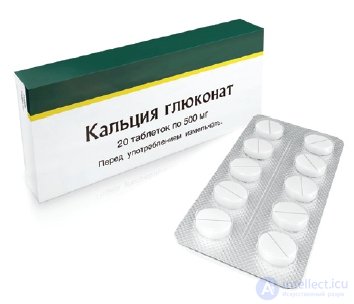 4. The calcium salt of gluconic acid — calcium gluconate — is used in medicine to replenish a deficiency of Ca2+ ions in the body. Write the structural formula of calcium gluconate.
5. During the alcoholic fermentation of glucose, carbon dioxide with a volume of 1,12 dm3 (STP) was released.
a) Write the equation of the chemical reaction taking place.
b) Calculate the mass of ethyl alcohol obtained during the fermentation.
6. Calculate the volume of ethyl alcohol that can be obtained from 100 g of glucose if the yield of ethanol in the fermentation process is 55 %. The density of ethanol is 0,79 g/cm3.

Comments