
Lecture
The phenol molecule contains a hydroxyl group, so it can be expected that phenol will display chemical properties characteristic of alcohols. At the same time, due to the influence of the benzene ring on the hydroxyl group, some properties of phenol differ from the chemical properties of alcohols.
1. Reaction with Alkali Metals
Like alcohols, phenol reacts with alkali metals. If a piece of metallic sodium is placed into molten phenol, the evolution of hydrogen is observed (the melting point of phenol is low, only 41 °C). During the reaction, the hydrogen atom of the hydroxyl group is replaced by a sodium atom: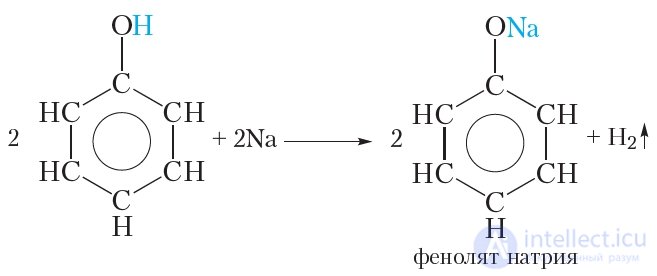
As a result, sodium phenolate is formed. Phenolates, like alcoholates, are solid, salt-like substances.
The reaction of phenol with alkali metals shows that phenol, like alcohols, exhibits weak acidic properties.
2. Reaction with Alkalis (a Difference Between Phenol and Alcohols)
The acidic properties of phenol are more pronounced than those of alcohols. This is manifested in the fact that, unlike alcohols, phenol reacts with alkalis:
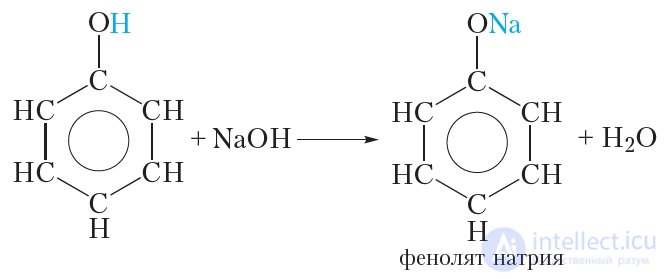
The resulting sodium phenolate is readily soluble in water. Thus, phenol is moderately soluble in water but dissolves well in a sodium hydroxide solution, since soluble sodium phenolate is formed in the process. The increased acidic properties of phenol compared with alcohols are due to the influence of the benzene ring, which reduces the strength of the O—H bond. As a result, the hydrogen atom of the hydroxyl group of the phenol molecule can be replaced by a metal atom not only when reacting with alkali metals, but also with alkalis.
In terms of acidic properties, phenol surpasses not only alcohols but also water. Therefore, phenolates, unlike alcoholates, are not decomposed by water. The presence of acidic properties in phenol is reflected in its trivial name — carbolic acid.
Nevertheless, phenol is a very weak acid. Even carbonic acid is stronger than phenol and therefore displaces it from sodium phenolate:
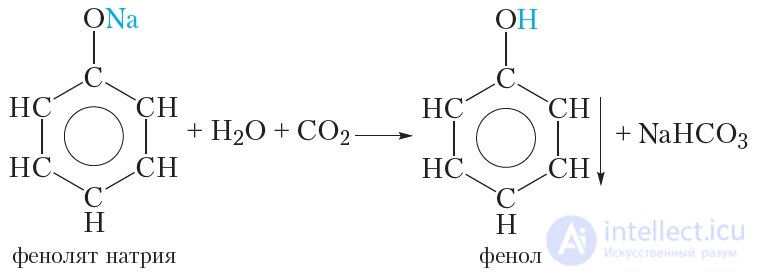
This reaction can be carried out as follows. Carbon dioxide is passed through a solution of sodium phenolate, and the solution becomes turbid, since the phenol formed precipitates out.
3. Reaction with Bromine Water (a Difference Between Phenol and Benzene)
The phenol molecule contains a benzene ring, so it can be expected that phenol will display chemical properties characteristic of aromatic hydrocarbons, such as benzene. As you already know, substitution reactions of hydrogen atoms are characteristic of benzene. Thus, benzene reacts with bromine in the presence of a catalyst. In this case, a reaction takes place in which one hydrogen atom is substituted with bromine:
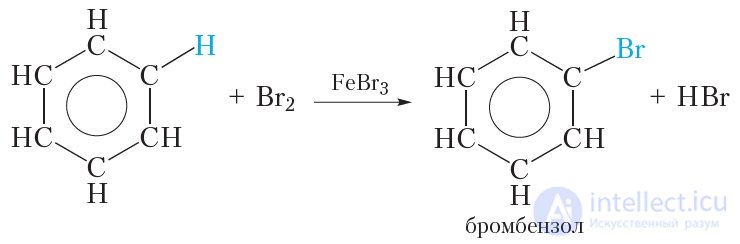
Benzene does not decolorize bromine water!
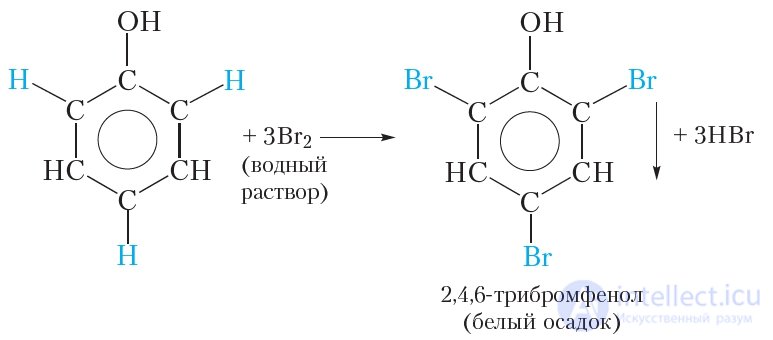
In the phenol molecule, the hydroxyl group affects the properties of the benzene ring, facilitating the substitution of hydrogen atoms, so the reaction of phenol with bromine proceeds readily even without a catalyst. Thus, when a dilute phenol solution is mixed with bromine water, decolorization of the bromine water and the formation of a white precipitate are observed. The equation for the reaction that takes place:

Video 28.1.
Qualitative
reactions for phenol
As a result of the reaction, three hydrogen atoms of the benzene ring are substituted with bromine atoms, forming 2,4,6-tribromophenol. Note that the substitution of a hydrogen atom of the benzene ring with a bromine atom is also possible for benzene, but the reaction conditions are much harsher than for phenol. This requires bromine rather than bromine water, as well as a catalyst. The bromination of phenol proceeds under mild conditions, which indicates the increased reactivity of the benzene ring in phenol. This is due to the influence of the hydroxyl group, which facilitates the substitution of hydrogen atoms at positions 2, 4, and 6 of the benzene ring of the phenol molecule.
4. Reaction with Nitric Acid
When phenol reacts with a mixture of concentrated nitric and sulfuric acids, three hydrogen atoms of the benzene ring can be replaced with —NO2 groups: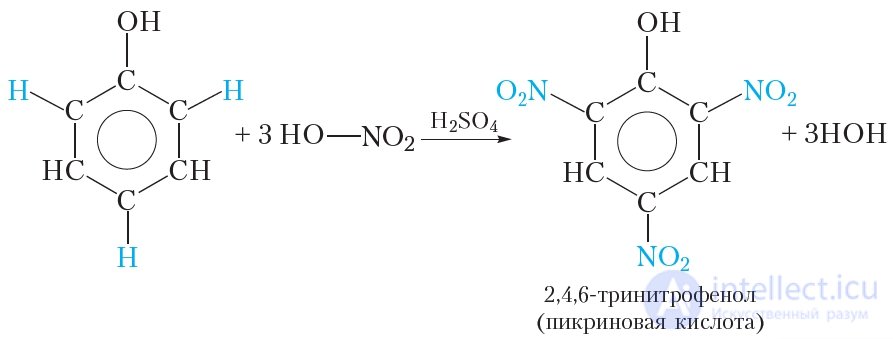

* Industrial
production of phenol
As a result of the reaction, 2,4,6-trinitrophenol is formed. The acidic properties of 2,4,6-trinitrophenol are significantly more pronounced than those of phenol. The trivial name of 2,4,6-trinitrophenol is picric acid. Picric acid and its salts are explosive substances.
The chemical properties of phenol considered above demonstrate the mutual influence of atoms in the molecules of organic compounds: the benzene ring enhances the acidity of the hydroxyl group of the phenol molecule, while, in turn, the hydroxyl group affects the benzene ring, facilitating the substitution of hydrogen atoms at positions 2, 4, and 6.
Most of the phenol produced is used to obtain various polymers, from which plastics, fibers, and other useful materials are manufactured.
Phenol is also used to obtain medicinal drugs, dyes, and other substances.
Phenol is a toxic substance. Chlorinated derivatives of phenol are even more dangerous. Given that chlorine is used in water purification, contamination of drinking water with phenol poses an enormous danger. Therefore, protecting the environment from industrial waste containing phenol is an important problem.
|
The phenol molecule contains a hydroxyl group and a benzene ring, so phenol exhibits some properties characteristic of alcohols and aromatic hydrocarbons. Under the influence of the benzene ring, the strength of the O—H bond in the phenol molecule decreases compared with alcohols, so the acidic properties of phenol are more pronounced than those of alcohols. Unlike alcohols, phenol reacts with alkalis. The hydroxyl group of the phenol molecule affects the benzene ring, facilitating the substitution of hydrogen atoms at positions 2, 4, and 6, so, unlike benzene, phenol decolorizes bromine water. Phenol is used to obtain plastics, fibers, medicines, dyes, and other substances. |
One of the sources of phenol for industrial needs is coal tar.
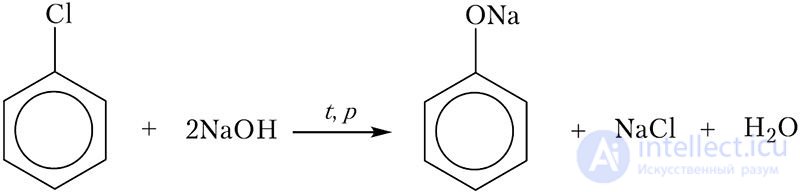
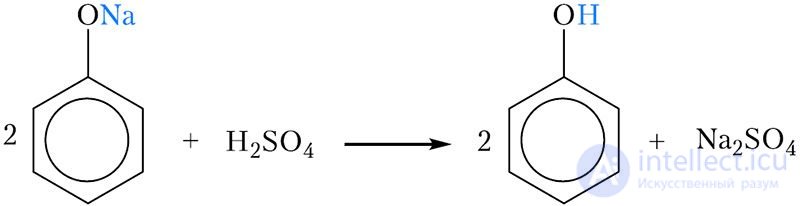
Phenol is also obtained by the reaction of chlorobenzene with sodium hydroxide at elevated temperature and pressure. Unlike alcohols, phenol reacts with alkalis, so in the first stage sodium phenolate is formed (the product of the reaction of the resulting phenol with sodium hydroxide):
In the second stage, phenol is displaced from sodium phenolate by a strong acid:
At present, the main method for producing phenol is the so-called cumene method. It consists of the following: first, isopropylbenzene, whose trivial name is cumene, is obtained from benzene and propene:
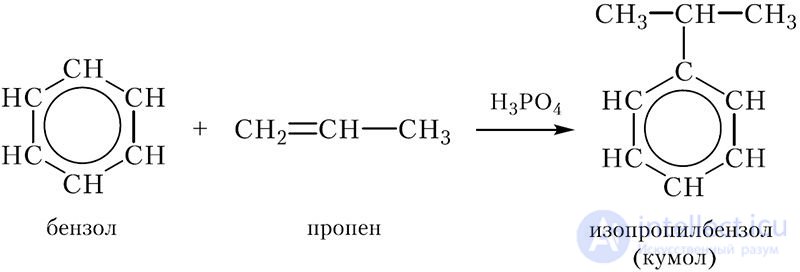
In the course of this reaction, an alkyl radical is introduced into the benzene molecule, so this reaction is called the alkylation reaction of benzene.
Isopropylbenzene is oxidized by atmospheric oxygen to cumene hydroperoxide:
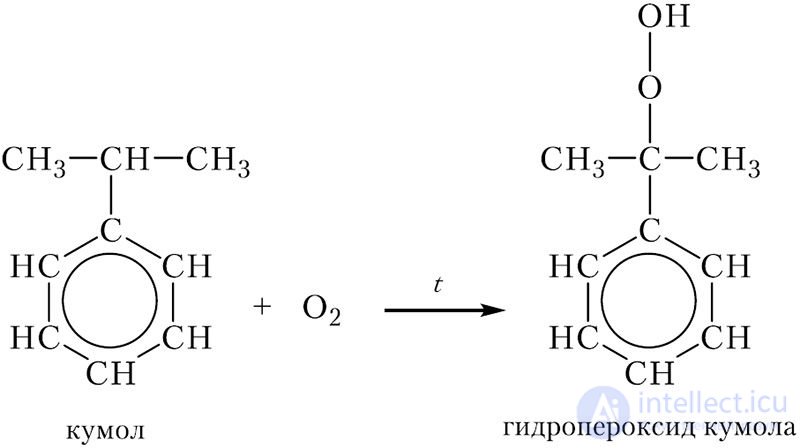
Cumene hydroperoxide is then decomposed with dilute sulfuric acid:
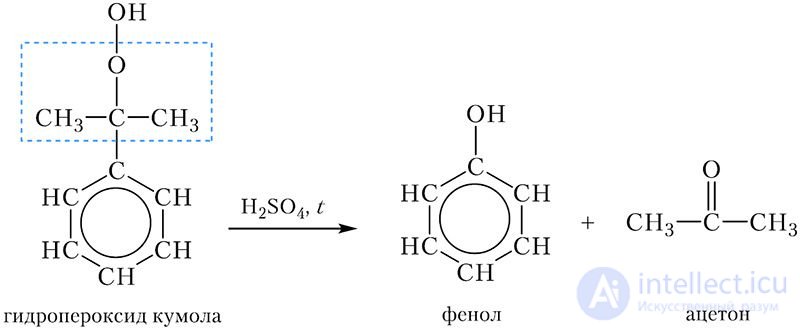
In addition to phenol, acetone is also formed — a representative of the ketone class. You are already familiar with it; it is formed as a result of the oxidation of propan-2-ol (§ 24).
1. Why does the solution become turbid when carbon dioxide is passed through a clear aqueous solution of sodium phenolate? Write the equation for the reaction that takes place.
2. Write the equation for the reaction that takes place when bromine water is added to an aqueous solution of phenol. Name the resulting organic substance.
3. Three unlabeled test tubes contain aqueous solutions of the following substances: ethanol, glycerol, and phenol. You have available aqueous solutions of the following substances: copper(II) sulfate, sodium hydroxide, and bromine. How can the substances in the test tubes be distinguished using the available reagents? Describe the experimental procedure and observations in detail.
4. A substance with the following structure is given:
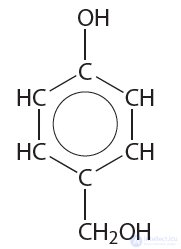
Write the equations for the reactions of this substance with: a) sodium; b) an aqueous solution of sodium hydroxide; c) hydrogen bromide. Calculate the volume of a 20% (by mass) sodium hydroxide solution with a density of 1.22 g/cm3 that will be required for complete reaction with 24.8 g of the specified substance.
5. The nitration product of phenol — picric acid — was widely used as an explosive in the early last century, but its use in filling ammunition eventually had to be abandoned due to its high corrosive activity. What causes the acidic properties of picric acid? The sodium salt of picric acid (sodium picrate) is also an explosive substance. Write the equation for the reaction forming sodium picrate from the reaction of picric acid with an alkali.
6*. How is phenol produced industrially? What other product is formed in the process? Where is phenol used?

Comments