
Lecture
Another carbohydrate we are about to become acquainted with is — fructose. Fructose is a colorless crystalline substance that is readily soluble in water. Fructose is approximately twice as sweet as glucose, and it is a component of bee honey.
The molecular formula of fructose is the same as that of glucose, — C6H12O6, that is, it is an isomer of glucose. You already know that the glucose molecule contains an aldehyde group. In the fructose molecule, unlike glucose, there is a ketone group: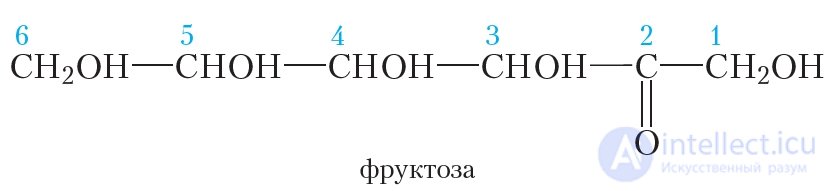
In addition to the ketone group, the fructose molecule contains five hydroxyl groups. Thus, fructose is both a polyhydric alcohol and a ketone.
Like glucose, fructose forms cyclic α- and β-forms:
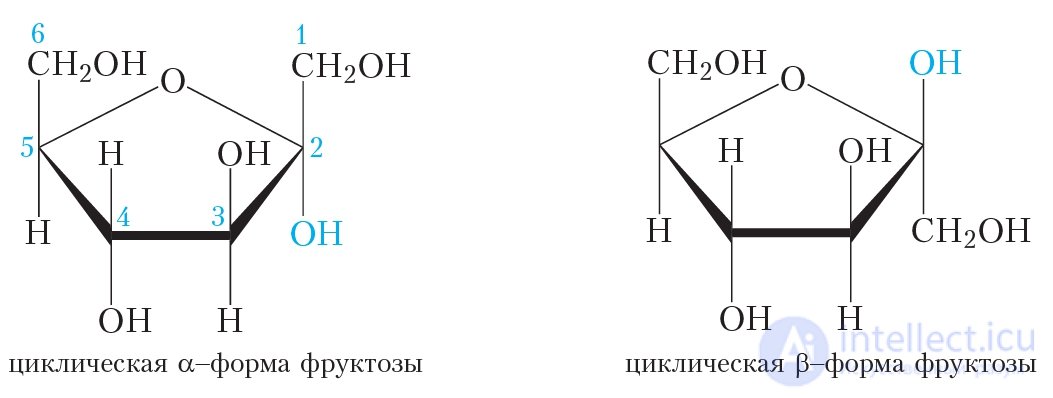
These forms differ from one another in the spatial arrangement of the hydroxyl group at the second carbon atom. The diagram shows that, unlike glucose, fructose is characterized by the formation of five-membered rings.
Residues of glucose and fructose are part of the well-known carbohydrate — sucrose, that is, ordinary sugar.
Sucrose — is a colorless crystalline substance, readily soluble in water, sweet to the taste. The molecular formula of sucrose is C12H22O11. The process of forming a sucrose molecule from glucose and fructose can be represented by the following scheme:
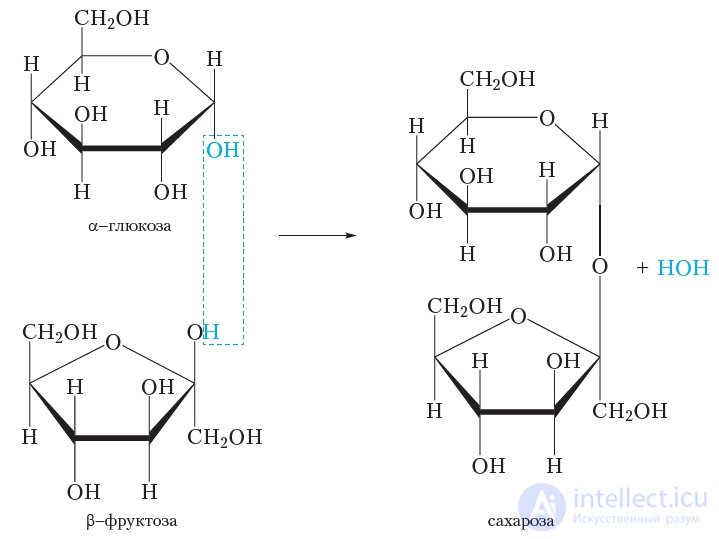
The scheme shown demonstrates that the sucrose molecule consists of residues of two carbohydrates — glucose and fructose. Therefore, sucrose belongs to the disaccharides. Accordingly, glucose and fructose are monosaccharides.
The residues of glucose and fructose in the sucrose molecule are linked to each other by an oxygen bridge, formed as a result of the elimination of one molecule of water from two monosaccharide molecules: glucose and fructose.
In the sucrose molecule, the bond between the glucose and fructose residues is formed through the hydroxyl group at the first carbon atom of the glucose molecule. Because of this, the cyclic form of glucose in the sucrose molecule is fixed, and the formation of the linear form containing an aldehyde group is impossible. Therefore, sucrose does not exhibit properties characteristic of aldehydes. For example, sucrose does not give the «silver mirror» reaction.
1. Reaction of Sucrose with Copper(II) Hydroxide
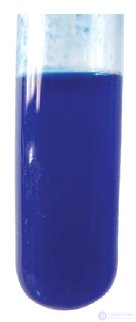
The reaction with copper(II) hydroxide is a characteristic reaction for polyhydric alcohols. When a sucrose solution is added to freshly precipitated copper(II) hydroxide, a transparent cornflower-blue solution is formed. This reaction proves that sucrose is a polyhydric alcohol.
When the resulting solution is heated, a red precipitate of copper(I) hydroxide does not form. This proves that, unlike glucose, sucrose does not exhibit properties characteristic of aldehydes.
2. Hydrolysis of Sucrose
The presence of glucose and fructose residues in the sucrose molecule can be proven experimentally. If a few drops of sulfuric acid are added to a sucrose solution and the solution is boiled, hydrolysis of sucrose will occur and glucose and fructose will form in the solution:
The presence of glucose in the hydrolysis products is confirmed using characteristic reactions for the aldehyde group.
Sucrose is found in sugar cane and sugar beet. Therefore, the production of sucrose comes down to extracting it from the juice of these plants.
To obtain sugar from sugar cane, it is pressed, and the resulting juice is purified and evaporated.
In Belarus, sugar is obtained from sugar beet. The largest sugar factories in our country are located in Skidel, Gorodeya, and Slutsk. To obtain sugar, washed sugar beet is crushed and treated with hot water. As a result, the sucrose from the sugar beet passes into an aqueous solution. In addition to sucrose, many other substances contained in the sugar beet also pass into the solution, so the resulting solution undergoes multiple purification stages. The purified sugar syrup is evaporated, the precipitated sucrose crystals are filtered out, and sugar is obtained.
|
The molecular formula of fructose is C6H12O6. Fructose and glucose are isomers. In the linear form of fructose there is a ketone group and five hydroxyl groups. The molecular formula of sucrose is C12H22O11. Sucrose is a disaccharide and consists of glucose and fructose residues linked by an oxygen bridge. Sucrose enters into a characteristic reaction for polyhydric alcohols, forming a cornflower-blue solution with freshly precipitated copper(II) hydroxide. Sucrose does not give characteristic reactions for the aldehyde group. As a result of the hydrolysis of sucrose, glucose and fructose are formed. Sucrose is obtained from sugar cane and sugar beet. |
1. Write the molecular and structural (for the linear form) formula of fructose. What functional groups are present in the fructose molecule? Where is fructose found in nature?
2. Give the formulas and names of the mono- and disaccharides known to you.
3. Among the substances listed, select those that undergo hydrolysis. Give the equations of the corresponding reactions.
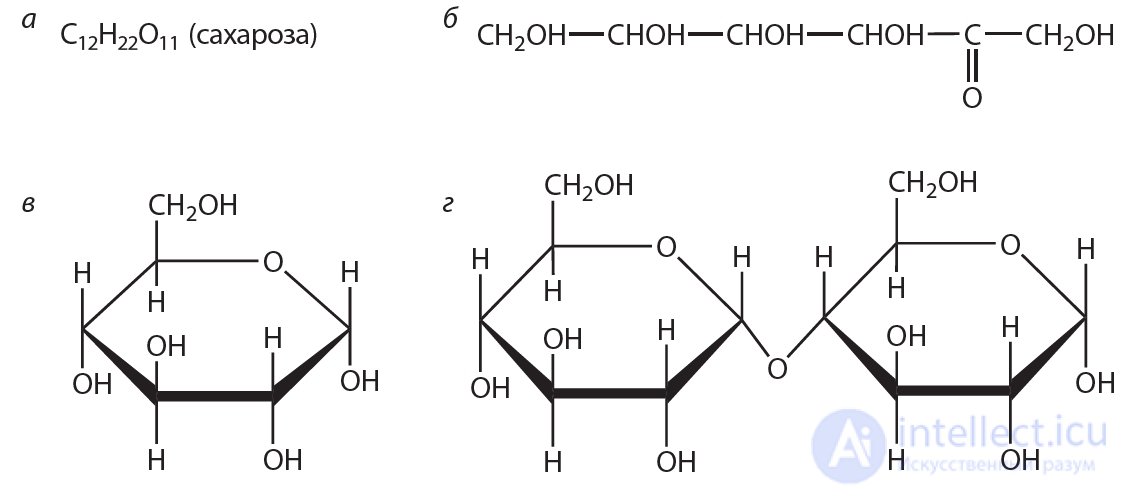
4. Which of the carbohydrates (glucose or sucrose) gives the «silver mirror» reaction? Give the equation of the reaction.
5. An aqueous solution of organic substance A was mixed with freshly precipitated copper(II) hydroxide. As a result, a cornflower-blue solution formed. The solution was heated. No change in color was observed. Propose a possible formula for substance A.
6. A few drops of sulfuric acid were added to a sucrose solution and the mixture was boiled. The solution was then neutralized with alkali. Will the resulting mixture give the «silver mirror» reaction? Give the equations of the reactions.
7. Compound A has a sweet taste, is readily soluble in water, and is found in sugar cane. Hydrolysis of A produces substances B and C, which have the same relative molecular mass. Substance B gives a red precipitate on heating with copper(II) hydroxide. Under the action of an enzyme from lactic acid bacteria, substance B forms compound D with a dual chemical function, which accumulates when milk turns sour. Give possible formulas for substances A, B, and D, and the equations of the reactions.
8. Given is a scheme of transformations of organic substances:

Write the equations of the reactions taking place.
9. Complete oxidation of 1 mole of glucose releases 670 kcal of energy, while complete oxidation of 1 mole of sucrose releases 1350 kcal of energy. Young chemist Stas unknowingly ate 5 g of glucose, and young chemist Vasily — 5 g of sucrose. Based on the data given, complete the following sentence.
Young chemist Stas consumed … kcal … than young chemist Vasily.
10. What is the maximum mass of ethanol that can be obtained from 1 kg of sucrose? Assume that ethanol is formed by the fermentation of both glucose and fructose.
11. A disaccharide with a mass of 29,6 g was subjected to complete hydrolysis. The relative molecular masses of the resulting monosaccharides are 180 and 134, respectively. Calculate the total mass (g) of the resulting monosaccharides.
 You can learn about carbohydrates of important biochemical significance — ribose and deoxyribose — by following the link in the QR code.

Comments