
Lecture
The name «aromatic compounds» arose because the first known representatives of this class, obtained back in the early 19th century, had a pleasant smell. Later it turned out that most substances that, by structure and chemical properties, belong to this same group do not have a pleasant smell. However, the historically established general name for these compounds has persisted.
The simplest representative of aromatic hydrocarbons is benzene. Its molecular formula is C6H6.
Benzene is a low-boiling (tbp = 80 °C), colorless, insoluble in water
liquid with a characteristic odor. Upon cooling, benzene readily solidifies into a white crystalline mass with a melting point of 5.5 °C.
Benzene was discovered by the great English physicist Michael Faraday. In 1825, he managed to isolate benzene from coal tar. Later, the simplest formula CH and the molecular formula C6H6 of benzene were established. However, for a long time it was not possible to establish the structure of this substance's molecule. Forty years after the discovery of benzene, the German chemist August Kekulé made the correct assumption about the cyclic structure of the benzene molecule and proposed the following structural formula:
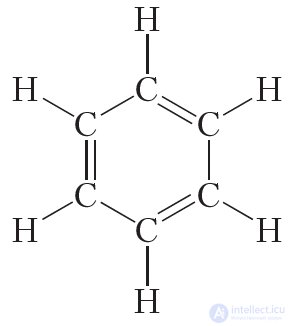
The formula shown for benzene is called the Kekulé formula. The Kekulé formula shows that the benzene molecule has a planar structure, with bond angles equal to 120°. The Kekulé formula also implies that hydrogenating the benzene molecule to cyclohexane requires three molecules of hydrogen:
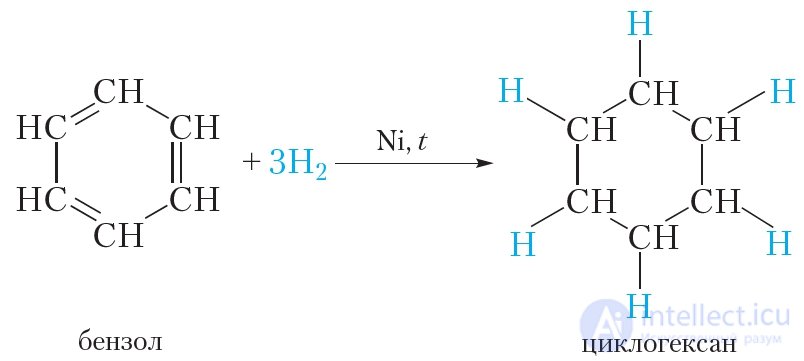
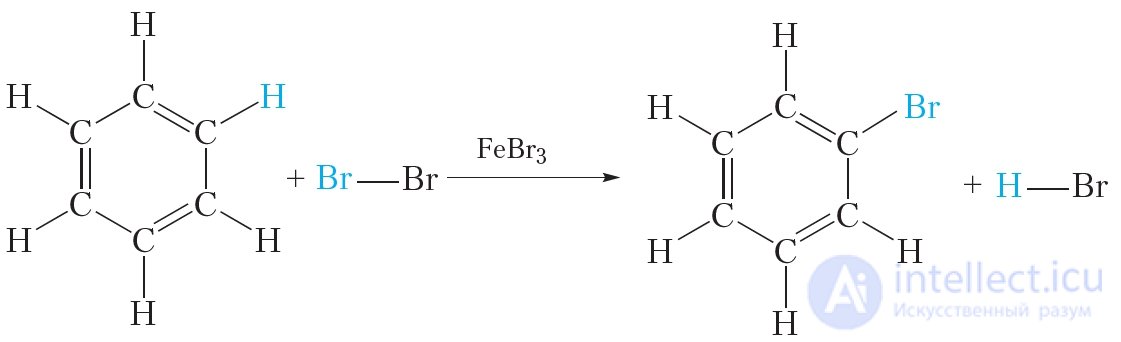
All these conclusions are confirmed by experimental data. However, the Kekulé formula does not explain a number of benzene's unusual properties. For example, benzene does not undergo the qualitative test reactions for a double  bond. Unlike alkenes, it does not decolorize bromine water or a potassium permanganate solution. In the presence of a catalyst, benzene reacts with halogens; however, this does not involve addition of the halogen but rather substitution of a hydrogen atom in the benzene molecule by a halogen atom:
Furthermore, it has been established experimentally that all the carbon-carbon bonds in the benzene molecule have the same length. Such unusual properties of benzene could only be explained in the 20th century, using the modern theory of the structure of matter.
The Kekulé formula implies that the double bonds in the benzene molecule are conjugated. Using the example of 1,3-butadiene, we saw that conjugation leads to a certain equalization of the lengths of double and single bonds. In the benzene molecule, the conjugation is so strong that the lengths of all the carbon-carbon bonds become equal:
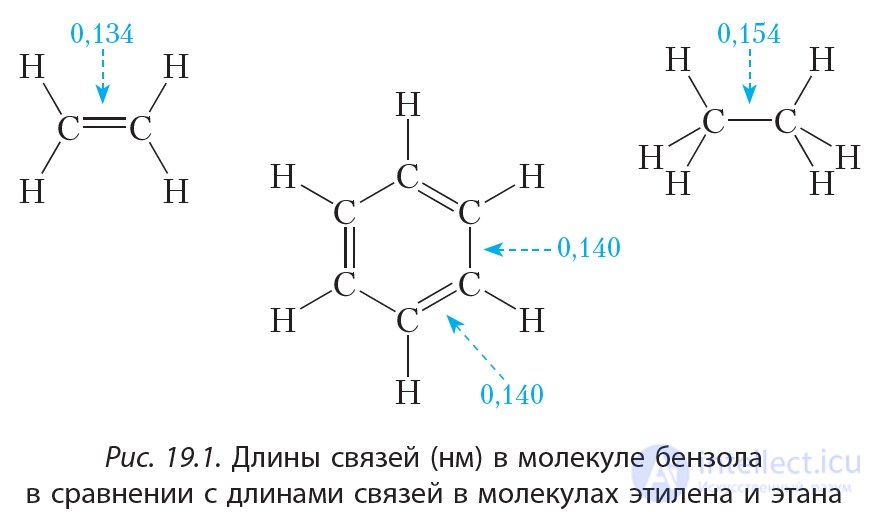 Thus, the benzene molecule has no double and single bonds. Each carbon atom in the benzene molecule, just as in 1,3-butadiene, is in a state of sp2-hybridization. π-Electrons are delocalized and form not three separate π-bonds but a single π-system (a conjugated system of π-bonds):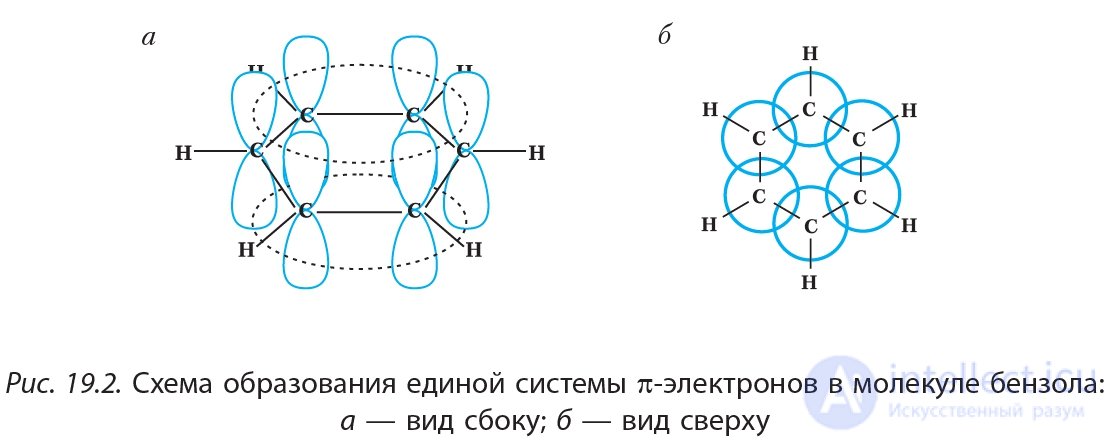
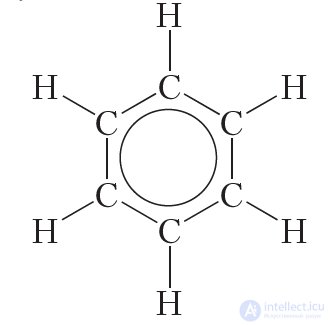
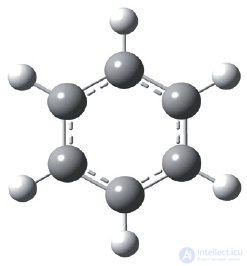
Alongside the formula for benzene that shows the delocalization of π-electrons, the Kekulé formula is also often used, bearing in mind that it does not quite accurately convey the structure of benzene:
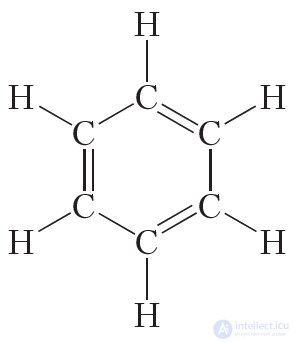
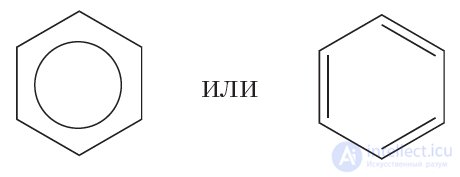
The delocalization of π-electrons gives the benzene molecule additional stability. Therefore, benzene is characterized by reactions in which the conjugated system of π-bonds in the molecule is preserved. Substitution reactions are such reactions (see the equation for the reaction with bromine).
As already noted, benzene is the simplest representative of the aromatic hydrocarbons. Its homologues can be regarded as the products of substituting one or more hydrogen atoms in the benzene molecule with hydrocarbon radicals. The formulas and names of some homologues of benzene are given in Figure 19.3.
As can be seen, for naming substances in whose molecules several hydrocarbon radicals are attached to the benzene ring, the carbon atoms of the benzene ring are numbered so that the substituents receive the lowest possible numbers, and numerals in the name are used to indicate the positions of the substituents.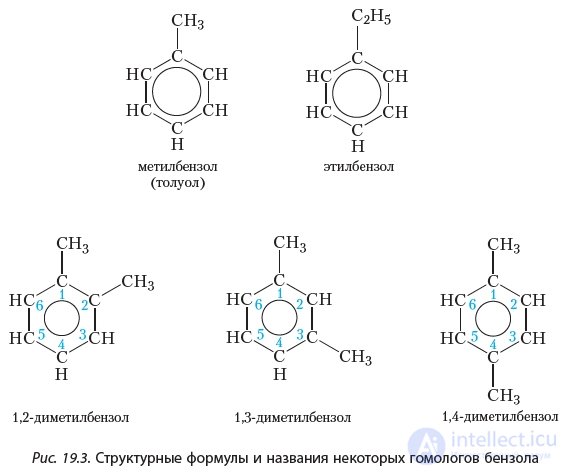
|
Benzene C6H6 — the simplest representative of the class of aromatic hydrocarbons. The benzene molecule has a planar structure, the bond angles equal 120°, and the lengths of all the carbon-carbon bonds are equal. π-Electrons in the benzene molecule are delocalized and form a single conjugated system of π-bonds. The conjugated system of π-bonds gives the benzene molecule increased stability; therefore, benzene is characterized by reactions in which the conjugated system is preserved. |
1. What is the main structural feature of the benzene molecule? Why does benzene not undergo the qualitative test reactions for double C  C bonds?
2. Which chemical reactions (addition or substitution) are more characteristic of benzene, and why? Give the equations for the reactions of ethene with bromine water and of benzene with bromine in the presence of a catalyst.
3. Write the structural formula of the nearest homologue of benzene — toluene. How many carbon atoms in the toluene molecule lie in a single plane?
4. Among the substances shown in Figure 19.3, identify the isomers.
5. Derive the general formula for the homologous series of benzene.
6. Burning 1.17 g of a hydrocarbon that is solid under normal conditions produced 2.016 dm3 (STP) of carbon dioxide and 0.81 g of water. The hydrocarbon does not decolorize bromine water. Determine the structural formula of this compound.

Comments