
Lecture
In the molecule of the first representative of the homologous series of saturated monobasic carboxylic acids, the carboxyl group is bonded to a hydrogen atom:
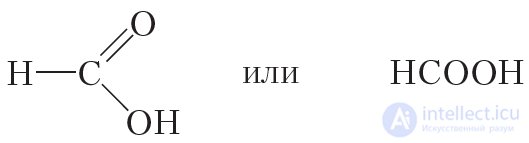
As you already know, this compound is called formic acid. Formic acid was first isolated from forest ants, which is why it received this name. In nature, formic acid is also found in nettles, certain fruits, the caustic secretions of jellyfish, and so on. At room temperature, formic acid is a colorless liquid with a pungent odor, with a boiling point of 101 °C.
The formula of the next representative of the homologous series of saturated monobasic carboxylic acids:
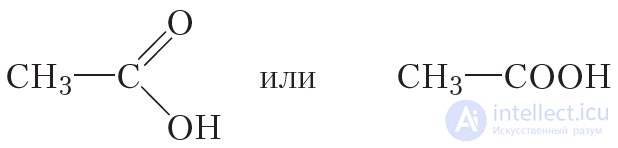 This compound is called acetic acid. Like formic acid, acetic acid is a colorless liquid with a pungent odor at room temperature. The boiling point of acetic acid is 118 °C.
The molecules of the homologs of acetic acid differ from it by one or more CH2 groups and have the general formula CnH2n+1 —COOH.
Homologs of acetic acid are known whose hydrocarbon radical includes a fairly long chain of carbon atoms. The most important representatives of such acids are palmitic acid C15H31 —COOH and stearic acid C17H35 —COOH.
In the molecules of palmitic and stearic acids, the hydrocarbon radicals have an unbranched structure. Ball-and-stick model of the palmitic acid molecule:
 Palmitic and stearic acids are obtained from fat-processing products and are known as higher fatty acids.
These acids are solid, colorless substances that are insoluble in water. The melting points of palmitic and stearic acids are 63 and 70 °C, respectively.
Carboxylic acids can exhibit carbon-skeleton isomerism. As with aldehydes, this type of isomerism first appears in the substance containing four carbon atoms in the molecule:
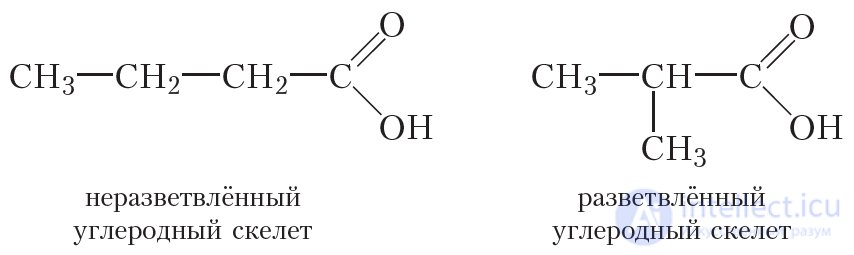
Since the carboxyl group is always located at the beginning of the molecule, isomerism associated with the position of the carboxyl group is not possible.
The names formic and acetic acid are historically established, or trivial, names. According to systematic nomenclature, the carboxyl group is denoted by the combination «-oic acid». The name of an acid consists of the name of the alkane with the same number of carbon atoms in the molecule as the acid, plus the ending «-oic acid». Numbering of the carbon atoms of the main chain always begins with the carbon atom of the carboxyl group.
Let us name all the carboxylic acids mentioned above: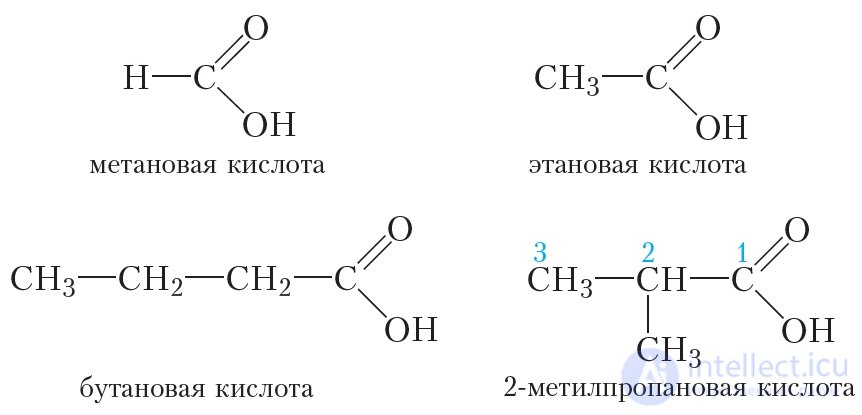 Using the rules of systematic nomenclature, we can also name carboxylic acids whose molecules have a more complex structure, for example:
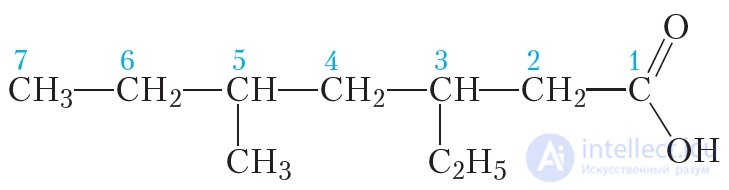
The main chain consists of seven carbon atoms. The corresponding alkane is called heptane. The third and fifth carbon atoms of the main chain are bonded to alkyl radicals, the names of which are listed in alphabetical order. We indicate that the compound belongs to the class of carboxylic acids using the combination «-oic acid». The name of the carboxylic acid is then 5-methyl-3-ethylheptanoic acid.
 You can learn about the intergroup isomerism of carboxylic acids and esters by following the link in the QR code.
Table 32.1 shows the formulas, names, and boiling points of some carboxylic acids.
Table 32.1. Formulas, names, and boiling points of some carboxylic acids
|
Formula |
Name |
tb, °C |
|
H—COOH |
methanoic acid |
101 |
|
CH3—COOH |
ethanoic acid |
118 |
|
CH3—CH2—COOH |
propanoic acid |
141 |
|
CH3—CH2—CH2—COOH |
butanoic acid |
164 |
|
CH3—CH2—CH2—CH2—COOH |
pentanoic acid |
185 |
As can be seen from the table data, the boiling points of carboxylic acids are significantly higher than those of aldehydes with the same number of carbon atoms in the molecule. Unlike aldehydes, there are no substances among carboxylic acids that are gaseous at room temperature. We have already encountered the absence of gaseous substances in the homologous series of monohydric alcohols (§ 23). Section 23 indicated the reason for the high boiling points of alcohols — the formation of hydrogen bonds between their molecules. The formation of hydrogen bonds between alcohol molecules is possible thanks to the presence of polar —OH groups.
In the molecules of carboxylic acids, as in alcohols, there is a —OH group:
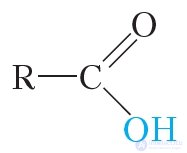 Therefore, hydrogen bonds also form between the molecules of carboxylic acids:
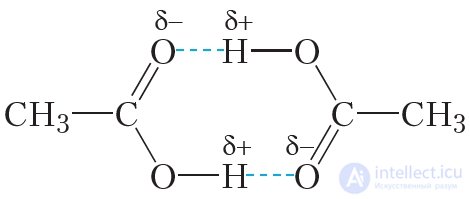
Hydrogen bonds hold the molecules of carboxylic acids together quite strongly, making the transition to the gaseous state difficult, which is why carboxylic acids have high boiling points.
Under normal conditions, the simplest representatives of carboxylic acids are liquids with a pungent odor. As the size of the hydrocarbon radical increases, the boiling points of carboxylic acids increase. The higher carboxylic acids — palmitic and stearic — are solid substances.
Formic, acetic, and propanoic acids mix with water in any proportion, meaning that aqueous solutions of these acids can be prepared at any concentration. As the number of carbon atoms in the hydrocarbon radical increases, the solubility of carboxylic acids in water decreases. The higher carboxylic acids — palmitic and stearic — are insoluble in water.
|
According to systematic nomenclature, the carboxyl group is denoted by the combination «-oic acid». In accordance with systematic nomenclature, the name of a carboxylic acid consists of the name of the hydrocarbon with the same number of carbon atoms in the molecule as the acid, plus the ending «-oic acid». Numbering of the carbon atoms of the main chain begins with the carbon atom of the carboxyl group. Hydrogen bonds form between the molecules of carboxylic acids, which accounts for their high boiling points. |
Carboxylic acids can exhibit intergroup isomerism with esters. For example, acetic acid is isomeric with the methyl ester of formic acid (methyl formate):

As can be seen, the composition of both substances can be expressed by the same molecular formula C2H4O2.
There are two esters isomeric to propanoic acid:

All three substances correspond to the molecular formula C3H6O2.
You can read more about how ester names are constructed in § 38.
1. Indicate the ball-and-stick model of propanoic acid:
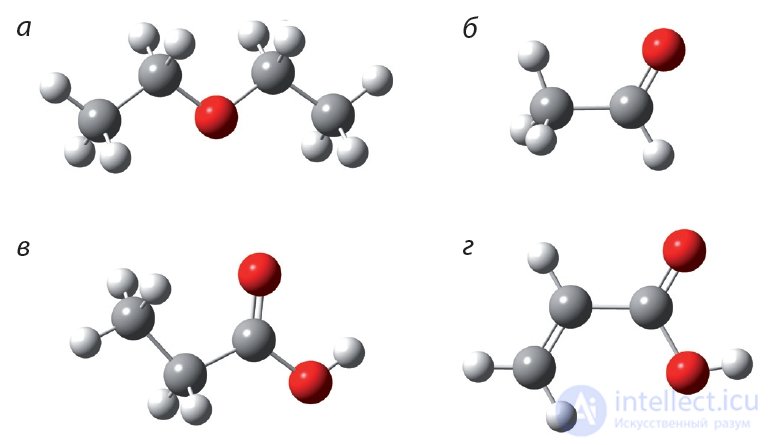
Write the structural formulas of monobasic carboxylic acids with the composition C5H10O2 and name them according to systematic nomenclature.
2. The figure shows models of the molecules of formic and acetic acids:
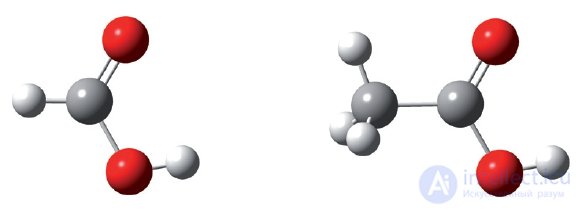
Indicate the types of hybridization of the carbon atoms in the molecules of these compounds and the approximate values of the bond angles.
3. Arrange the following substances in order of increasing boiling point: ethanol, acetaldehyde, acetic acid. Explain your answer.
4. Show the formation of hydrogen bonds between molecules of acetic acid and water.
5. Due to the formation of hydrogen bonds in the vapor phase, formic acid exists both as individual molecules and as cyclic dimers:
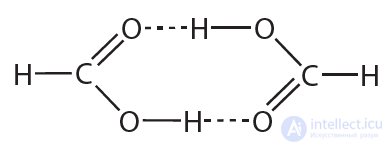
Determine the average molar mass of a vapor consisting of formic acid and its dimer, given that in the vapor phase there are 30 dimer molecules for every 100 individual formic acid molecules.

Comments