
Lecture
In the molecules of organic substances, carbon atoms joined by covalent bonds can form linear, branched, and cyclic structures. This explains the diversity of organic compounds, the number of which is far greater than the number of known inorganic substances.
Many organic substances have the same composition but a different molecular structure. You already know that such substances are called isomers. In the case of alkanes, the phenomenon of isomerism appears starting with the fourth member of the homologous series — butane C4H10, for which two isomers exist. Pentane C5H12 has three isomers: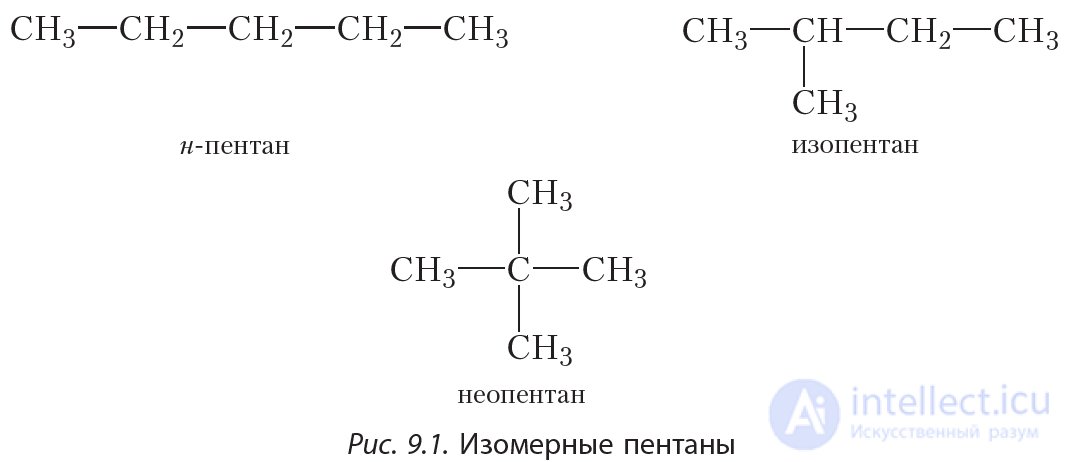 It is clear that the name pentane is insufficient, since it does not indicate which isomer (n-pentane, isopentane, or neopentane) is meant.
For alkanes with a large number of carbon atoms in the molecule, the number of isomers is enormous. For example, there can exist 36 797 588 isomeric alkanes of composition C25H52, which is almost forty million substances! This raises the question: how should these substances be named? To solve this problem, rules for constructing the names of organic compounds (nomenclature) were developed. Today, the most widely used nomenclature is IUPAC (IUPAC — International Union of Pure and Applied Chemistry).
Let us consider the basic principles of the nomenclature of organic compounds using alkanes as an example.
The carbon chain in alkane molecules can have a linear or branched structure. Let us first consider the names of unbranched (normal) alkanes (Table 9.1).
Table 9.1. Formulas and names of unbranched alkanes
|
Molecular formula |
Structural formula |
Name |
|
CH4 |
CH4 |
methane |
|
C2H6 |
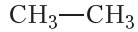
|
ethane |
|
C3H8 |
|
propane |
|
C4H10 |
|
n-butane |
|
C5H12 |
|
n-pentane |
|
C6H14 |
|
n-hexane |
|
C7H16 |
|
n-heptane |
|
C8H18 |
|
n-octane |
|
C9H20 |
|
n-nonane |
|
C10H22 |
|
n-decane |
The names of the first four members of the homologous series of alkanes — methane, ethane, propane, butane — are historically established (trivial) names. The names of the subsequent alkanes consist of a Greek numeral indicating the number of carbon atoms in the alkane molecule, and the suffix -ane. Note that, starting with butane, the letter «n» is placed at the beginning of the name. This is because butane and the subsequent alkanes have isomers. The letter «n» at the beginning of the name denotes a hydrocarbon with an unbranched (normal) carbon chain.
Constructing the name of a branched alkane is somewhat more complicated. Let us be guided by an obvious principle: if an object cannot be named as a whole, let us divide it into parts and name it part by part. In this case, it is logical to represent a molecule of branched structure as similar to a tree, having a trunk to which branches are attached at certain points (Fig. 9.2). The role of the trunk is played by the longest carbon chain; such a chain is called the main chain. The «branches» attached to the «trunk» are groups of atoms 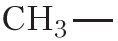 ,
,  etc. Such groups are called alkyl radicals, or alkyl groups.
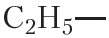
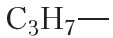
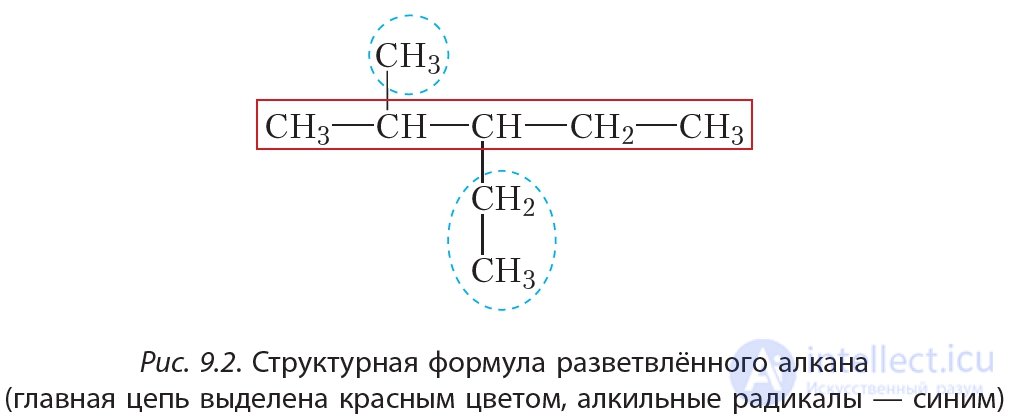 An alkyl radical is formed as a result of the removal of one hydrogen atom from an alkane molecule. The branched alkane shown in Figure 9.2 can be regarded as the product of substituting hydrogen atoms in the unbranched alkane (n-pentane) with alkyl radicals ( and ). Therefore, alkyl radicals are called substituents. The name of an alkyl radical is formed similarly to the name of the alkane, by replacing the suffix -ane with -yl (Table 9.2).
Table 9.2. Formulas and names of alkyl radicals
|
Molecular formula |
Structural formula |
Name |
|
|
|
methyl |
|
|
|
ethyl |
|
|
|
propyl |
Before constructing the name, the carbon atoms in the main chain are numbered starting from the end closer to the branch point:
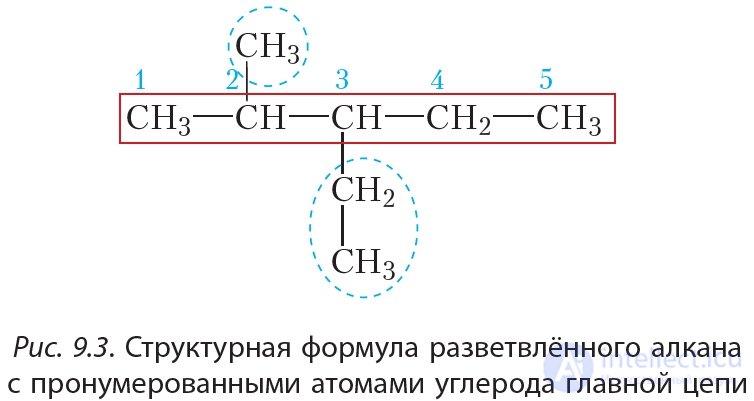
In the name, alkyl substituents are listed in alphabetical order, with numbers indicating the position of each substituent in the main chain. According to the rules given above, the name of this alkane is 2-methyl3-ethylpentane. Let us examine the principles for constructing the names of alkanes in more detail using specific examples.
Example 1. Let us name the simplest alkane of branched structure:
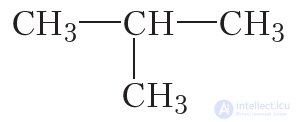
The main chain of this molecule consists of three carbon atoms. An alkane with this number of carbon atoms is called propane. A methyl group is attached to this chain at position 2.
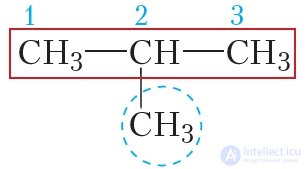
The name of the substance is 2-methylpropane.
Example 2. Let us construct the name of one of the isomers of pentane:
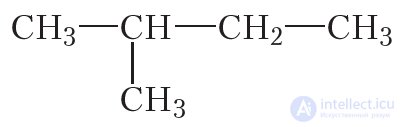
We find the longest carbon chain in the structural formula. We number the carbon atoms of this chain starting from the end closer to the branch point:
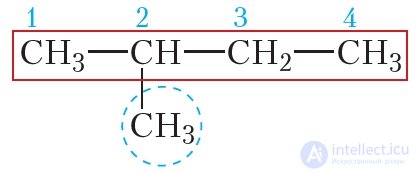 As can be seen, the main chain contains four carbon atoms. An alkane with four carbon atoms in the molecule is butane. A methyl group is attached to carbon atom number 2 of the main chain. Consequently, the hydrocarbon will be named 2-methylbutane.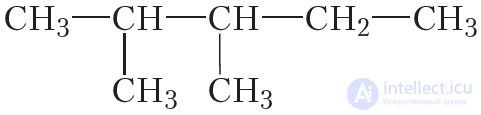
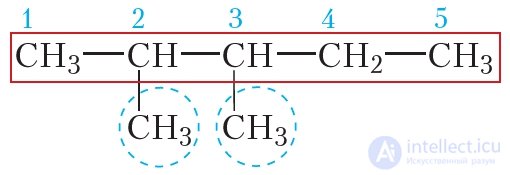
This example is interesting because two methyl groups are attached to the main chain, connected to the second and third carbon atoms. Note that when a molecule contains several identical alkyl radicals, their number is indicated by an additional prefix, for example: diethyl-, tripropyl-, pentamethyl, etc. Therefore, in the name of the alkane under consideration, the prefix di- must be placed before the name of the hydrocarbon radical (methyl-). The name of the compound is 2,3-dimethylpentane.
Example 4. Let us solve the inverse problem — write the structural formula of an alkane from its name. The name of the alkane: 2,2,3,5,5-pentamethyl-3-ethylheptane.
From the name it can be seen that the main chain consists of seven carbon atoms (heptane), to which five methyl groups are attached at positions 2, 3, and 5, and one ethyl group at position 3.
By drawing a chain of seven carbon atoms and attaching the listed groups to it at the corresponding positions, we obtain the formula of the substance: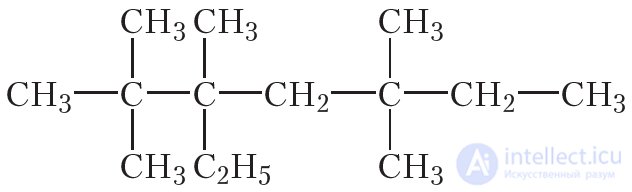
As can be seen, the principles of IUPAC nomenclature make it possible to name alkanes of fairly complex structure and to write the formula of a substance from its name.
|
IUPAC nomenclature is used to construct the names of organic substances. When constructing the name, a branched alkane is regarded as the product of substituting hydrogen atoms in an unbranched alkane with alkyl radicals. The name of an alkane consists of the name of the main chain and the names of the substituents, indicating their positions. |
1. Give the structural formulas of the hydrocarbon radicals methyl, ethyl, and propyl.
2. Name, according to IUPAC nomenclature, the substances whose formulas are:
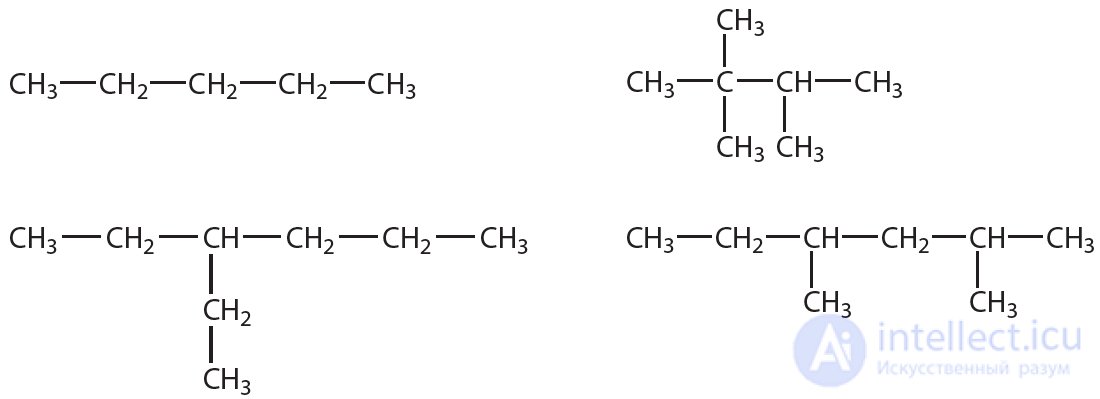
3. Write the structural formulas of all isomers of n-hexane. Name these substances according to IUPAC nomenclature.
4. Write the structural formulas of the following hydrocarbons:
a) 2,4-dimethylheptane;
b) 3,3-diethylhexane;
c) 2,3,3,4-tetramethyl-4,5-diethyloctane.
5. Which of the given alkane names are constructed correctly:
a) 2,3,4-trimethyl-2-ethylpentane;
b) 1,1-dimethyl-3-ethylpentane;
c) 2,2,4,5-tetramethyl-3-ethylheptane;
d) 3,3-diethylpentane;
e) 4,5-dimethyl-4-ethylhexane?
Correct the errors made.










Comments