
Lecture
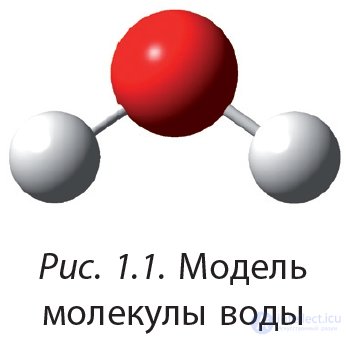 From the chemistry course of grades 7–9, you already know that substances are made up of atoms. For example, water molecules consist of oxygen and hydrogen atoms (Fig. 1.1).
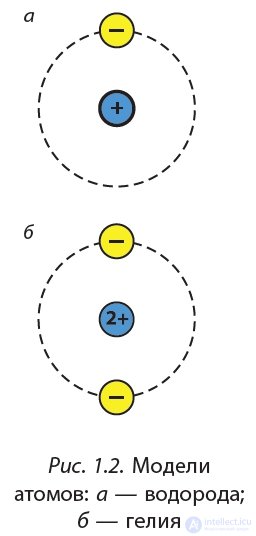
At the center of the atom is a positively charged nucleus. The charge of the nucleus is equal to the atomic number of the element in the periodic table. Negatively charged electrons move around the nucleus, forming an electron shell. The positive charge of the nucleus is compensated by the negative charge of the electrons, so the atom is electrically neutral.
For example, a hydrogen atom consists of a nucleus with a charge of 1+ and one electron. The charge of the helium atom’s nucleus is 2+, so a helium atom has two electrons (Fig. 1.2).
| An atom is an electrically neutral particle consisting of a positively charged nucleus and negatively charged electrons. |
If an atom gives up an electron, a positively charged ion is formed – a cation. If an atom gains an electron, a negatively charged ion is formed – an anion (Fig. 1.3).
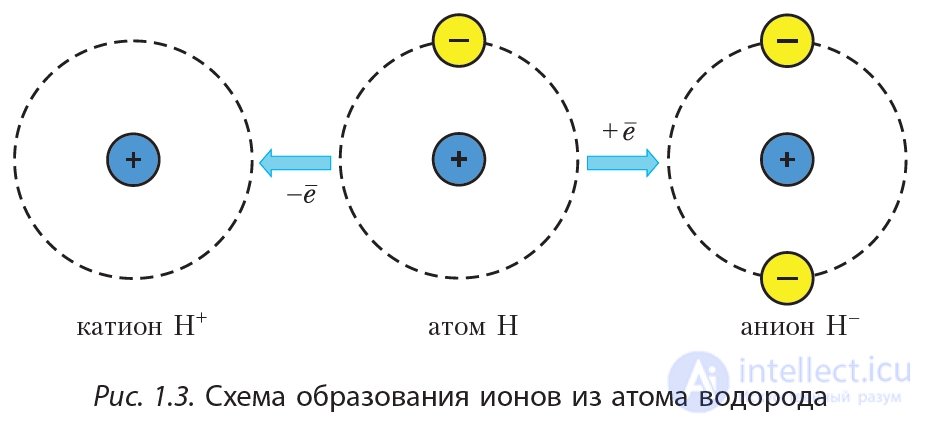
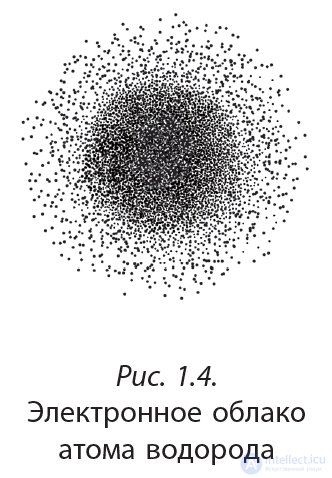
Looking at Figures 1.2 and 1.3, one might mistakenly assume that electrons revolve around the atomic nucleus the way planets revolve around the sun. In reality, it is impossible to determine the trajectory of an electron’s motion in an atom. Each electron forms around the nucleus a cloud of negative charge of a certain shape and size – an electron cloud. For example, the single electron in a hydrogen atom forms a cloud of spherical shape (Fig. 1.4).
Looking at Figures 1.2 and 1.3, one might mistakenly assume that electrons revolve around the atomic nucleus the way planets revolve around the sun. In reality, it is impossible to determine the trajectory of an electron’s motion in an atom. Each electron forms around the nucleus a cloud of negative charge of a certain shape and size – an electron cloud. For example, the single electron in a hydrogen atom forms a cloud of spherical shape (Fig. 1.4).
To better visualize the electron cloud, let’s carry out a thought experiment. Suppose we had the ability to photograph a hydrogen atom at different moments in time; then in the photographs we would see the electron in different positions relative to the nucleus (Fig. 1.5).
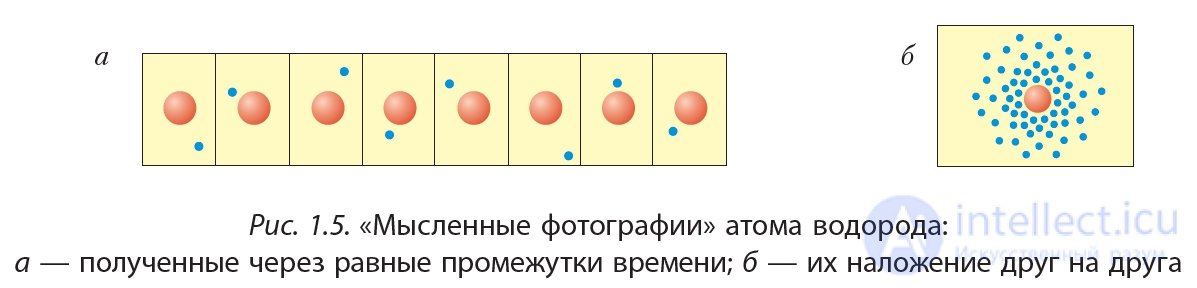
If we take many such pictures and overlay the photographs on top of one another, the density of the dots will show us how often the electron turns out to be in a given region of space.
Figure 1.5 shows that the electron in a hydrogen atom is most often found in the immediate vicinity of the nucleus; as the distance from the nucleus increases, the probability of finding the electron drops sharply.
The electron has another distinctive feature. In a hydrogen atom, the electron cannot have just any energy value, but only certain specific ones. These energy values of the electron in a hydrogen atom are called energy levels. Energy levels are designated by numbers.
Figure 1.6 shows the energy levels of the hydrogen atom.
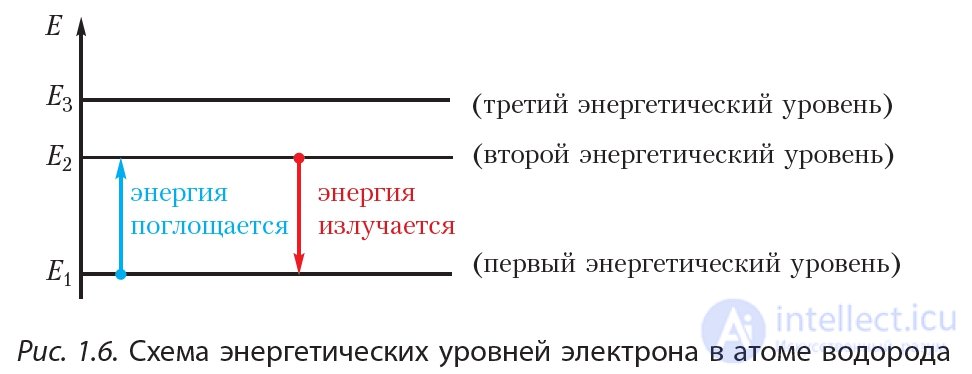 It is most energetically favorable for the electron to occupy the first level, which has the lowest energy; in this state it is located closer to the nucleus.
The electron can transition from one energy level to another. When transitioning from the first level to the second, it absorbs a portion of energy equal to E2 – E1, and during the reverse transition it emits the same portion of energy.
Now we can refine the concept of an orbital, which was introduced in the 8th-grade chemistry course. We already know that an electron in an atom can only exist in certain states. Each state corresponds to a specific energy value and a specific shape of the electron cloud. An electron state is called an orbital.
| An atomic orbital is the state of an electron in an atom, characterized by a specific energy value, shape, and spatial orientation of the electron cloud. |
The electron cloud does not have clearly defined boundaries, so when depicting the shape of an orbital, not the entire electron cloud is shown, but only the region of space within which the probability of finding the electron is sufficiently high.
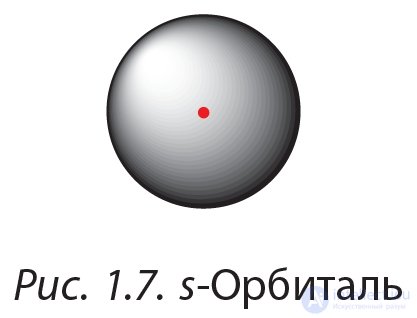
Orbitals can have different shapes. Orbitals of spherical shape are called s-orbitals:
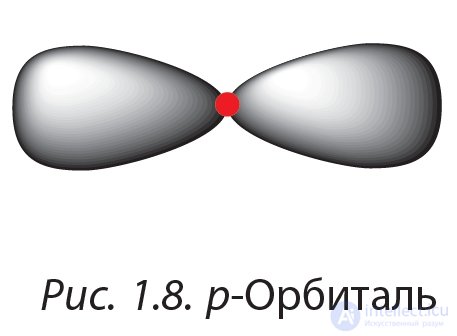
 Orbitals shaped like a three-dimensional figure eight are called p-orbitals:

Atomic
orbitals
Atoms also contain d- and f-orbitals of even more complex shape; you can learn more about them by following the link in the QR code.
|
An atom consists of a positively charged nucleus and negatively charged electrons. Each electron in an atom is in a state with a specific energy (occupies a specific atomic orbital). An orbital is characterized by the energy and shape of the electron cloud. |

Comments