
Lecture
The molecules of polyhydric alcohols, unlike monohydric ones, contain not one but several hydroxyl groups. Let us give the formulas of the simplest dihydric and trihydric alcohols: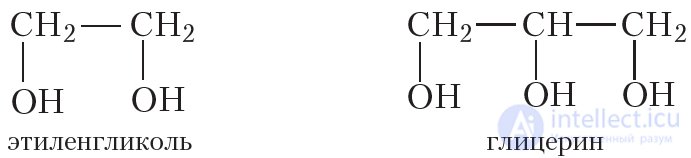
Note that in the molecules of polyhydric alcohols, the hydroxyl groups are located on different carbon atoms. Substances in which two hydroxyl groups are attached to the same carbon atom are unstable and cannot be obtained in free form. Such substances immediately eliminate a molecule of water: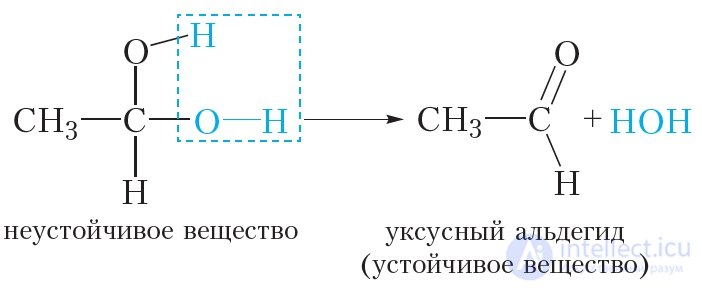
Accordingly, a molecule of a dihydric alcohol must contain at least two carbon atoms, a trihydric one at least three, and so on.
The simplest dihydric alcohol is called ethylene glycol, and the trihydric one — glycerol. These substances are similar to each other in their physical properties and are colorless, viscous liquids. Hydrogen bonds form between molecules of polyhydric alcohols, just as between molecules of monohydric alcohols, so ethylene glycol and glycerol have high boiling points: 198 °C and 290 °C respectively. Polar hydroxyl groups give polyhydric alcohols solubility in water. Ethylene glycol and glycerol mix with water in any proportion.
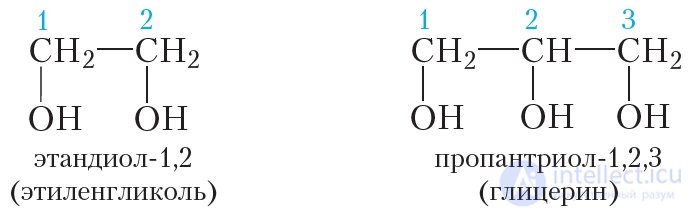
The names of polyhydric alcohols are formed in the same way as the names of monohydric alcohols. The presence of two hydroxyl groups in a molecule is indicated by the combination -diol, three — -triol and so on. Let us name ethylene glycol and glycerol according to IUPAC nomenclature:
The composition of the molecules of ethylene glycol and glycerol differs by a CH—OH group, not a CH2 group: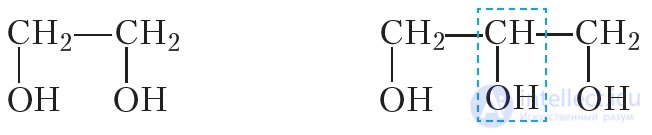
That is, ethylene glycol and glycerol are not homologues. The nearest homologue of ethylene glycol is propane-1,2-diol:
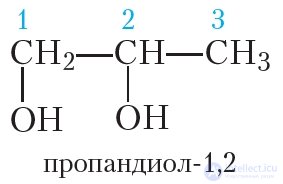
The nearest homologue of glycerol — butane-1,2,3-triol: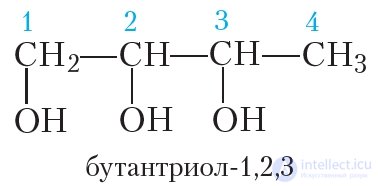
The molecules of polyhydric alcohols contain hydroxyl groups. Therefore, polyhydric alcohols can undergo the same chemical reactions as monohydric alcohols.
1. Reaction with alkali metals
Like monohydric alcohols, polyhydric alcohols react with alkali metals. In the course of the reaction, the hydrogen atoms of the hydroxyl groups are replaced by metal atoms:

2. Reaction with hydrogen halides
When reacting with hydrogen halides, the hydroxyl groups in the molecules of polyhydric alcohols are replaced by halogen atoms. Let us give the equation for the reaction of ethylene glycol with hydrogen bromide:

Replacement of the second hydroxyl group is more difficult than of the first.
When polyhydric alcohols react with nitric acid, —NO2 groups are introduced into the alcohol molecule in place of the hydrogen atoms of the hydroxyl groups. The reaction takes place in the presence of concentrated sulfuric acid, which acts as a catalyst. Let us give the equation for the reaction of glycerol with nitric acid:
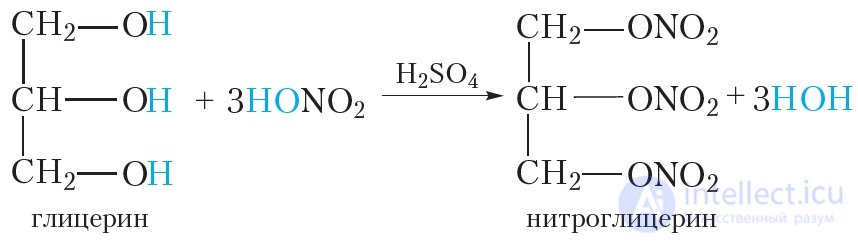
The product of the reaction — nitroglycerin — is a colorless, oily liquid. It explodes easily (it is prone to detonation), so it is not used in pure form. Nitroglycerin is a vasodilator, so it is included in the composition of medicinal preparations.
Not only polyhydric but also monohydric alcohols react with alkali metals, hydrogen halides, and nitric acid. At the same time, polyhydric alcohols can undergo reactions that do not occur with monohydric alcohols. One such reaction is the reaction of polyhydric alcohols with copper(II) hydroxide.
4. Reaction with copper(II) hydroxide
To carry out this reaction, an alkali solution is poured into a test tube, then a little copper(II) sulfate solution. This causes a blue precipitate of copper(II) hydroxide to form:

An aqueous solution of ethylene glycol is then added to the test tube with the precipitate. The copper(II) hydroxide dissolves and a clear, cornflower-blue solution forms. The dissolution of copper(II) hydroxide when reacting with ethylene glycol occurs because of the formation of a complex compound:


Video 25.1.
A qualitative reaction
for polyhydric alcohols
Glycerol reacts with copper(II) hydroxide in the same way. This reaction makes it easy to distinguish aqueous solutions of polyhydric alcohols from solutions of other organic substances, so the reaction with copper(II) hydroxide is a qualitative test for polyhydric alcohols.
Despite their outward similarity and comparable chemical properties, the physiological effects of ethylene glycol and glycerol are completely different. Ethylene glycol is toxic, whereas glycerol is non-toxic and is even used as a food additive (E422).
Aqueous solutions of ethylene glycol have a very low freezing point (down to –70 °C). Because of this, ethylene glycol is used as a component of non-freezing fluids — antifreezes, used in the cooling systems of car engines.
Glycerol absorbs moisture well (it has the property of hygroscopicity). It is therefore used as a moisturizing component in the production of various ointments, creams, and other cosmetic products. Like ethylene glycol, glycerol is also used in the production of antifreeze.
In addition, ethylene glycol and glycerol are used in the chemical industry as reagents for obtaining other organic substances.
|
Polyhydric alcohols, unlike monohydric ones, contain several hydroxyl groups in their molecule. The simplest dihydric alcohol is ethylene glycol, and the trihydric one is glycerol. Like monohydric alcohols, ethylene glycol and glycerol react with alkali metals and hydrogen halides. The reaction between glycerol and nitric acid produces nitroglycerin. Nitroglycerin is a vasodilator, so it is included in the composition of medicinal preparations. A qualitative test for polyhydric alcohols is the formation of a cornflower-blue solution when they react with freshly precipitated copper(II) hydroxide. |
1. Write the structural formulas of ethylene glycol and glycerol. Are these substances homologues?
2. Why do ethylene glycol and glycerol have high boiling points and dissolve well in water?
3. Write the structural formula of the nearest homologue of ethylene glycol. Give its name according to IUPAC nomenclature and write the equation for its reaction with sodium.
4. Name a reagent that can be used to distinguish aqueous solutions of ethanol and ethylene glycol. Write the equation for the reaction.
5. Write reaction schemes that can be used to carry out the following transformations of organic substances:

6. Sodium with a mass of 3,45 g was added to ethylene glycol with a mass of 6,2 g. Find the volume (at STP) of hydrogen released after the reaction is complete.

Comments