Thought experiment - The bus stop dilemma (the dilemma of the latecomer) - this is about understanding that it's better not to wait and just start walking
and be guaranteed to get there in an hour, or wait the extra ten
minutes, spend 15 minutes on the ride, and end up arriving
half an hour earlier - the only problem is...
Not to be confused with the question about the bus stop
You are driving your car on a dark night. You pass by a bus stop and see that three people are waiting for the bus:
- An old woman who looks as though she is about to die.
- An old friend who once saved your life.
- The perfect man (or) woman you have dreamed of.
Which of them would you offer a ride, knowing that your car can only hold one passenger?
Think about it before reading further. This is a moral-ethical dilemma that was once even used as part of a job application.
You could take the old woman, because she is going to die, and so you should save her first. You could take the old friend, because he once saved your life, and this would be the perfect chance to repay the debt. Or you could choose the man/woman of your dreams, whom you might never meet again.
The candidate who was hired (out of 200 applicants) had no trouble answering. I liked his answer. I might use it myself someday in an interview.
He simply answered: «I would give the car keys to my old friend and let him drive the lady to the hospital. I would stay behind and wait for the bus with the woman of my dreams»
Never forget to «think outside the box».
What do you think is the main problem with flying to other stars
- not sufficiently advanced engines?
- maybe the very long travel time,?
- where to get the energy to sustain the crew's life during the flight?
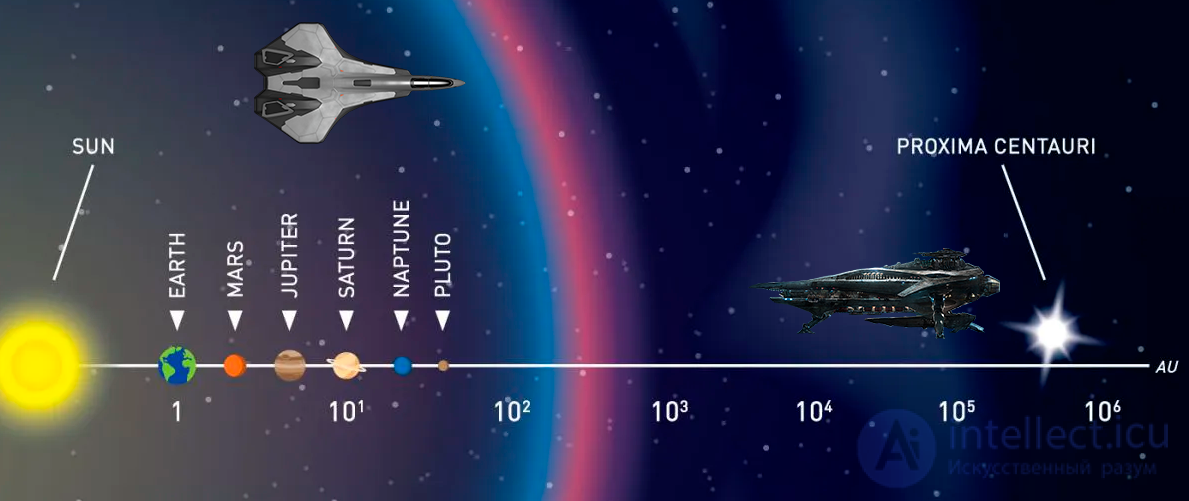
all of this is relevant, but theoretically solvable. However, there is a potentially much more serious problem.
It may turn out that making the first move is a knowingly losing strategy, so, paradoxically as it may seem -
no one will fly anywhere at all.
Let's now unpack this thesis -
suppose you have found an exoplanet ideal for life around a star that is, say, 15 light years away from us - not
too close nor too far.
Now we want to send colonists there. To do this we build a large ship with very many berths, because the journey will be long - during the flight more than one generation of people will pass aboard it, and it will only be the descendants of those who started out
who will arrive and settle the world. At the destination, this concept is called a generation ship - a kind of interstellar ark.
So we send such a ship on its way, let's say it can reach a speed of a thousand kilometers per second
the fastest object made by man
as of today, which means the whole journey will take
about 5000 years. When the ark arrives at the distant planet, the descendants of those who started out prepare to disembark and colonize.
Everything they see turns out to have already long been colonized - on the planet, life is already in full swing, cities are thriving.
And now they are not really pioneers at all, just guys who are late for the party and traveled for so long
for nothing.
How did this happen?
Simply, say 200 years after the launch of the first ship, scientists on Earth invented a new engine technology, and after
that, ships were able to reach, say, five thousand kilometers per second.
So the earthlings built and launched the next ship, which covered the entire journey in just one and a half thousand years.
That is, having started two hundred years later, it arrived a whole thousand years earlier, and even so it's not at all certain that the second ship
won't meet the same fate, that it won't end up being overtaken by a third ship, and that the third won't be overtaken by a fourth, and so on.
Just as with the bus stop dilemma, so too with interstellar travel, we don't actually know when it will arrive.
The space bus - how fast it will be able to go, and whether it will arrive at all?
The question of calculating the optimal time to begin an interstellar journey was studied, in particular, by Andrew Kennedy. His
publications, which he presented in 2006, are quite entertaining and written in simple language with a minimum of formulas.
https://www.researchgate.net/publication/260275150_Interstellar_Travel_-_The_Wait_Calculation_and_the_Incentive_Trap_of_Progress
Thus, he examined the optimal time to begin a journey to Barnard's Star - a red dwarf located at a distance
of only six light years from us, and which can realistically be considered one of the destinations for future flights.
From his article it follows that, in theory, one can calculate the earliest possible arrival time at any given place in space
and, based on this data, decide when it is optimal to fly and when it is still too early.
True, for this you need to be able to predict at least to some degree.
how technological progress will behave in the very distant future, and this is a much more difficult task than it might seem at first glance.
Kennedy quite logically links
travel speed to available energy in a quadratic relationship, that is, in order to
double the speed of the ship, you need to increase the energy fourfold, in order to
accelerate further you'd need nine times more energy then, but all of this only works
if the energy available to humanity grows according to some predictable
After all, it is far from certain that it works that way.
There is no guarantee that we, for example, will not run into some upper limit related, say, to some
limitations of the laws of physics.
Or, conversely, that we will make a sharp technological leap, mastering, say, cold thermonuclear fusion, building an antimatter engine
or making a battery out of a black hole.
In general, if anything like that happens, all our calculations of the minimum arrival time to some stars become absolutely useless, and the risk that you are flying to sacrifice yourself in vain becomes real again. And we haven't even taken into account all the risks, effects, not the fact that on the generation ship itself there may be its own scientists who can also improve and accelerate their ship somehow in the process, and generally a whole bunch of other unknowns.
But in general, the very concept that technological progress, by the mere fact of its existence, can make space travel meaningless, forcing us to constantly wait and wait for the optimal time in the future, seems very interesting. That there may exist a certain time threshold before which we will not reach certain places no matter how hard we try.
Maybe that's why no one has flown to us yet — they are waiting for the optimal time for the flight, before which one cannot reach us? and which for us has not yet
arrived?
This concept once again shows how truly enormous the distances between stars actually are, and how counterintuitive
See also
- Trust
- Unexpected hanging paradox
- Stag hunt
- Three Prisoners problem
- Social dilemmas
- [[b8350]]
- [[b8351]]
- [[b8352]]
- [[b8353]]
- [[b537]]
See also


Comments