
Lecture
Definition
The process of managerial decision-making is understood as a set of sequential actions aimed at selecting and adopting a managerial decision.
The subject of the process of managerial decision-making is an individual or a group of people. Therefore, a significant factor in the final choice of a managerial decision (MD) and its quality is the factor of the psychological behavior of the people involved in the process of developing and adopting the MD.
When constructing various models of the decision-making process, a distinction is made between:
The factor of the psychological behavior of subjects significantly affects both the decision-making process itself and its results. The theoretical importance of taking it into account is determined by the fact that the process of forming the final managerial decision is the most complex and elaborate type of process of subjective choice. The practical relevance of taking its influence into account is determined by the fact that the processes of managerial decision-making play a key role in ensuring managerial activity.
It is precisely in order to emphasize the significance of this factor that a distinction is made between psychological and non-psychological approaches to constructing a decision-making model.
The influence of the factor of the psychological behavior of subjects can be disregarded in the case when the decision-making process itself is formalized, algorithmized in such a way that the psychological behavior of the subjects participating in it practically has no effect on the course of constructing the decision.
Note!
Models for implementing the decision-making process, in which the psychological behavior of people has practically no effect on the selection of the final decision, are called normative decision-making models .
These decision-making models, as a rule, implement the concept of maximum utility.
Definitions
As a general concept, a concept represents a certain system of views. A decision-making concept is a system of views related to making a managerial decision.
In accordance with the concept of utility maximization, the DM sets the task of finding the best (optimal) solution among all possible ones in accordance with a criterion chosen in advance, aimed at maximizing utility.
The conditions for applying normative models are:
In this case, the algorithms, rules and actions applied ensure that all possible alternatives are considered, the consequences of each of them can be calculated, and the concept of maximum utility is aimed at finding the optimal solution.
Along with the concept of utility maximization, other decision-making concepts can also be used when constructing alternative solutions and choosing the final one from among them.
Among the most widespread concepts, one can name the concept of bounded rationality, proposed by the Nobel laureate in economics Herbert Simon .
Note!
The essence of the concept of bounded rationality comes down to the fact that alternatives are considered until the one (or those) that satisfy the DM's requirements is found.
This concept is based on the possibility of implementing such a psychological feature of a person as the ability to make decisions that are difficult to compare or practically incomparable across a set of criteria under conditions of uncertainty and under conditions of limited time.
In normative decision-making models, this concept can also be implemented, for example, in the case when decision-making methods aimed at obtaining a solution variant with maximum utility, at the DM's discretion, do not presuppose the consideration of all alternatives. In particular, a variant is possible of searching not for the optimal alternative, but for alternatives satisfying certain requirements, for example, deviating from the optimal one by no more than 10%. The most important thing here is that in normative models the rules for selecting alternatives are known in advance, and the DM's level of aspiration here is set by the deviation of the sought alternatives precisely from the optimal one — in our example, a deviation equal to 10%.
Note!
Since the conditions for applying normative models (a known criterion aimed at maximizing utility, available complete information and known decision-making methods) make it possible to find the optimal solution, normative decision-making models, as a rule, implement the concept of utility maximization.
Normative models actually exclude taking into account the influence of the psychological behavior of people on the decision-making process, and its content is the method (algorithm) adopted by the DM for finding the optimal or effective solution.
In addition to normative models, descriptive decision-making models are also widespread.
The prerequisites and conditions for their application are the incompleteness or excess of information, as well as the absence of preference rules (rules for selecting alternatives) known in advance and of methods (calculation methods) for assessing the possible consequences of their implementation, known in advance. All this requires the intervention of the DM in the decision-making process and leads to the fact that in descriptive decision-making models the subjective, psychological factor influencing the selection of alternatives and the search for the final decision — the behavior of the DM — is significant.
Note!
In descriptive models, when implementing the concept of bounded rationality, the DM determines preference rules based on his own idea of their rationality.
The behavior of the DM in descriptive decision-making models is a subjective factor that significantly influences the results of forming the final decision.
Above all, the behavior of the DM affects the choice of the decision-making concept implemented within the descriptive model — that system of views in accordance with which the final decision is formed.
Among the main concepts of decision-making used in descriptive models is the concept of bounded rationality. Unlike the concept of utility maximization (expected utility theory), it (the concept of bounded rationality) is aimed at finding not the optimal alternative but the one that, in the DM's opinion, will be effective, i.e., will meet his requirements and aspirations.
The simplification of the decision-making process in descriptive models proceeds:
Please note!
Descriptive models, as a rule, implement the concept of bounded rationality.
Note that descriptive models may involve the search for an optimal solution in accordance with the adopted preference rules used for selecting alternatives. In this case, they in a certain sense implement the concept of utility maximization. However, the specific feature of optimization in descriptive models is that the optimal solution is sought within the requirements defined by the alternative preference rules formed by the DM.
Please note!
The main concepts of decision-making are the concept of utility maximization and the concept of bounded rationality.
The relationship between decision-making models (normative and descriptive) and the main concepts of decision-making implemented by these models (the concept of utility maximization and the concept of bounded rationality) determines the specifics and features of the final decision formed (Fig. 2.1):
• for normative models implementing the concept of utility maximization, the final decision formed is the result of applying known algorithms (normative rules) and will be optimal in accordance with the utility (optimality) criterion under consideration;
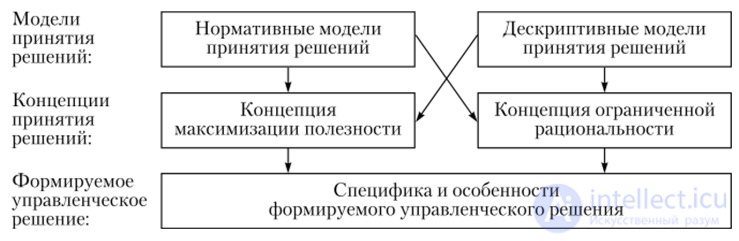
Fig. 2.1. The influence of decision-making models and concepts on the specifics and features of decision formation
Since the subject of the managerial decision-making process is an individual person or a group of people, it is important to determine in which decision-making models, and when implementing which concepts, the influence of the subjective factor — human behavior — is significant.
An analysis of the features of forming final managerial decisions for different decision-making models and concepts has shown that this subjective factor is significant in descriptive decision-making models, regardless of whether this is the concept of utility maximization or the concept of bounded rationality being implemented.
In normative models implementing the concept of utility maximization, this factor does not manifest itself at all, while in normative models implementing the concept of bounded rationality, it manifests itself only in establishing the degree of deviation of the effective solution from the optimal one.
That is precisely why the question of the influence of a person's psychological behavior on the process and results of decision-making in descriptive models is very important.

Comments