
Lecture
Any managerial decision (MD), as an action aimed at correcting an unsatisfactory situation in a managed system (control object) by changing its state or transforming it, must presuppose the existence of a goal for such an action; therefore, formulating the goal of a managerial decision is a condition for its construction.
The managed system's exit from a situation undesirable from the DM's (decision maker's) point of view is possible on the basis of a managerial decision aimed at such a change in the values of the parameters describing the unsatisfactory initial state of the managed system that would correspond to an improvement in the situation. The new parameter values describing the managed system obtained as a result of the MD must be better than those the managed system had before the MD was developed and implemented.
Note that the desired value of the parameter being changed, which describes the state of the system, and the corresponding goal of the managerial decision can be represented in different ways — both quantitatively and verbally, descriptively. For this reason, and also because the goal of a managerial decision can be achieved through different options, the goal of the MD itself can be specified by various particular criteria and objective functions.
Please note!
In general, by a criterion defined on a set of alternatives, we will mean an attribute whose value serves as the basis for choosing one solution or another.
Since the overall goal of the MD can be achieved through different options, in the situation under consideration a particular criterion, as a specification of the overall goal of the MD, is an attribute whose value serves as the basis for considering the corresponding alternative solution . The concept of an alternative managerial decision is closely related to the general concepts of «alternative» and «alternative option» that are used.
Definitions
An alternative — is the possibility of a new choice that excludes the one under consideration, already made.
An alternative option — is a choice option that excludes the option under consideration.
Then an alternative managerial decision — is a new managerial decision that excludes others, including those under consideration.
Please note!
Alternative options are often simply called alternatives, thereby emphasizing the impossibility of choosing them simultaneously.
The overall goal of a managerial decision can be specified by a set of alternative particular criteria. In this case, these particular criteria are alternatives — the use of one of them excludes the application of the others (Fig. 1.2).
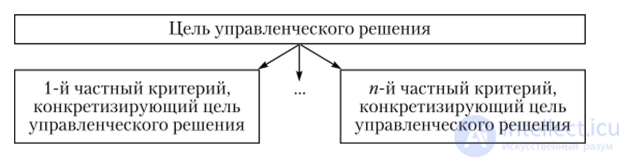
Fig. 1.2. Alternative particular criteria specifying the goal of a managerial decision
For example, the goal of an MD «improving the efficiency of production organization» can be specified as:
Please note!
The final MD is selected by the DM based on a comparison of alternative managerial decisions.
To achieve goals expressed by particular alternative criteria, whether verbally or quantitatively, various economic-mathematical and instrumental methods can be used. For example, in example 2, to achieve the goal formulated by the MD — minimizing the total costs of producing products A and B — some optimization methods implemented through computer programs can be used. The situation is similar for example 3.
The use of any specific criterion for implementing the goal of a managerial decision, in order to construct the corresponding variant of the MD, presupposes the availability of information required specifically for that criterion. Therefore, the work of determining the set of information corresponding to it is closely linked to the choice of a specific criterion for implementing the goal of the managerial decision.
Please note!
Since the goal of a particular managerial decision can be specified by various options of quantitative and verbal criteria, at this stage of the MD life cycle the goal of the managerial decision and the criteria for implementing that goal are formulated, and for each of the possible criteria for implementing the goal of the MD, the characteristics (data) describing the system and corresponding to the chosen criterion for implementing the goal of the managerial decision are identified.
The content of stage 1 of the managerial decision life cycle scheme defines the following steps for implementing the detailed procedure of constructing an MD based on its life cycle (Fig. 1.3):
Naturally, depending on the set of actions by which a managerial decision to be adopted can be implemented, all MDs can, by the criterion of complexity, be divided into two large groups — simple ones, which do not require other MDs for their implementation, and complex ones, which presuppose the preliminary implementation of other, preceding managerial decisions (see Fig. 1.3).
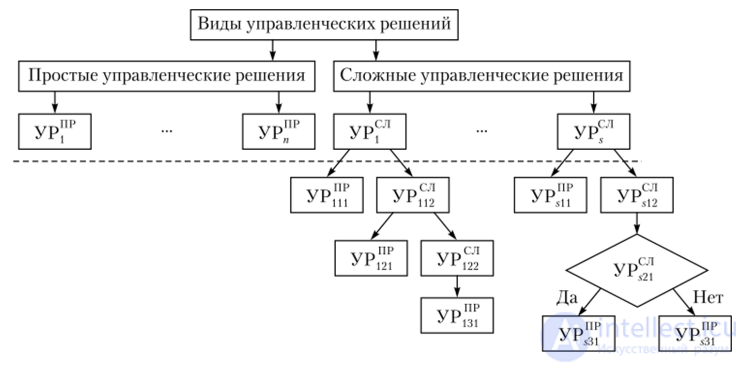
Fig. 13. Examples of simple and complex managerial decisions
In the notation adopted.
When working with complex managerial decisions, each of them must be represented as a set of all interconnected simple and complex MDs that precede it. Such a representation of the managerial decision is necessary for the following reasons.
First. A unified formalized procedure for developing, adopting and implementing a separate MD (for example, based on the life-cycle scheme of a managerial decision) can be applied to each of such managerial decisions, which substantially clarifies and facilitates the very process of changing the state of the system, i.e., changing an unsatisfactory situation.
Second. Representing complex managerial decisions in the form of diagrams will subsequently make it possible not only to know and understand their composition. It will also make it possible to assess the effectiveness of changing the situation based on an analysis of the intermediate MDs that form the individual complex managerial decisions.
The division of managerial decisions into simple and complex is largely conventional. The degree of detail to which a complex managerial decision is "broken down" into the simple and complex MDs preceding it is largely determined by the position of the DM. A particular MD, defined by the decision maker as simple, may in fact turn out to be complex. It is simply that the DM formulates it at his own level as a simple managerial decision. However, its adoption, development and implementation at the level of other performers may result in it becoming a complex MD requiring further detailing through the managerial decisions preceding it.
This stage of the MD life cycle is one of the most complex — it is difficult to formalize and depends very substantially on the level of the DM's professional knowledge, as well as on the situation being analyzed regarding the state of the system. Improving it may require changing either one or several characteristics of the system under study. In this case, the MD itself can be either simple or quite complex. At the same time, the technology for developing, adopting and implementing any MD can be realized through the proposed scheme of its life cycle.
Please note!
The result of stage 1 of the MD life-cycle scheme is the goal of the MD, which coincides with the goal of moving the system under study from an unsatisfactory state to a new one, as well as the options for the criteria for achieving this goal that specify it.

Comments