
Lecture
The method was developed in the late 1950s in the USA to solve military problems. During the years of the missile-nuclear race between the USA — USSR, one of the main problems was the sufficiency of an attack system for overcoming the defenses of a potential adversary. To analyze options for constructing military-technical systems, an approach was proposed according to which the evaluation of alternative options was carried out in three stages.
If no other criteria (besides cost and effectiveness) were considered, then the problem with two criteria was reduced to a single-criterion problem, i.e., to optimization over a single parameter, which is always solved unambiguously. When other criteria are present, the procedure reduces the number of criteria, thereby narrowing the Pareto — Edgeworth set.
Note!
The first two stages — modeling effectiveness and cost — can be regarded as objective: they are carried out on the basis of actual data, i.e., on the basis of reliable statistical material. As a rule, a sufficiently extensive array of data is processed by statistical methods, which makes it possible to minimize the errors of individual measurements.
At the final step, when carrying out the synthesis, the judgment of the DM is necessarily used in one form or another. In principle, synthesis can be regarded as one of the varieties of combining partial criteria into a single global criterion (utility function) . The simplest and most common variant of such a combination, which appeared much earlier than the «cost — effectiveness» method — is a linear combination (convolution) of partial criteria with weighting coefficients corresponding to the importance of the criteria. This approach, known as the classical Bayes—Laplace principle (or its particular case — the Bernoulli—Laplace principle of insufficient reason), we consider in the following chapters. However, the linearity of the criteria leads to significant drawbacks, the main one of which is that a deterioration in the value of one partial criterion — can be compensated by an improvement in the value of another, i.e., the partial criteria are assumed in advance to be comparable. Unlike linear approaches, synthesis by the «cost — effectiveness» method has three important features.
First, it is assumed that the measurement scales of the cost and effectiveness criteria are different, which does not allow them to be combined directly. For example, the simplest analysis method «cost — benefit» , in which all criteria are reduced to one by expressing them in monetary equivalent, is not applicable.
Second, the formulas applied are nonlinear from the very outset, which precludes the application of the most well-developed theory of linear optimization (including — linear programming methods).
Third, the existence of a maximally simple and clear interpretation has led to a very wide spread of the approach in practice, especially — in the field of medical statistics and the testing of new medicinal drugs and means of prevention and treatment .
It is emphasized here that «cost — effectiveness analysis is a research methodology that has been developed to help determine which intervention provides the most effective medical care». The importance of the multi-criteria approach is confirmed by experts from various countries, despite the fact that «many people who study cost — effectiveness analysis in economically developed countries question the logic of evaluating the effectiveness of an intervention based on both cost and effectiveness, rather than on effectiveness alone. They argue: “Should we not buy the best treatment regardless of its cost?”»
Initially, the simple ratio of the effectiveness indicator to cost, i.e., to the volume of expenditures, was considered as the main criterion for this approach. But subsequently clarifications were required. In particular, in medical applications a criterion of the following form is considered
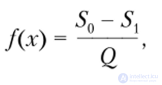
where S0 — is the cost of the intervention; S{ — is the expenses avoided by the intervention; Q — is the number of additional years of the patient's life (adjusted for its quality) gained as a result of this intervention.
Each of the indicators S0, S{ and Q requires detailed statistical evaluation and quite complex, careful analysis. Say, when assessing S0, it is necessary to take into account not only the treatment costs avoided, but also the costs of future doctor visits, possible hospitalization, transportation, and even costs associated with the environment.
When passing to the new criterion in the plane of the original cost and effectiveness parameters, the Pareto — Edgeworth set is modified by replacing dominance over two parameters with the concept of dominance over a single composite parameter f(x), whose axis can be represented geometrically as the direction along the normal to the curvilinear level lines f(x) = const in the direction of increasing f(x).
Note!
In practice, in multi-criteria problems, for a single cost criterion there may be several effectiveness indicators characterizing various positive changes that may occur as a result of the expenditures made.
The main contribution to the global criterion is made only by the first two indicators - the price of the new product and the one-time costs of marketing and the project. If we limit ourselves to considering only the first two partial criteria, we can construct preference angles for each of the variants, which will lead to the same Pareto — Edgeworth set of three variants that was obtained as a result of a comprehensive consideration of all four criteria.
Based on the results of the analysis of these examples and, in general, of practical applications of the «cost — effectiveness» combination of criteria, the following conclusions can be drawn.
Note!
Reducing the dimensionality of the criterial space by the «cost—effectiveness» method, compared with linear approaches, has such advantages as simplicity and clarity, the accounting of criteria measured on different scales, and the nonlinearity of dependencies (consistent with the structure of the Pareto—Edgeworth set). However, the specific nature of constructing the combination of criteria deprives this approach of universality, limits its area of application, and requires, in each individual problem, careful verification and reconciliation of the chosen combination of criteria with the DM's preferences. Furthermore, as will be seen in subsequent chapters, there is one more drawback — this approach has no unified way of accounting for the importance of the criteria.

Comments