
Lecture
Factor F-1, which affects the content of the controlled system under study (CSUS), is the type of the controlled system being studied — socio-economic, technical, biological, etc. (Fig. 3.4). The specific feature of a socio-economic system is that it necessarily includes, as a mandatory element, a human being, who may have his own interests with respect to the controlled system under study, determined by his social and economic
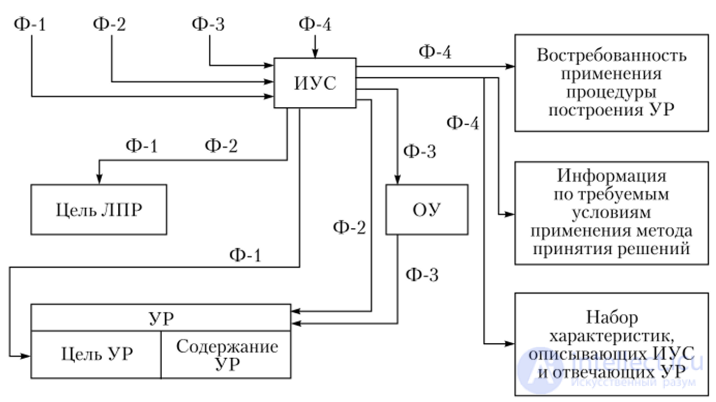
Fig. 3.4. Diagram of the interrelation of factors influencing the CSUS and other control parameters
status. In this case, the person's interests determine his behavior, which becomes a subjective factor influencing the functioning of the controlled system.
Through the CSUS, this factor also influences other control parameters — the DM's (decision maker's) goal and, through it, the goal and content of the managerial decision (MD) (see Fig. 3.4).
Note!
A significant influence on the content of the CSUS is exerted by factor F-2 — the specifics of the subject domain within which the system under study functions (see Fig. 3.4). The subject domain makes it possible to identify the specific characteristics describing the system under study. Among the possible specific socio-economic systems under study, distinguished by the criterion of «subject domain», one can name, for example, the system of state tax regulation, or the resource allocation system of a particular industry.
Through the interaction of the CSUS with other control parameters, this factor influences the DM's goal and, through it, the goal and content of the MD (see Fig. 3.4).
Note!
1. The content of the CSUS is influenced by factor F-2 — the subject domain to which the controlled system under study belongs.
2. The influence of the subject domain as a factor determining the specificity of the CSUS on other control parameters is manifested in the fact that the subject domain makes the DM's goal, as well as the goal and content of the MD, more specific, taking into account its particularities .
Another factor — factor F-3, which has a significant influence on the content of the CSUS — is the complexity of the CSUS (see Fig. 3.4).
Through the interaction of the CSUS with other control parameters, this factor influences the control object as a specific representation of the CSUS, as well as the formation of the DM's goal with respect to the system under study and, thereby, the formation of the goal and content of the MD being developed (see Fig. 3.4, 3.5).

Fig. 3.5. Influence of the CSUS complexity factor on the other control parameters
For a newly created controlled system, its complexity is determined by the specifics of the project being implemented by the managerial decision; for functioning CSUS, it is determined by their technological features.
The complexity of the system under study determines the complexity of the control object as a set of characteristics describing it. Naturally, the complexity of the control object, in turn, influences the content of the goal of the control subject (the DM), as well as the goal and content of the corresponding managerial decision. The more complex the controlled object, the more difficult it is for the DM to determine a goal with respect to it. For this reason, more specialists may be included among the decision makers. In this case, the managerial decisions themselves may also be complex, presupposing the development and implementation of a whole series of other MDs for their realization.
Depending on what set of actions can be used to implement the managerial decision being made, all MDs can be divided, according to the criterion of complexity, into two large groups — simple ones, which do not require other managerial decisions for their implementation, and complex ones, which presuppose the prior implementation of other, preceding MDs.
When working with complex managerial decisions, each of them must be represented as a set of all the interrelated simple and complex MDs that precede it.
Note!
Note that the influence of the three factors identified, which determine the specificity of the CSUS, on the formation of the MD is indirect — through the DM's goal with respect to the controlled system under study (Fig. 3.6).

Fig. 3.6. Influence of the factors determining the specificity of the CSUS on the formation of the MD
A significant influence on the content of the CSUS is exerted by factor F-4 — the way in which the characteristics describing this system change over time (see Fig. 3.4). The functioning of the CSUS may presuppose the constancy of the values of the characteristics describing it, or the possibility of their changing over time. The latter is characteristic of a CSUS that implements a certain process unfolding over time.
This specific feature of the CSUS directly influences the choice of the method for making the MD. In the first case, the characteristics describing the system take discrete values, and discrete decision-making methods correspond to them. In the second case, the characteristics change continuously, so continuous decision-making methods correspond to them (see Fig. 3.4).
The way in which the characteristics describing this system change over time also has a great influence on such a control parameter as the demand for applying the procedure of constructing a separate managerial decision.
When controlling the system under study, the question arises of how often it is necessary to construct anew a managerial decision that implements the DM's already known goal with respect to this system. The answer to this question depends, first of all, on the specific nature of the system under study itself, as determined by the way in which the characteristics describing this system change over time.
If a system is only just being created and it is implemented on the basis of a specific project, the managerial decision is tied precisely to that project. Therefore, as soon as the project has been implemented, the need to construct a new managerial decision connected with the implementation of that particular project disappears. This means that the MD is a special-purpose decision, and this is what determines the one-off character of applying the procedure for constructing a managerial decision (see Fig. 3.4).
However, during the functioning of the system such a need may arise again. In this case, if the system is described by a set of characteristics whose values are assumed to remain constant during its functioning, the need to construct a new MD arises at certain points in time, when the system for some reason ceases to correspond to the DM's goal with respect to it (see Fig. 3.4). If, on the other hand, the system is described by a set of characteristics whose values change over time during its functioning, constant monitoring of the state of the system is needed, and the need to construct an MD arises as soon as the values of the time-varying characteristics become unsatisfactory, i.e., cease to meet the DM's goal with respect to that system (see Fig. 3.4).
Pay attention!
If the managed system under study implements a specific process unfolding over time, the values of the characteristics describing it may change over time. Therefore, monitoring the behavior of the system under study is always needed, and the need to use the procedure for constructing an MD may be practically constant.
The demand for using the procedure for constructing a managerial decision is also determined by the fact that the procedure for constructing an MD based on the scheme of its life cycle initially involves forming alternative managerial decisions, and only then — selecting the final decision from among them . Therefore, constructing each alternative variant of the MD involves using the procedure for constructing an MD, moreover as many times as there are alternative decisions to be constructed for the selection of the final variant.
Pay attention!

Comments