
Lecture
The concept of risk plays an important role in comparing random variables.
Definition
The risk R(?) of the random variable ? is defined as its deviation from the expected value 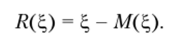
Note!
The risk of a random variable is itself a random variable.
The following values can be chosen as the expected value of a random variable:
Definition
A measure or risk function ρ: Ψ* —? 9? is defined as the mathematical expectation of the quantity g(R(i))): 
where g(x) — is a certain function called the loss function.
A number of requirements are imposed on the loss function g(x):
Note that satisfying all the requirements is not mandatory, although it is desirable. The following can be given as examples of commonly used loss functions:
3) «with a flat bottom» 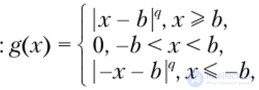
i.e., in this case it is assumed that in some neighborhood [-b, b] of the expected value the risk equals zero.
Other types of loss functions also exist. The choice of a specific form of the function is dictated by the problem being solved.
An important special case of a risk measure is the variance, which computes the square of the mean deviation from the mean value of the random variable:

Such a measure is obtained for the expected value M = ?(%) and the power loss function ?(x) = x2.
Note!
Just as with the utility function, the risk measure is a function of x: 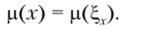
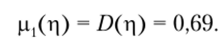
Example of determining the value of the risk function. Consider a random variable p of discrete type such that P{p = -1} = 0.3, P{r = 0} = 0.3, P{x] = 1} = 0.4. Let us take as the expected value the mean value of the random variable M = E{r|} = -0.3 + 0.4 = 0.1, and as the loss function the quadratic function; then the risk measure will represent the variance of the random variable p and will equal
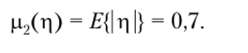
If we take M = 0 as the expected value, and the uniform function as the loss function, then the risk measure will equal
Just as with the utility function, the risk measure generates preference relations on the set of distribution functions T as follows:
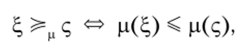
i.e., the random variable ^ is no less preferable than c; if and only if ρ(^) < ρ(<;).
Example: suppose the random variable ?, takes the values -1 and 1 with probabilities 0.5, and the random variable <; — the values -5 and 5 with probabilities 0.5. Then if we choose the variance as the risk measure, we obtain ?, r|, since 

Comments