
Lecture
Until now we have assumed that the state of the environment is unchanging. If this is not so, the task of constructing preferences becomes more complex. Let us consider such cases in more detail.
Let us denote by R — the set of all possible outcomes obtained when a decision is made, X — the set of all possible alternatives of the problem, S — the set of all possible states of the environment. We shall assume that each outcome obtained in a DMP, r ∈ R, depends both on the alternative x ∈ X chosen by the DM from the set of all possible alternatives X, and on the state of the environment S ∈ S, which is a random element.
Then the mapping given below will be called a choice function
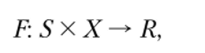
which assigns a definite outcome to each alternative and random state of the environment.
Note!
Since each outcome r ∈ R also depends on the random state of the environment, this outcome is itself a certain random element.
In this case, based on the outcome obtained, one cannot say unambiguously which of the alternatives is best, since the outcome is also influenced by a random component that cannot be fully controlled.
In order to rigorously describe the resulting randomness, it is necessary to define probabilistic structures on the sets S and R!.
Let us define a probability structure on the set of possible states of the environment *S in the following way. An event or random event A of the set .S is any subset thereof A ⊂ S. Let us define the set Σ -
1 One can become acquainted with the basic concepts of probability theory, for example, in the books: Borovkov A. A. Probability Theory. Moscow: URSS, 1999. 470 p.; Kremer N. Sh. Probability Theory and Mathematical Statistics: a textbook for universities. Moscow: Unity-Dana, 2001. 543 p.
the σ-algebra of events, i.e., a set of random events forming a system closed with respect to complementation, countable unions and intersections. In this case the set S is said to be endowed with the structure of a measurable space: (S, Σ). On the events of the σ-algebra Σ we define a probability (probability measure) Py, i.e., we assign to each event Ay belonging to the σ-algebra Σ some number P{A), which is the probability of that event. We then obtain the classical «probability triple»
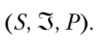
Let us also endow the set of outcomes with the structure of a measurable space (R, B), i.e., let us define on it a σ-algebra of random events B. Then for each alternative x ∈ X the mapping, measurable with respect to the σ-algebras (Σ, B) mapping Fx = F(x: S R, where F — the choice function defined above, forms a random element of the set of outcomes R. Here the probability distribution Px on (R, B) for the random event B ∈ B is given as follows 
Note!
For every random event B ∈ B the set Td B) is a random event of the space (S, Σ), i.e., Tx. B) ∈ Σ.
This result confirms the possibility of defining the probability
P(p;v)).
Thus, each decision, or each alternative chosen by the DM, leads to a certain probability distribution, and the problem of choosing the best decision reduces to the problem of choosing the best distribution in the class {PxY x ∈ X). Since the distribution described generates a certain random variable ?d., the problem arises of comparing the probability distributions (or random variables) corresponding to different alternatives.
The distribution of a random variable is completely determined by its distribution function 7(?) = P{^x < ?}, defined on the set of real numbers (? € 9?). Let us denote by T the collection of all possible real distribution functions generated by the given DMP:

Thus, the DM's preference system in the case of a DMP under conditions of probabilistic uncertainty will be constructed on the set T.

Comments